Question
When two tuning forks (fork $1$ and fork $2$ ) are sounded together, $4$ beats per second are heard. Now some tape is attached on the prong of the fork $2$. When the tuning forks are sounded again, $6$ beats per second are heard. If the frequency of fork $1$ is $200 \,Hz$, then the original frequency of fork $2$ is ........... $Hz$
Answer

b
(b)

Frequency of fork $1=200 \,Hz$

Frequency of fork $2=200 \pm 4$

When tape is added frequency of fork $2$ decreases.

When frequency of fork $2$ decreases number of beats increases.

Hence we know frequency of fork $2$ is

$f_2=200-4=196 \,Hz$

Need a full question paper?

Generate a complete, print-ready paper with questions like this in minutes — across 16+ boards, with answer keys.

Start Generating Free

Similar questions

An $\alpha $-particle is accelerated through a potential difference of $200\,V$. The increase in its kinetic energy is.......$eV$
Under isothermal condition, the pressure of a gas is given by $P = aV ^{-3}$, where $a$ is a constant and $V$ is the volume of the gas. The bulk modulus at constant temperature is equal to $..........\,P$
Two thermometers $X$ and $Y$ have ice points marked at $15^o$ and $25^o$ and steam points marked as $75^o$ and $125^o$ respectively. When thermometer $X$ measures the temperature of a bath as $60^o$ on it, what would thermometer $Y$ read  when it is used to measure the temperature of the same bath ? ...... $^o$
The critical angle for diamond (refractive index $= 2$) is........$^o$
A sound source of frequency $170 Hz$ is placed near a wall. A man walking from a source towards the wall finds that there is a periodic rise and fall of sound intensity. If the speed of sound in air is $340\, m/s$ the distance (in metres) separating the two adjacent positions of minimum intensity is
The $H$ amount of thermal energy is developed by a resistor in $10\,s$ when a current of $4\,A$ is passed through it. If the current is increased to $16\,A$, the thermal energy developed by the resistor in $10\,s$ will be $........\,H$
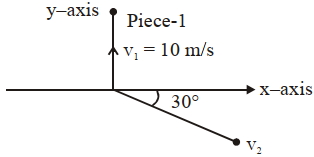
A ball of mass $10\, kg$ moving with a velocity $10 \sqrt{3} m / s$ along the $x-$axis, hits another ball of mass $20\, kg$ which is at rest. After the collision, first ball comes to rest while the second ball disintegrates into two equal pieces. One piece starts moving along $y-$axis with a speed of $10$ $m / s$. The second piece starts moving at an angle of $30^{\circ}$ with respect to the $x-$axis. The velocity of the ball moving at $30^{\circ}$ with $x-$ axis is $x\, m / s$. The configuration of pieces after collision is shown in the figure below. The value of $x$ to the nearest integer is
A common transistor radio set requires $12\,V (D.C.)$ for its operation. The $D.C.$ source is constructed by using a transformer and a rectifier circuit, which are operated at $220\, V$ $(A.C.)$ on standard domestic $A.C.$ supply. The number of turns of secondary coil are $24,$ then the number of turns of primary are
Two identical charged spheres are suspended by string of equal lengths. The string make an angle of $37^{\circ}$ with each other. When suspended in a liquid of density $0.7 g / \ cm ^3,$ the angle remains same. If density of material of the sphere is $1.4 g / \ cm ^3,$ the dielectric constant of the liquid is $..........\left(\tan 37^{\circ}=\frac{3}{4}\right)$.
In a transistor amplifier, $\beta = 62, R_L = 5000\, \Omega$ and internal resistance of the  transistor is $500\, \Omega$. The voltage amplification of the amplifier will be: