Questions · Page 1 of 2

M.C.Q (1 Marks)

Take a timed test

50 questions · self-marked practice — reveal the answer and mark yourself.

MCQ 11 Mark
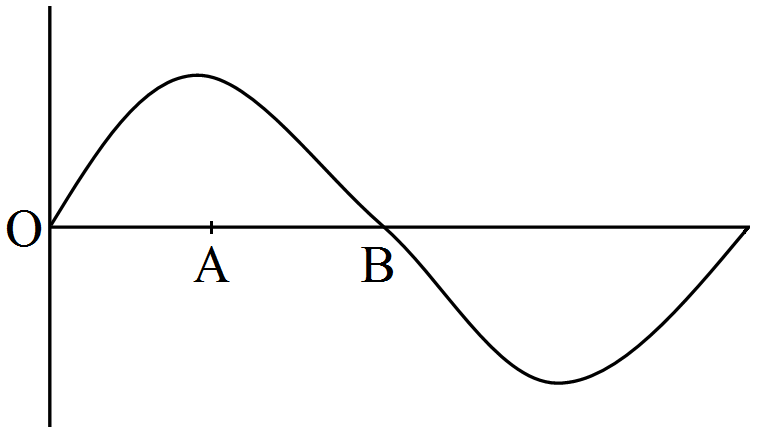
Which of the following statements are true for a stationary wave?
  • A
    Every particle has a fixed amplitude which is different from the amplitude of its nearest particle.
  • B
    All the particles cross their mean position at the same time.
  • C
    There is no net transfer of energy across any plane.
  • D
    There are some particles which are always at rest.
Answer
  1. Every particle has a fixed amplitude which is different from the amplitude of its nearest particle
  1. All the particles cross their mean position at the same time.  
  1.  There is no net transfer of energy across any plane.
  1.  There are some particles which are always at rest.

Explanation:

In stationary waves $[\text{y}(\text{x, t})=\text{a}\sin\text{kx}\cos\omega\text{t}]$ the particles between two nodes vibrates with different amplitude which increases fron nodes.

The amplitude of a particle will remain constant a cos kx, but varies with $\lambda$

$\because\text{k}=\frac{2\pi}{\lambda}.$ Hence verifies the option (a)

particles between two nodes are in same phase i.e., motion of particles between two nodes will be either upward or downward and crosses the mean position at same time. Hence the verifies option (b)

Hence the reject option (c)

As the particles at nodes are rest so energy does not transfer verifies option (d)

The amplitude of particles at nodes has amplitude zero verifies option (e)
View full question & answer
MCQ 21 Mark
Speed of sound waves in a fluid depends upon:
  • A
    Directty on density of the medium.
  • B
    Square of Bulk modulus of the medium.
  • C
    Inversly on the square root of density.
  • D
    Directly on the square root of bulk modulus of the medium.
Answer
  1. Inversly on the square root of density.
  2. Directly on the square root of bulk modulus of the medium.

Explanation:

Speed od sound wave in fluid of bulk modules k and density $\rho$ is given by $\text{v}=\sqrt{\frac{\text{k}}{\rho}}$

so $\text{v}=\sqrt{\text{k}}$ (if $\rho$ is constant)

And $\text{v}=\sqrt{\frac{1}{\rho}}$ (if k is constann)

so verifies the option (c) and (d).

View full question & answer
MCQ 31 Mark
When both the listener and source are moving towards each other, then which of the following is true regarding frequency and wavelength of wave observed by the observer?
  • A
    More frequency, less wavelength.
  • B
    More frequency, more wavelength.
  • C
    Less frequency, less wavelength.
  • D
    More frequency, constant wavelength.
Answer
  1. More frequency, less wavelength.
View full question & answer
MCQ 41 Mark
In a sinusoidal wave, the time required for a particular point to move from maximum displacement to zero displacement is 0.17s. The frequency of the wave is:
  • A
    1.47Hz
  • B
    0.36Hz
  • C
    0.73Hz
  • D
    2.94Hz
Answer
  1. 1.47Hz

Explanation:

T = 4 × Time from max. displacement to zero displacement.

$=4\times0.170=0.68\text{s}$

$\text{n}=\frac{1}{\text{T}}=\frac{1}{0.68}$

$=1.47\text{Hz}$

View full question & answer
MCQ 51 Mark
A siren placed at a railway platform is emitting sound of frequency 5kHz. A passenger sitting in a moving train A records a frequency of 5.5kHz, while the train approaches the siren. During his return journey in a different train B, he records a frequency of 6.0kHz. while approaching the same siren. The ratio of the velocity of train B to that of train A is:
  • A
    $\frac{242}{252}$
  • B
    $2$
  • C
    $\frac{5}{6}$
  • D
    $\frac{11}{6}$
Answer
  1. $2$

Explanation:

When listener alone is moving towards the source.

$\text{n}'=\frac{(\nu+\nu_\text{L})\text{n}}{\nu}$

$\therefore 5.5=\Big(\frac{\nu+\nu_\text{A}}{\nu}\Big)5$

and $6.0=\Big(\frac{\nu+\nu_\text{B}}{\nu}\Big)5$

Solving (i) and (ii), we get

$\frac{\nu_\text{B}}{\nu_\text{A}}=2$

View full question & answer
MCQ 61 Mark
A vehicle with a horn of frequency n is moving with a velocity of 30m/s in a direction perpendicular to the straight line joining the observer and the vehicle. The observer precedes the sound to have a frequency (n + n1). If velocity of sound in air is 300m/s, n, would be:
  • A
    n1 = 10n
  • B
    n1 = 0
  • C
    n1 = 0.1n
  • D
    n1 = -0.1n
Answer
  1. n1 = 0

Explanation:

As source is moving at 90° to the line joining the observer and the vehicle, therefore n’ = n. Hence n1 = 0

View full question & answer
MCQ 71 Mark
A transverse harmonic wave on a string is described by $\text{y}(\text{x},\text{t})=3.0\sin(36\ \text{t}+0.018\text{x}+\pi/ 4)$ where x and y are in cm and t is in s. The positive direction of x is from left to right.
  • A
    The wave is travelling from right to left.
  • B
    The speed of the wave is 20m/ s.
  • C
    Frequency of the wave is 5.7Hz.
  • D
    The least distance between two successive crests in the wave is 2.5cm.
Answer
  1. The wave is travelling from right to left.
  2. The speed of the wave is 20m/ s.
  3. Frequency of the wave is 5.7Hz.

Explanation:

The standard from of a wave propagated from left to right i. e., in+ ve direction

$\text{y}=\text{a}\sin(\omega\text{t}-\text{k}\text{x}+\phi)$ and

$\text{y}=3.0\sin\Big(36\text{t}+0.018\text{x}+\frac{\pi}{4}\Big)$ (given)

  1. As in given equation x is in positive sigh so given wave travalling from right to left verifies option (a)
  2. $\text{k}=0.018=\frac{2\pi}{\lambda}=0.018\Rightarrow\lambda=\frac{2\pi}{0.018}$

$\therefore\text{v}=\text{v}\lambda=\frac{18}{\pi}\times\frac{2\pi}{0.018}=2000\text{cm}/ \ \text{s}=20\text{m/ s}$

Verifies the option (b)

  1. $\omega=36$ or $2\pi\text{n}=36$ or $\text{v}=\frac{36}{2\pi}=\frac{18}{3.14}=5.7\text{Hz}$

Verifies option (c) n = 5.7Hz

View full question & answer
MCQ 81 Mark
With propagation of longitudinal waves through a medium, the quantity transmitted is:
  • A
    Matter.
  • B
    Energy.
  • C
    Energy and matter.
  • D
    Energy, matter and momentum.
Answer
  1. Energy.

Explanation:

During propagation of any wave in a medium only energy is transmitted from one point to another. Matter does not change its own position it, vibrates about its mean position only.

View full question & answer
MCQ 91 Mark
Let a wave $\text{y(x, t)}=\text{a}\sin(\text{kx}-\omega\text{t})$ is reflected from an open boundary and then the incident and reflected waves overlaps. Then the amplitude of resultant wave:
  • A
    $2\text{a}\cos(\text{kx})$
  • B
    $2\text{a}\sin(\text{kx})$
  • C
    $2\text{a}\sin\Big(\frac{\text{kx}}{2}\Big)$
  • D
    $\text{a}\sin(\text{kx}) $
Answer
  1. $2\text{a}\sin(\text{kx})$

Explanation:

We have incident wave $\text{y}_1=\text{a}\sin(\text{kx}-\omega\text{t})$

So the reflected wave is $\text{y}_2=\text{a}\sin(\text{kx}+\omega\text{t})$

From principle of superposition, the standing wave equation obtained after superimposing y1 and y2,

we get

$\text{y(x, t)}=2\text{a}\sin\text{kx}\cos\omega\text{t}$

Thus, the resultant amplitude is

$\text{A(x)}=2\text{a}\sin\text{kx}$

View full question & answer
MCQ 101 Mark
A transverse wave propagating along X-axis is represented by
$\text{y (x, t)}=8.0\sin(0.5\pi\text{x}-4\pi\text{t}-\frac{\pi}{4})$
where x is in metre and t is in seconds. The speed of the wave is:
  • A
    $8\text{m/s}$
  • B
    $4\pi\text{m/s}$
  • C
    $0.5\pi\text{m/s}$
  • D
    $\frac{\pi}{4}\text{m/s}$
Answer
  1. $\frac{\pi}{4}\text{m/s}$
View full question & answer
MCQ 111 Mark
Two waves of equal amplitude A and equal frequency travel in the same direction in a medium. The amplitude of the resultant wave is:
  • A
    0
  • B
    A
  • C
    2A
  • D
    Between 0 to 2A
Answer
  1. Between 0 to 2A
View full question & answer
MCQ 121 Mark
Two waves represented by $\text{y}_1=\text{a}\sin\omega\text{t}$ and $\text{y}_2=\text{a}\sin(\omega\text{t}+\phi)$ with $\phi=\frac{\pi}{2}$ are superposed at any point at a particular instant. The resultant amplitude is:
Answer
  1. $\sqrt{2}\text{a}$
View full question & answer
MCQ 131 Mark
A transverse wave propagating along X-axis is represented by
$\text{y}(\text{x,t})=8.0\sin\Big(0.5\pi\text{x}-4\pi\text{t}-\frac{\pi}{4}\Big)$
where x is in metre and t is in seconds. The speed of the wave is:
  • A
    $8\text{m/s}$
  • B
    $4\pi\text{m/s}$
  • C
    $0.5\pi\text{m/s}$
  • D
    $\frac{\pi}{4}\text{m/s}$
Answer
  1. $8\text{m/s}$

Explanation:

Comparing with the standard wave equation

$\text{y}=\text{r}\sin \Big[\frac{2\pi\text{x}}{\lambda}-\frac{2\pi\text{t}}{\text{T}}-\phi\Big], \text{we get}$

$\frac{2\pi}{\lambda}=0.5\pi,\lambda =4\text{m},\frac{2\pi}{\text{T}}=4\pi,\text{T}=0.5\text{s}$

Speed of wave = 8m/s

View full question & answer
MCQ 141 Mark
A car is moving towards a high cliff. The driver sounds a horn of frequency f. The reflected sound heard by the driver has a frequency 2f. If y be the velocity of sound, then the velocity of the car, in the same velocity units would be:
  • A
    $\frac{\nu}{4}$
  • B
    $\frac{\nu}{2}$
  • C
    $\frac{\nu}{\sqrt{2}}$
  • D
    $\frac{\nu}{3}$
Answer
  1. $\frac{\nu}{3}$

Explanation:

The frequency of sound incident on the cliff.

$\text{f}_1=\frac{\nu}{\nu-\nu'}\text{f}$

where v' is velocity of car (source)

For the sound reflected from the cliff, driver is the listener, moving towards the source

$\therefore$ Frequency of sound heard, $\text{f}_2=\frac{\nu+\nu'}{\nu}\text{f}_1$

$\text{f}_2=\frac{\nu+\nu'}{\nu}\times\frac{\nu}{\nu-\nu'}\text{f}=\frac{\nu+\nu'}{\nu-\nu'}\text{f}$

As $\text{f}_2=2\text{f}$

$\therefore \frac{\nu+\nu'}{\nu-\nu'}=2=\nu'=\frac{\nu}3{}$

View full question & answer
MCQ 151 Mark
A train, standing in a station yard, blows a whistle of frequency 400Hz in still air. The wind starts blowing in the direction from the yard to the station with a speed of 10m/ s. Given that the speed of sound in still air is 340m/ s,
  • A
    The frequency of sound as heard by an observer standing on the platform is 400Hz.
  • B
    The speed of sound for the observer standing on the platform is 350m/ s.
  • C
    The frequency of sound as heard by the observer standing on the platform will increase.
  • D
    The frequency of sound as heard by the observer standing on the platform will decrease.
Answer
  1. The frequency of sound as heard by an observer standing on the platform is 400Hz.
  2. The speed of sound for the observer standing on the platform is 350m/ s.

Explanation:

As the disatance between listener and source does not change so frequency of sound does not change the as heard listener. i.e.,he heard $\text{v}_0=400\text{Hz}.$ verifies option(a)

$\text{v}_0=400\text{Hz}$ frequency of source of sound.

Velocity of wind $\text{v}_\text{w}=10\text{m/ s}$ from source of listenr.

Speed of sound in still air $= \text{v}_\text{s}=340\text{m/ s}$

As the listenner is standing on platfrom.

Speed od sound with respect to listener $\text{v}_\text{s}+\text{v}_\text{w}=340+10=350\text{m/ s}$

Verifies the option (b)

Reject the option (c)and (d) as it constant $\text{v}_0=400\text{Hz}$

View full question & answer
MCQ 161 Mark
In a longitudinal wave, the elastic property of the constituents of the medium that determines the stress under compressional strain is:
  • A
    Young's modulus (Y).
  • B
    Bulk modulus (B).
  • C
    Shear modulus (S).
  • D
    Either (b) or (C).
Answer
  1. Bulk modulus (B).
View full question & answer
MCQ 171 Mark
If a propagating wave meets a boundary which is not completely rigid or is an interface between two different elastic media, then which of the statements is/ are correct?
  • A
    A part of the incident wave is reflected and a part is transmitted into the second medium.
  • B
    The incident wave is completely reflected from the boundary.
  • C
    Only part of the wave is reflected and the remaining part disappears art disappears.
  • D
    None of the above.
Answer
  1. A part of the incident wave is reflected and a part is transmitted into the second medium.
View full question & answer
MCQ 181 Mark
Equation of a plane progressive wave is given by $\text{y}=0.6\sin2\pi\Big(\text{t}-\frac{\text{x}}{2}\Big).$ On reflection from a denser medium its amplitude becomes 2/3 of the amplitude of the incident wave. The equation of the reflected wave is:
  • A
    $\text{y}=0.6\sin2\pi\Big(\text{t}+\frac{\text{x}}{2}\Big)$
  • B
    $\text{y}=-0.4\sin2\pi\Big(\text{t}+\frac{\text{x}}{2}\Big)$
  • C
    $\text{y}=0.4\sin2\pi\Big(\text{t}+\frac{\text{x}}{2}\Big)$
  • D
    $\text{y}=-0.4\sin2\pi\Big(\text{t}-\frac{\text{x}}{2}\Big)$
Answer
  1. $\text{y}=-0.4\sin2\pi\Big(\text{t}+\frac{\text{x}}{2}\Big)$

Explanation:

After reflection of wave changes by phase 180°

$\text{y}_\text{i}=0.6\sin2\pi\Big[\text{t}+\frac{\text{x}}{2}\Big]$

$\text{y}_\text{r}\Big(\frac{2}{3}\times0.6\Big)\sin2\pi\Big[\pi+\text{t}+\frac{\text{x}}{2}\Big]$

$\text{y}_\text{r}=-0.4\sin2\pi\Big(\text{t}+\frac{\text{x}}{2}\Big).$ Hence verifies the option (b).

View full question & answer
MCQ 191 Mark
A tuning fork produces 4beats/ sec with another fork of frequency 288 c.p.s. A little wax is placed on the unknown fork and it then produces 2beats/ sec. The unknown frequency is:
  • A
    368c.ps.
  • B
    292c.p.s
  • C
    284c.p.s.
  • D
    290c.p.s.
Answer
  1. 292c.p.s

Explanation:

Known frequency of A, n1 = 288c.p.s.

Number of beats/ sec m = 4

$\therefore$ Unknown freq. of B, n2$288\pm4=292 \text{ or }284$

on loading B, number of beats/ sec decreases to 2.

Therefore, m is +.

$\therefore $ n2 = 288 + 4 = 292c.p.s.

View full question & answer
MCQ 201 Mark
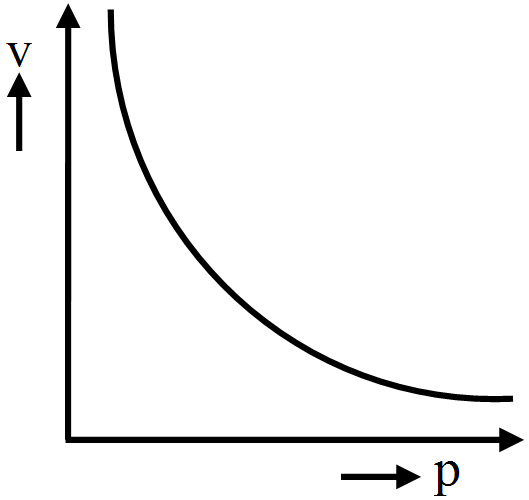
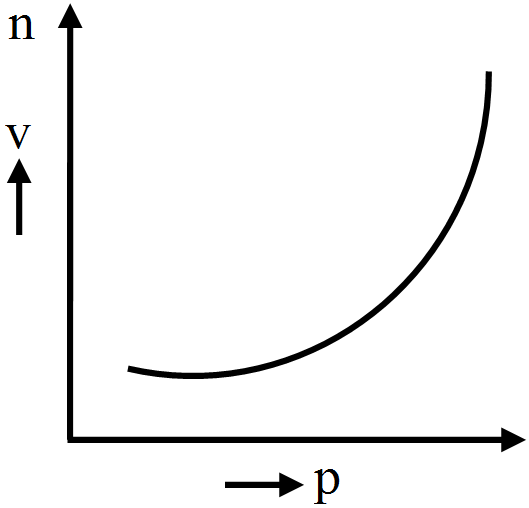
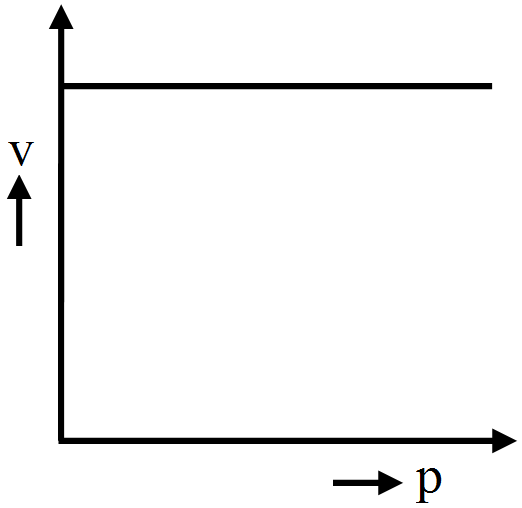
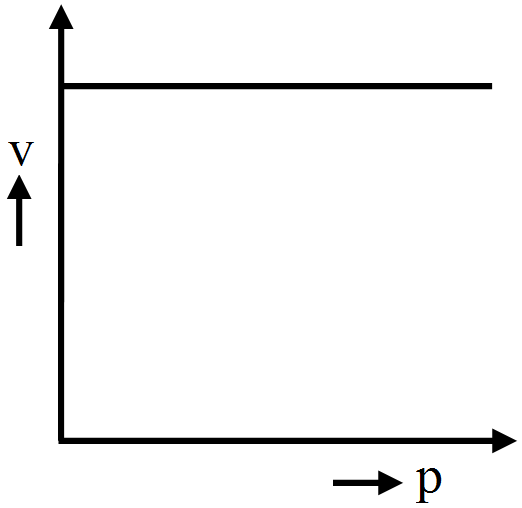
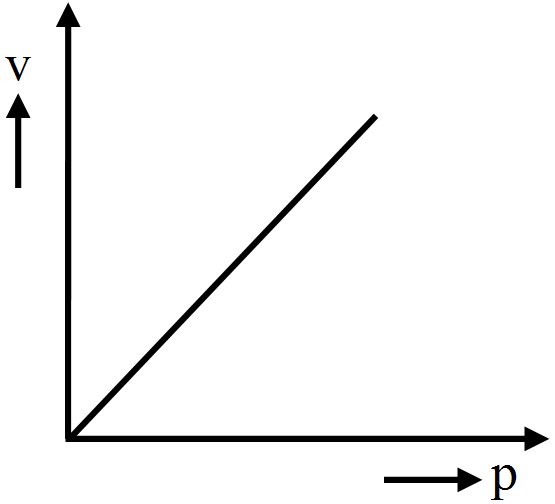
A student plotted the following four graphs representing the variation of velocity of sound in a gas with the pressure p at constant temperature. Which one is correct?
  • A
     
    1. B
       
      1. C
         
        1. D
           
        Answer
        1.  

        View full question & answer
        MCQ 211 Mark
        The displacement of a string is given by $\text{y}(\text{x, t})=0.06\sin(2\pi\text{x}/ 3)\cos(120\pi\text{t})$ where x and y are in m and t in s. The length of the string is 1.5m and its mass is $3.0\times10^{-2}\text{kg}$
        • A
          It represents a progressive wave of frequency 60Hz.
        • B
          It represents a stationary wave of frequency 60Hz.
        • C
          It is the result of superposition of two waves of wavelength 3m, frequency 60Hz each travelling with a speed of 180m/ s in opposite direction.
        • D
          Amplitude of this wave is constant.
        Answer
        1. It represents a stationary wave of frequency 60Hz.
        2. It is the result of superposition of two waves of wavelength 3m, frequency 60Hz each travelling with a speed of 180m/ s in opposite direction.

        Explanation:

        We know thet standard equation of stationary wave is $\text{y}(\text{x, t})=\text{a}\sin(\text{kx})\cos(\omega\text{t})$ and given equation is $\text{y}(\text{x, t})=0.06\sin\Big(\frac{2\pi}{3}\Big)\cos[9120\pi)\text{t})$

        1. Comparring both equation $\omega=120\pi$

        $2\pi\text{v}=120\pi$ or $\text{v}=\frac{120}{2}=60\text{Hz}$

        Verifies the option (b).

        1. $\frac{2\pi}{\lambda}=\text{k}$ from $\text{k}=\frac{2\pi}{3}$

        $\therefore\frac{2\pi}{\lambda}=\frac{2\pi}{3}$

        $\Rightarrow\lambda=3\text{m},\ \text{v}=60\text{Hz}$

        speed $\text{v}=\text{v}\lambda=60\times3=180\text{m/ s}.$ Hence, verifies the option (c).

        View full question & answer
        MCQ 221 Mark
        When two waves of almost equal frequency n1 and n2 are produced simultaneously, then the time interval between successive maxima is:
        Answer
        1. $\frac{1}{\text{n}_1-\text{n}_2}$

        Explanation:

        Time interval between two successive maxima = time interval between two successive beats

        $=\frac{1}{\text{n}}=\frac{1}{\text{n}_1-\text{n}_2}$

        View full question & answer
        MCQ 231 Mark
        The wave generated from up and down jerk given to the string or by up and down motion of the piston at end of the pipe is:
        • A
          Transverse.
        • B
          Longitudinal.
        • C
          Both (a) and (b).
        • D
          Electromagnetic wave.
        Answer
        1. Both (a) and (b).
        View full question & answer
        MCQ 241 Mark
        The frequency of a sound wave is n and its velocity is v. If the frequency is increased to 4n, the velocity of the wave will be:
        • A
          $\nu$
        • B
          $2\nu$
        • C
          $4\nu$
        • D
          $\frac{\nu}{4}$
        Answer
        1. $\nu$

        Explanation:

        Velocity of sound is independent of frequency. Therefore, it is same $(\nu)$ for frequency n and 4n.

        View full question & answer
        MCQ 251 Mark
        A hospital uses an ultrasonic scanner to locate tumours in a tissue. The operating frequency of scanner is 4.2MHz. The speed of sound in the tissue is 1.7km s-1. The wavelength of sound in the tissue is close to:
        • A
          4 × 10⁻⁴m
        • B
          8 × 1-4m
        • C
          4 × 10⁻³m
        • D
          8 × 10⁻³m
        Answer
        1. 4 × 10⁻⁴m

        Explanation:

        $\text{n}=4.2\text{MHz}=4.2\times10^6\text{Hz}$

        $\nu=1.7\text{km s}^{-1}=1.7\times10^3\text{m s}^{-1}$

        $\lambda =\frac{\nu}{\text{n}}=\frac{1.7\times10^3}{4.2\times10^6}$

        $=4\times10^{-4}\text{m}$

        View full question & answer
        MCQ 261 Mark
        A string of length 0.4m and mass 10-2kg is tightly clamped at the ends. The tension in the string is 1.6N. Identical wave pulses are produced at one end at equal intervals of time $\Delta\text{t}.$ The minimum value of $\Delta\text{t}$ which allows constructive interference between successive pulses is:
        • A
          0.05s
        • B
          0.10s
        • C
          0.20s
        • D
          0.40s
        Answer
        1. 0.05s

        Explanation:

        ​​​​​​​$\text{n}=\frac{1}{27}\sqrt{\frac{\text{T}}{\text{m}}}=\frac{1}{2\times0.4}\sqrt{\frac{1.6}{\frac{10^{-2}}{0.4}}}=10\text{Hz}$

        $\therefore$ Time period t $=\frac{1}{\text{n}}=\frac{1}{10}=0.1\text{s}$

        As distance between two fixed ends $=\frac{\lambda}{2}$

        $\therefore$ for constructive interference, min value of time

        $\Delta \text{t}=\frac{\text{t}}{2}=\frac{0.1}{2}=0.05\text{s}$

        View full question & answer
        MCQ 271 Mark
        Sound waves of wavelength $\pi$ travelling in a medium with a speed of v m/ s enter into another medium where its speed is 2v m/ s. Wavelength of sound waves in the second medium is:
        • A
          $\pi$
        • B
          $\frac{\pi}{2}$
        • C
          $2\pi$
        • D
          $4\pi$
        Answer
        1. $2\pi$

        Explanation:

        When wave passes from one medium to another its frequency (v) does not chang but its velocity and wavelength changs.

        $\text{v}=\text{v}\lambda$ or $\text{v}=\frac{\text{v}}{\lambda}$

        $\frac{\text{v}}{\lambda}=\frac{2\text{v}}{\lambda_2}\Rightarrow\lambda_2=2\lambda.$

        Hence verifies the correct option (c)

        View full question & answer
        MCQ 281 Mark
        If equation of sound wave is $\text{y}=0.0015\sin(62.4\text{x}+316\text{t}),$ then its wavelength will be:
        • A
          0.2 unit
        • B
          0.3 unit
        • C
          0.1 unit
        • D
          2 unit
        Answer
        1. 0.1 unit

        Explanation:

        The given equation is $\text{y}=0.0015\sin(62.4\text{x}+316\text{t}),$ Compare it with the standard equation.

        $\text{y}=\text{r}\sin\Big(\frac{2\pi}{\lambda}\text{x}+\frac{2\pi\text{t}}{\text{T}}\Big)$

        $\frac{2\pi}{\lambda}=62.4$

        $\lambda=\frac{2\pi}{62.4}=\frac{2\times3.14}{62.4}=0.1\text{ unit}$

        View full question & answer
        MCQ 291 Mark
        The transverse displacement of a string (clamped at its both ends) is given by $\text{y}(\text{x, t})=0.06\sin(1\pi\text{x/ 3})\cos(120\pi\text{t}).$
        All the points on the string between two consecutive nodes vibrate with
        • A
          Same frequency.
        • B
          Same phase.
        • C
          Same energy.
        • D
          Different amplitude.
        Answer
        1. Same frequency.
        1. Same phase. 
        1. Different amplitude.

        Explanation:

        The frequencies of all particles are same, verifies the option (a).  

        particles between any two consecutive nodes vibrates either upside or downside having sameb phase $120\pi\text{t}$ ay atime, verifies the option (b)

        particles have ditternt energies. so rejects the option (c)

        As the amplitude of different particles are diffrent between two nodes energy (E)  $\propto\text{A}^2.$ verifies the option (d)

        View full question & answer
        MCQ 301 Mark
        A sound source is moving towards a stationary listener with $\frac{1}{10}$ of the speed of sound. The ratio of apparent to real frequency is:
        Answer
        1. $\frac{10}{9}$

        Explanation:

        When source is moving towards a stationary listener, apparent frequency.

        $\text{f}'=\frac{\nu\times\text{f}}{\nu-\nu_\text{s}}=\frac{\nu}{\nu-\frac{\nu}{10}}\text{f}=\frac{10}{9}\text{f}$

        $\frac{\text{f}'}{\text{f}}=\frac{10}{9}$

        View full question & answer
        MCQ 311 Mark
        A string is stretched between fixed points separated by 75.0cm. It is observed to have resonant frequencies of 420Hz and 315Hz. There are no other resonant frequencies between these two. Then the lowest resonance frequency for this string is:
        • A
          1.05Hz
        • B
          1050Hz
        • C
          10.5Hz
        • D
          105Hz
        Answer
        1. 105Hz
        View full question & answer
        MCQ 321 Mark
        A particle has displacement y given by $\text{y}=3\sin(5\pi\text{t}+\phi),$ where y is in metre and t is in second. What are frequency and period of motion?
        • A
          0.4Hz, 2.5s
        • B
          2.5Hz, 0.4s
        • C
          2.5Hz, 2.5s
        • D
          0.4Hz, 0.4s
        Answer
        1. 2.5Hz, 0.4s

        Explanation:

        Comparison with the standard equation shows that

        $\frac{2\pi}{\text{T}}=5\pi,\text{T}=\frac{2\pi}{5\pi}=0.4\text{s}$

        $\text{n}=\frac{1}{\text{T}}=\frac{1}{.4}=2.5\text{Hz}$

        View full question & answer
        MCQ 331 Mark
        A wire under tension T emits a note of fundamental frequency 200Hz. If the tension is increased by 3T, the fundamental frequency will be:
        • A
          $400\text{Hz}$
        • B
          $0\text{Hz}$
        • C
          $100\sqrt{3}\text{Hz}$
        • D
          $200\sqrt{3}\text{Hz}$
        Answer
        1. $400\text{Hz}$

        Explanation:

        Here, $\text{v}=\frac{1}{2\text{l}}\sqrt{\frac{\text{T}}{\text{m}}}$

        When tension is increased by 3T

        $\text{v}'=\frac{1}{2\text{l}}\sqrt{\frac{(\text{T}+3\text{T})}{\text{m}}}=2\text{v}$

        $\text{v}'=2\times200=400\text{Hz}$

        View full question & answer
        MCQ 341 Mark
        Two sound waves with wavelength 5.0m and 5.5m respectively, each propagate in a gas with velocity 330m/s. We expect the following number of beats/sec:
        • A
          6
        • B
          12
        • C
          0
        • D
          1
        Answer
        1. 6
        View full question & answer
        MCQ 351 Mark
        During propagation of a plane progressive mechanical wave:
        • A
          All the particles are vibrating in the same phase.
        • B
          Amplitude of all the particles is equal.
        • C
          Particles of the medium executes S.H.M.
        • D
          Wave velocity depends upon the nature of the medium.
        Answer
        1. Amplitude of all the particles is equal.
        2. Particles of the medium executes S.H.M.
        3. Wave velocity depends upon the nature of the medium.

        Explanation:

        During propagation of mechanical wave each particles displaces from zero to maximum i.e., upto amplitude So amplitude of each particle is equal. Verifies the option (b).

        For progressive wave medium particles oscillates about their mean position in which restoring force $\text{F}\propto(-\text{y}).$ So motion of medium particles is simple harmonic motion. So verifies the option(c).For progressive wave propagating in a medium of density $(\rho)$ and Bulk modulus k the velocity $(\nu)$

        As the depends on k and $(\rho)$ and k, $(\rho)$ are different for different medium so of wave depends on nature of medium, hence, verifies the option (d).

        View full question & answer
        MCQ 361 Mark
        Water waves produced by a motor boat sailing in water are:
        • A
          Neither longitudinal nor transverse.
        • B
          Both longitudinal and transverse.
        • C
          Only longitudinal.
        • D
          Only transverse.
        Answer
        1. Both longitudinal and transverse.

        Explanation:

        As the waves are produced by motor boat on surface as well as inside water, the waves are both, transverse as well as longitudinal.

        View full question & answer
        MCQ 371 Mark
        Two pulses having equal and opposite displacements moving in opposite directions overlap at t =t1s. The resultant displacement of the wave at t = t1s is:
        • A
          Twice the displacement of each pulse.
        • B
          Half the displacement of each pulse.
        • C
          Zero.
        • D
          Either (a) or (c).
        Answer
        1. Zero.

        Explanation:

        The displacement due to two pulses will exactly cancel out each other. Thus, there will be no displacement throughout.

        View full question & answer
        MCQ 381 Mark
        Two sound waves of slightly different frequencies propagating in the same direction produce beats due to:
        • A
          Interference.
        • B
          Diffraction.
        • C
          Reflection.
        • D
          Refraction.
        Answer
        1. Interference.

        Explanation:

        Beats are produced on account of interference of sound waves of slightly different frequencies.

        View full question & answer
        MCQ 391 Mark
        Two sound sources emitting sound each of wavelength $\lambda$ are fixed at a given distance apart. A listener moves with a velocity u along the line joining the two sources. The number of beats heard by him per second is:
        • A
          $\frac{2\text{u}}{\lambda}$
        • B
          $\frac{\text{u}}{\lambda}$
        • C
          $\frac{\text{u}}{3\lambda}$
        • D
          $\frac{2\lambda}{\text{u}}$
        Answer
        1. $\frac{2\text{u}}{\lambda}$

        Explanation:

        Number of extra waves received/ sec. $=\pm\frac{\text{u}}{\lambda}$

        $\therefore$ Number of beats/ sec. $=\frac{\text{u}}{\lambda}-\Big(\frac{-\text{u}}{\lambda}\Big)=\frac{2\text{u}}{\lambda}$

        View full question & answer
        MCQ 401 Mark
        A steel wire has linear mass density 6.9 × 10⁻³kgm-1. If the wire is under a tension of 60N, then the speed of the transverse waves on the wire is:
        • A
          63ms-1
        • B
          75ms-1
        • C
          73ms-1
        • D
          93ms-1
        Answer
        1. 93ms-1

        Explanation:

        Linear mass density = 6.9 × 10-3 kg m-1

        Tension, T = 60N Thus, speed of wave on the wire is given by

        $\nu=\sqrt{\frac{\text{T}}{\mu}}=\sqrt{\frac{60\text{N}}{6.9\times10^{-3}\text{kg m}^{-1}}}$

        $=93\text{ms}^{-1}$

        View full question & answer
        MCQ 411 Mark
        Change in temperature of the medium changes:
        • A
          Frequency of sound waves.
        • B
          Amplitude of sound waves.
        • C
          Wavelength of sound waves.
        • D
          Loudness of sound waves.
        Answer
        1. Wavelength of sound waves.

        Explanation:

        Speed of sound wave in amedium $\text{v}=\sqrt{\frac{\gamma\ \text{RT}}{\text{M}}}.$ here $\gamma,\text{R}$ and M are constent.

        Hence, $\text{v}\propto\sqrt{\text{T}}$ (where T is tempreature of the medium)

        It mence when temprature changes, speed also changes.

        As, $\text{v}=\text{f}\lambda,$ where f is frequency and $\lambda$ is wavelength.

        As frequency (f) remains fixed, $\text{v}\propto\lambda$ or $\lambda$ hence wavelength $(\lambda)$changes.

        Hence verifies the option (c).

        View full question & answer
        MCQ 421 Mark
        The displacement of the wave given by equation $\text{y (x, t)}=\text{a}\sin(\text{kx}-\omega\text{t}+\phi),$ where $\phi = 0$ at point x and t = 0 is same as that at point:
        Answer
        1. $\text{x}+\frac{2\text{n}\pi}{\text{k}}$

        Explanation:

        $\text{y}(\text{x}, 0)=\text{a}\sin\text{kx}=\text{a}\sin (\text{kx}+2\text{n}\pi)$

        $=\text{a}\sin\text{k}\Big(\text{x}+\frac{2\text{n}\pi}{\text{k}}\Big)$

        $\Rightarrow $ The displacement at points x and $\Big(\text{x}+\frac{2\text{n}\pi}{\text{k}}\Big)$

        are the same where, n = 1, 2, 3,......

        View full question & answer
        MCQ 441 Mark
        A source emits a sound of frequency of 400Hz, but the listener hears it to be 390Hz. Then:
        • A
          The listener is moving towards the source.
        • B
          The source is moving towards the listener.
        • C
          The listener is moving away from the source.
        • D
          The listener has a defective ear.
        Answer
        1. The listener is moving away from the source.

        Explanation:

        Since, apparent frequency is lesser than the actual frequency, hence the relative separation between source and listener should be increasing.

        View full question & answer
        MCQ 451 Mark
        A standing wave is generated on a string. Which of the following statement(s) is/are correct for the standing waves?
        • A
          The amplitude of standing wave varies from point to point but each element of the string oscillates with the same angular frequency $'\omega'$ or time period.
        • B
          The string as a whole vibrates in phase with differing amplitudes at different points.
        • C
          The wave pattern in neither moving to the right nor to the left.
        • D
          All of the above.
        Answer
        1. All of the above.

        Explanation:

        There is no phase difference between oscillations of different elements of the wave. However, the string as a whole vibrates in phase with different amplitudes at different points. Also, there is zero movement of the wave pattern. Hence, they are called standing or stationary waves.

        View full question & answer
        MCQ 461 Mark
        A resonating column has resonant frequencies as 100Hz, 300Hz, 500Hz. Then it may:
        • A
          An open pipe.
        • B
          A pipe closed at both ends.
        • C
          Pipe closed at one end.
        • D
          Data insufficient.
        Answer
        1. Pipe closed at one end.
        View full question & answer
        MCQ 471 Mark
        Which of the following statements are true for wave motion:
        • A
          Mechanical transverse waves can propagate through all mediums.
        • B
          Longitudinal waves can propagate through solids only.
        • C
          Mechanical transverse waves can propagate through solids only.
        • D
          Longitudinal waves can propagate through vacuum.
        Answer
        1. Mechanical transverse waves can propagate through solids only.

        Exlanation:

        In case of mechanical transverse wave propagates through a medium, the medium particles oscillate right angles to the direction of wave motion or energy propagation. It travels in the form of crests and troughs.

        When mechanical transverse wave propagates through a medium element of the medium is subjected to shearing stress. Solids and strings have shear modulus, that is why, sustain shearing stress. Fluids have no shape of their own, they yield to shearing stress. Transverse waves can be transmitted through solids, they can be setup on the surface of liquids. But they cannot be transmitted into liquids and gases.

        View full question & answer
        MCQ 481 Mark
        To increase the frequency from 100Hz to 400Hz the tension in the string has to be changed by:
        • A
          4 times.
        • B
          16 times.
        • C
          2 times.
        • D
          None of these.
        Answer
        1. 16 times.
        View full question & answer
        MCQ 491 Mark
        Speed of sound wave in air:
        • A
          Is independent of temperature.
        • B
          Increases with pressure.
        • C
          Increases with increase in humidity.
        • D
          Decreases with increase in humidity.
        Answer
        1. Increases with increase in humidity.

        Explanation:

        Speed of sound (longitudinal) wave in air is $\text{v}=\sqrt{\frac{\lambda\text{p}}{\text{p}}}.$ the density of water vapours is less (rises up) than the air so on increasing humidity, the density of medium decrease in turn increases the speed of sound in air by $\text{v}=\propto\frac{1}{\sqrt{\text{p}}}$ (relation).

        Hence verifies the option (c).

        View full question & answer
        MCQ 501 Mark
        A whistle producing sound waves of frequencies 9500Hz and above is approaching a stationary person with speed v ms-1. The velocity of sound in air is 300ms-1. If the person can hear frequencies upto a maximum of 10000Hz the maximum value of v upto which he can hear the whistle is:
        Answer
        1. $15\text{ms}^{-1}$

        Explanation:

        Here, f = 9500Hz, $\nu_\text{s}=?$, v = 300ms-1, f' = 1000Hz

        As the source is approaching a stationary listener,

        $\therefore \text{f}'=\frac{\nu\times\text{f}}{\nu-\nu_\text{s}}$

        $1000=\frac{300\times9500}{300-\nu_\text{s}}$

        $285=300=\nu_\text{s}$

        $\nu_\text{s}=300-285=15\text{ms}^{-1}$

        View full question & answer
        M.C.Q (1 Marks) - Physics STD 11 Science Questions - Vidyadip