MCQ
When vapour condenses into liquid
  • A
    It absorbs heat
  • It liberates heat
  • C
    Its temperature increases
  • D
    Its temperature decreases

Answer

Correct option: B.
It liberates heat
b
(b) In vapor to liquid phase transition, heat liberates.

Need a full question paper?

Generate a complete, print-ready paper with questions like this in minutes — across 16+ boards, with answer keys.

Start Generating Free

Similar questions

Velocity of a particle is in negative direction with constant acceleration in positive direction. Then, match the following columns.
Colum $I$ Colum $II$
$(A)$ Velocity-time graph $(p)$ Slope $\rightarrow$ negative
$(B)$ Acceleration-time graph $(q)$ Slope $\rightarrow$ positive
$(C)$ Displacement-time graph $(r)$ Slope $\rightarrow$ zero
  $(s)$ $\mid$ Slope $\mid \rightarrow$ increasing
  $(t)$ $\mid$ Slope $\mid$ $\rightarrow$ decreasing
  $(u)$ |Slope| $\rightarrow$ constant
A milli voltmeter of $25$ $milli$ $volt$ range is to be converted into an ammeter of $25$ $ampere$ range. The value (in $ohm$) of necessary shunt will be
A $2\,mW$ laser operates at a wavelength of $500\,nm.$ The number of photons that will be emitted per second is [Given Planck’s constant $h = 6.6 \times 10^{-34}\,Js,$ speed of light $c = 3.0\times 10^8\,m/s$ ]
A mass of $1\, kg$ is hanging from a spring of spring constant $1\, N/m$. If Saroj pulls the mass down by $2\,m$. The work done by Saroj is......$J$
A circular disc of radius $R$ is removed from a bigger uniform circular disc of radius $2R$ such that the circumferences of the discs coincide. The centre of mass of the new  disc is $\alpha R$ from the centre of the bigger disc. The value of $\alpha$ is
A block of mass $m$ moving at a speed $v$ compresses a spring through a distance $x$ before its speed becomes one fourth. Find the spring constant of the spring
A block of mass $2 kg$ slides down an incline plane of inclination $30^o$. The coefficient of friction between block and plane is $0.5$. The contact force between block and plank is :
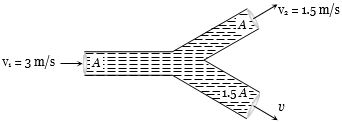
An incompressible liquid flows through a horizontal tube as shown in the following fig. Then the velocity $ v$ of the fluid is .......$m/s$
The correct graph between the frequency $n$ and square root of density ($\rho$) of a wire, keeping its length, radius and tension constant, is
$Assertion :$ In simple harmonic motion, the velocity is maximum when the acceleration is minimum.
$Reason :$ Displacement and velocity of $S.H.M.$ differ in phase by $\frac{\pi }{2}$