Question
When $\vec A.\vec B = - |A||B|,$ then

Answer

(c) $\overrightarrow A .\overrightarrow B = AB\cos \theta $

In the problem $\overrightarrow A .\overrightarrow B = - AB$ i.e. $\cos \theta = - 1$

$\theta = 180^\circ $

i.e. $\overrightarrow A $ and $\overrightarrow B $ acts in the opposite direction.

Need a full question paper?

Generate a complete, print-ready paper with questions like this in minutes — across 16+ boards, with answer keys.
Start Generating Free

Similar questions

A body of mass $m $ is attached to the lower end of a spring whose upper end is fixed. The spring has negligible mass. When the mass $m$ is slightly pulled down and released , it oscillates with a time period of $3\,s$ . When the mass $m$ is increased by $1\,kg$ , the time period of oscillations becomes $5\,s$ . The value of $m$ in $kg$ is
If a gas is heated at constant pressure, its isothermal compressibility
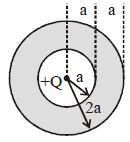
A solid spherical conducting shell has inner radius a and outer radius $2a$. At the center of the shell is located a point charge $+Q$. What must the excess charge of the shell be in order for the charge density on the inner and outer surfaces of the shell to be exactly equal ?
For a gas, the difference between the two specific heats is $4150\, J\, kg^{-1}\, K^{-1}$ and the ratio of the two specific heats is $1.4$. What is the specific heat of the gas at constant volume in units of $J\, kg^{-1}\, K^{-1}$ ?
The image distance of an object placed $10 cm$ in front of a thin lens of focal length $+ 5 cm$ is......$cm$
When light of a given wavelength is incident on a metallic surface, the minimum potential needed to stop the emitted photoelectrons is $6.0 V$. This potential drops to $0.6 V$ if another source with wavelength four times that of the first one and intensity half of the first one is used. What are the wavelength of the first source and the work function of the metal, respectively? $\left[\right.$ Take $\left.=\frac{h c}{c}=1.24 \times 10^{-6} Jm ^{-1}.\right]$
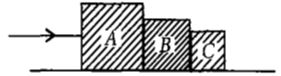
Three blocks $A, B$ and $C,$ of masses $4\, kg, \,2 \,kg$ and $1\, kg$ respectively, are in contact on a frictionless surface, as shown. If a force of $14\, N$ is applied on the $4 \,kg$ block, then the contact force between $A$ and $B$ is  .......... $N$
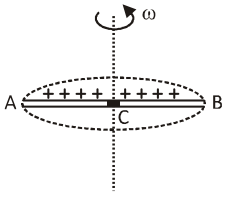
A non-conducting rod AB of length I has a total charge q. The rod is rotated about an axis passing through its centre of mass with a constant angular velocity $\omega$ as shown in figure. The magnetic moment of the rod is :
Image
A body of mass $m$ moving with velocity  $v$ elastic collides head on with another body of mass $2\,\,m$ which is initially at rest. The ratio of  $K.E.$  of the colliding body before and after collision will be
The dipole moment of a system of charge $+q$ distributed uniformly on an arc of radius $R$ subtending an angle $\pi /2$ at its centre where another charge $-q$ is placed is :