Question
When walking on ice, one should take short steps rather than long steps. Why?
Answer

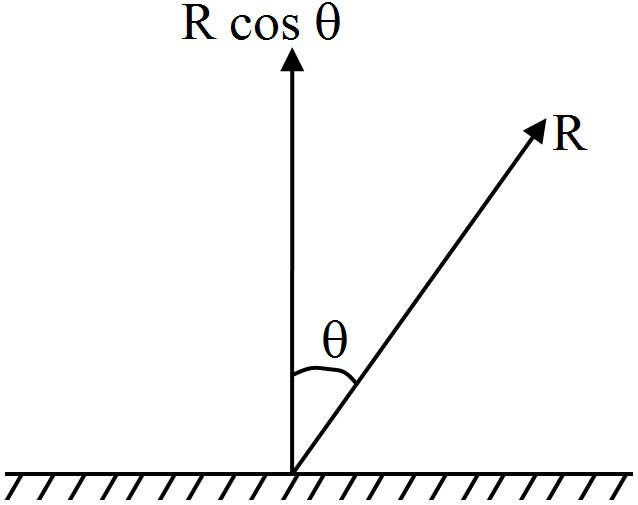
Let R represent the reaction offered by the ground. The vertical component $\text{R}\cos\theta$will balance the weight of the person and the horizontal component $\text{R}\sin\theta$ will help the person to walk forward. Now, normal reaction $=\text{R}\cos\theta$ Friction force $=\text{R}\sin\theta$ Coefficient of friction, $\mu=\frac{\text{R}\sin\theta}{\text{R}\cos\theta}=\tan\theta$ In a long step, $\theta$ is more. So tan $\theta$ is more. But µ has a fixed value. So, there is danger of slipping in a long step.

Need a full question paper?

Generate a complete, print-ready paper with questions like this in minutes — across 16+ boards, with answer keys.
Start Generating Free

Similar questions

A uniformly moving train passes by a long platform. Consider the events' engine crossing the beginning of the platform' and 'engine crossing the end of the platform'. Which frame (train frame or the platform frame) is the proper frame for the pair of events?
A diver having a moment of inertia of $6.0kg-m^2$ about an axis through its centre of mass rotates at an angular speed of $2rad/s$ about this axis. If he folds his hands and feet to decrease the moment of inertia to $5.0kg-m^2​​​​​​​$, what will be the new angular speed?
By suddenly compressing a gas at a temperature of 300 K, its pressure is made 8 times the initial pressure. Calculate the temperature increase due to compression $(\gamma=1.5)$.
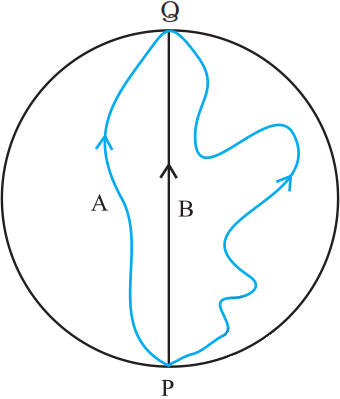
Three girls skating on a circular ice ground of radius 200m start from a point P on the edge of the ground and reach a point Q diametrically opposite to P following different paths as shown in Fig. What is the magnitude of the displacement vector for each? For which girl is this equal to the actual length of path skate?
Specific heat of Argon at constant Pressure is $0.125 cal / g / K$ and at constant volume is $0.075 cal / g / K$. Calculate the density of Argon at N.T.P. Given that $J =4.2$ Joule/cal?
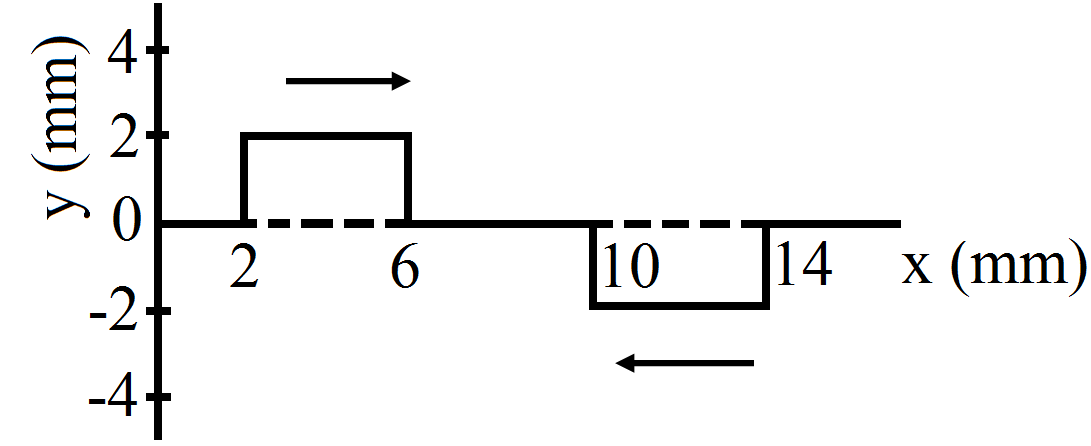
Figure shows two wave pulses at t = 0 travelling on a string in opposite directions with the same

wave speed 50cm/s. Sketch the shape of the string at t = 4ms, 6ms, 8ms, and 12ms.
  1. Why do you prefer to use a wrench of long arm?
  2. A $3m$ long ladder weighing $20\ kg$ leans on a frictionless wall. Its feet rest on the floor $1m$ from the wall. Find the reaction forces of the wall and the floor.
It is known that the period T of a magnet of magnetic moment M vibrating in a uniform magnetic field of intensity H depends upon M, H and I where I is the moment of inertia of the magnet about its axis of oscillations. Show that T = $2\pi\sqrt{\frac{\text{I}}{\text{MH}}}.$
One end of a nylon rope, of length $4.5 cm$ and diameter $6 mm$, is fixed to a free limb. A monkey, weighing $100 N$ , jumps to catch the free end and stays there. Find the elongation of the rope and the corresponding change in the diameter. Given Young's modulus of nylon $=4.8 \times 10^{11} \mathrm{~N} / \mathrm{m}^2$ and Poisson's ratio of nylon $=0.2$.
A cricket ball of mass $150g$ is moving with a velocity of $12ms^{-1}$ and is hit by a bat so that the ball is turned back with a velocity of $20ms^{-1}$. The force of the blow acts for $0.01s$. Find the average force exerted on the ball by the bat.