MCQ
When water boils or freezes, during these processes its temperature:
  • A
    Increases.
  • B
    Decreases.
  • C
    Does not change.
  • D
    Sometimes increase and sometimes deceases.

Answer

  1. Does not change.

Explanation:

When water boils or freezes, its temperature does not change during these processes. Heat here is absorbed or liberated as latent heat.

Need a full question paper?

Generate a complete, print-ready paper with questions like this in minutes — across 16+ boards, with answer keys.
Start Generating Free

Similar questions

An aluminium sphere is dipped into water. Which of the following is true?
  1. Buoyancy will be less in water at 0°C than that in water at 4°C.
  2. Buoyancy will be more in water at 0°C than that in water at 4°C.
  3. Buoyancy in water at 0°C will be same as that in water at 4°C.
  4. Buoyancy may be more or less in water at 4°C depending on the radius of the sphere.
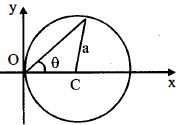
A particle is moving in a circular path of radius $a,$ with a constant velocity $v$ as shown in the figure.The centre of circle is marked by $'C'$. The angular momentum from the origin $O$ can be written as
For a particle in a non-uniform accelerated circular motion
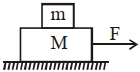
Two blocks $( m =0.5\, kg$ and $M =4.5\, kg$ ) are arranged on a horizontal frictionless table as shown in figure. The coefficient of static friction between the two blocks is $\frac{3}{7} .$ Then the maximum horizontal force that can be applied on the larger block so that the blocks move together is ......... $N.$ (Round off to the Nearest Integer) [Take g as $9.8\, ms ^{-2}$ ]
If a man pushes a wall and is unable to displace it, he:
A batsman hits back a ball of mass $0.4 \; kg$ straight in the direction of the bowler without changing its initial speed of $15 \; ms ^{-1}$. The impulse imparted to the ball is $\dots \; Ns$
Ice in a freezer is at $-7^{\circ} C .100 \,g$ of this ice is mixed with $200 \,g$ of water at $15^{\circ} C$. Take the freezing temperature of water to be $0^{\circ} C$, the specific heat of ice equal to $2.2 \,J / g { }^{\circ} C$, specific heat of water equal to $4.2 \,J / g ^{\circ} C$ and the latent heat of ice equal to $335 \,J / g$. Assuming no loss of heat to the environment, the mass of ice in the final mixture is closest to .......... $g$
Rocket engines lift a rocket from the earth surface because hot gas with high velocity
The rates of cooling of two different liquids put in exactly similar calorimeters and kept in identical surroundings are the same if:
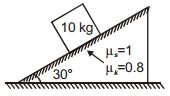
A block of $10 \,kg$ mass is placed on a rough inclined surface as shown in figure. The acceleration of the block will be