Question
When we heat an object, it expands. Is work done by the object in this process ? Is heat given to the object equal to the increase in its internal energy?

Answer

When we heat an object, it expands, i.e. its volume increases.
Work done by the system, $\Delta\text{W}=\text{P}\Delta\text{V}$
Using the first law of thermodynamics, we get,
$\Delta\text{Q}=\Delta\text{U}+\Delta\text{W}$
Since the volume changes, $\Delta\text{W}$ has some non-zero positive value. Thus, heat given to the object is not equal to the increase in the internal energy of the system.

Need a full question paper?

Generate a complete, print-ready paper with questions like this in minutes — across 16+ boards, with answer keys.
Start Generating Free

Similar questions

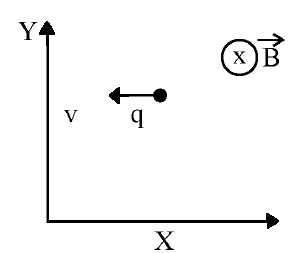
  1. A point charge q moving with speed v enters a uniform magnetic field B that is acting into the plane of the paper as shown. What is the path followed by the charge q and in which plane does it move?
  2. How does the path followed by the charge get affected if its velocity has a component parallel to $\overrightarrow{\text{B}}$?
  3. If an electric field $\overrightarrow{\text{E}}$ is also applied such that the particle continues moving along the original straight line path, what should be the magnitude and direction of the electric field $\overrightarrow{\text{E}}$?
A certain material has refractive indices 1.56, 1.60 and 1.68 for red, yellow and violet light respectively.
  1. Calculate the dispersive power.
  2. Find the angular dispersion produced by a thin prism of angle 6° made of this material.
An object P is focused by a microscope M. A glass slab of thickness 2.1cm is introduced between P and M. If the refractive index of the slab is 1.5, by what distance should the microscope be shifted to focus the object again?
By what fraction does the mass of a boy increase when he starts running at a speed of 12km/h?
A string of length 40cm and weighing 10g is attached to a spring at one end and to a fixed wall at the other end. The spring has a spring constant of 160N/m and is stretched by 1.0cm. If a wave pulse is produced on the string near the wall, how much time will it take to reach the spring?
A short magnet is moved along the axis of a conducting loop. Show that the loop repels the magnet if the magnet is approaching the loop and attracts the magnet if it is going away from the loop.
A spherical conducting shell of inner radius $r_1$ and outer radius $r_2$ has a charge Q.
  1. A charge q is placed at the centre of the shell. What is the surface charge density on the inner and outer surfaces of the shell?
  2. Is the electric field inside a cavity (with no charge) zero, even if the shell is not spherical, but has any irregular shape? Explain
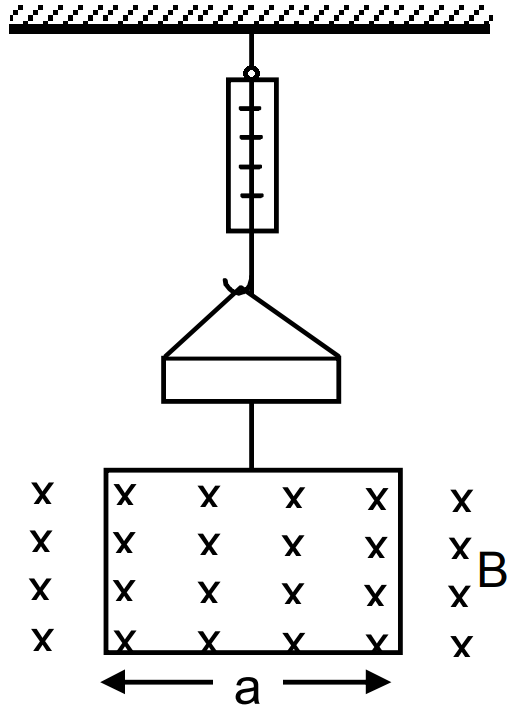
A rectangular wire loop of width a is suspended from the insulated pan of a spring balance, as shown in A current i exists in the anti-clockwise direction in the loop. A magnetic field Bexists in the lower region. Find the change in the tension of the spring if the current in the loop is reversed.
Prove that the magnitude of electric current in a circuit is proportional to the drift velocity of free electrons. Verify Ohm's law with the help of drift velocity.
A beam of light having wavelengths distributed uniformly between 450nm to 550nm passes through a sample of hydrogen gas. Which wavelength will have the least intensity in the transmitted beam?