MCQ
When we see an object, the image formed on the retina is:
- AReal.
- BVirtual.
- CErect.
- DInverted.
When we see an object, the image formed on the retina is:
Explanation:
The retina acts as a screen in the eye; only real, inverted images can be obtained on the screen.
Generate a complete, print-ready paper with questions like this in minutes — across 16+ boards, with answer keys.
The ratio of areas within the electron orbits for the first excited state to the ground state for hydrogen atom is
| (a) 16 : 1 | (b) 18 : 1 | (c) 4 : 1 | (d) 2 : 1 |
The mutual inductance of an induction coil is 5H. In the primary coil, the current reduces from 5A to zero in  . What is the induced emf in the secondary coil
|
(a) 2500 V |
(b) 25000V |
(c) 2510V |
(d) Zero |
Which of the following is not reversible
|
(a) Joule effect |
(b) Peltier effect |
(c) Seebeck effect |
(d) Thomson effect |
When a magnet is pushed in and out of a circular coil C connected to a very sensitive galvanometer G as shown in the adjoining diagram with a frequency v, then
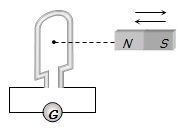
|
(a) Constant deflection is observed in the galvanometer |
|
(b) Visible small oscillations will be observed in the galvanometer if v is about 50 Hz |
|
(c) Oscillations in the deflection will be observed clearly if v = 1 or 2 Hz |
|
(d) No variation in the deflection will be seen if v = 1 or 2 Hz |
Assertion : A parallel plate capacitor is connected across battery through a key. A dielectric slab of constant K is introduced between the plates. The energy which is stored becomes K times.
Reason : The surface density of charge on the plate remains constant or unchanged.
|
(a) If both assertion and reason are true and the reason is the correct explanation of the assertion. |
|
(b) If both assertion and reason are true but reason is not the correct explanation of the assertion. |
|
(c) If assertion is true but reason is false. |
|
(d) If the assertion and reason both are false. |
The retarding potential for having zero photo-electron current
|
(a) Is proportional to the wavelength of incident light |
|
(b) Increases uniformly with the increase in the wavelength of incident light |
|
(c) Is proportional to the frequency of incident light |
|
(d) Increases uniformly with the increase in the frequency of incident light wave |
The work function of a metallic surface is 5.01 eV. The photo-electrons are emitted when light of wavelength 2000Å falls on it. The potential difference applied to stop the fastest photo-electrons is [h = 4.14 
|
(a) 1.2 volts |
(b) 2.24 volts |
(c) 3.6 volts |
(d) 4.8 volts |