Question
When will $(a)$ simultaneous increase and $(b)$ simultaneous decrease in both demand and supply, not affect the equilibrium price? Explain with the help of diagrams.
Answer

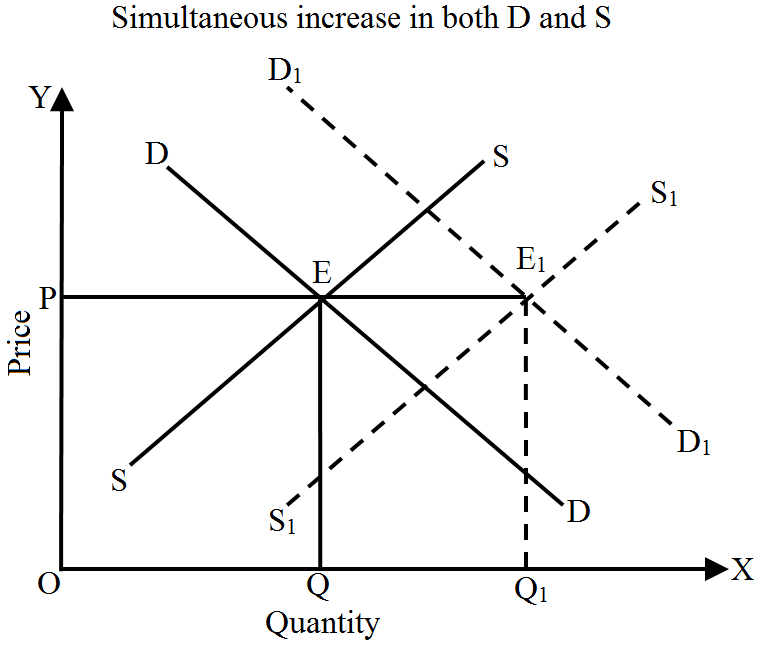
Case I: (When both demand and supply of a commodity simultaneously increase) When both demand and supply of a commodity increase in equal proportion, then there is no change in equilibrium price but the equilibrium quantity will increase.
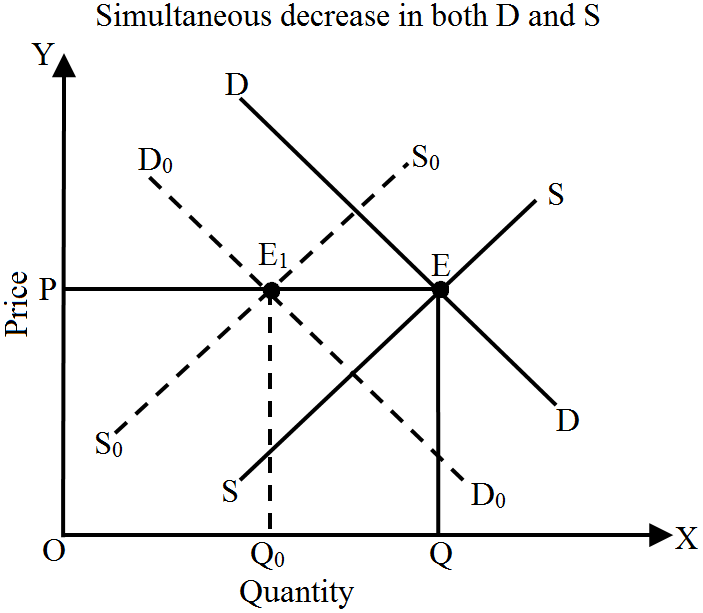
In the diagram, supply increases, so, the supply curve shifts from $SS$ to $S_1S_1$ and demand increases, so, the demand curve shifts from $DD$ to $D_1D_1$ Both demand and supply increase in equal proportion, therefore equilibrium price remains unchanged at $OP$ but equilibrium quantity increases from $OQ$ to $OQ_1$. Case II: (When both demand and supply of a commodity simultaneously decrease). When both demand and supply of a commodity decrease in equal proportion, then there is no change in equilibrium price but the equilibrium quantity will decrease.
In the diagram, supply decreases, so, the supply curve shifts from $SS$ to $S_0S_0$ and demand decreases, so, the demand curve shifts from $DD$ to $D_0D_0$. Both demand and supply decrease in equal proportion, therefore, the equilibrium price remains unchanged at $OP$ but the equilibrium quantity decreases from $OQ$ to $OQ_0$.

Need a full question paper?

Generate a complete, print-ready paper with questions like this in minutes — across 16+ boards, with answer keys.

Start Generating Free

Similar questions

From the following schedule find out the level of output at which the producer is in equilibrium. Calculate profit. Give reasons for your answer.
Output(Units)
1
2
3
4
5
6
7
Price (Rs.)
24
24
24
24
24
24
24
Total Cost (Rs.)
26
50
72
92
115
139
165
Compute mode from the following data.
ScoreFrequency
0-1010
10-2020
20-3018
30-4032
40-5021
Explain the relationship between AC and MC with the help of a diagram.
If the monopolist firm of Exercise $3$, was a public sector firm. The government set a rule for its manager to accept the goverment fixed price as given (i.e. to be a price taker and therefore behave as a firm in a perfectly competitive market), and the government decide to set the price so that demand and supply in the market are equal. What would be the equilibrium price, quantity and profit in this case?
State the phases of the law of variable proportions in terms of total physical product. Use diagram.
Explain the meaning and implications of maximum price ceiling and minimum price ceiling.
Explain the conditions of producer's equilibrium. under perfect competition.
Explain the features of free entry and exit of firms.
OR
Explain the outcome of the following features of a perfectly competitive market:
  1. Freedom to firms to enter the industry.
  2. Freedom to the firms to leave the industry.
A consumer consumes only two goods $X$ and $Y$ whose prices are Rs. $5$ and Rs. $4$ respectively. If the consumer chooses a combination of the two goods with marginal utility of $X$ equal to $4$ and that of $Y$ equal to $5$, is the consumer in equilibrium? Why or why not? What will a rational consumer do in this situation? Use utility analysis.
Explain with the help of diagram the effect of the following on the supply of a good.
  1. A rise in the rate of excise duty.
  2. A fall in the price of other goods.
  3. A fall in the price of factor inputs.