Questions

6 Marks Question

Take a timed test

67 questions · self-marked practice — reveal the answer and mark yourself.

Question 16 Marks
Explain how price is determined in a perfectly competitive market with fixed number of firms.
Answer
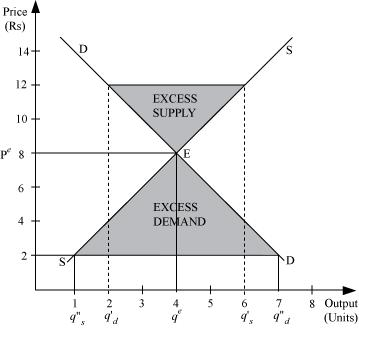
When the number of firms in a perfectly competitive market is fixed, the firms are operating in the short-run. The equilibrium price is determined by the intersection of market demand curve and supply curve. It is the price at which the market demand equals market supply. In the given figure, if at any price above $P^e$, let us say Rs. $12$, there will be an excess supply, which will increase the competition among the sellers and they will reduce the price in order to sell more output. This causes a fall in the price, finally to Rs. $8 (P^e)$, where the demand equals supply. If at any price lower than $P^e$​​​​​​​, let us say Rs. $2$, there will be an excess demand that will raise the competition among the buyers or consumers and they will be ready to pay higher price for the given output. This will increase the price to Rs. $8$ (equilibrium price), where the market will reach the equilibrium. Thus, the invisible hands of market operate automatically whenever there exist excess demand and excess supply; ensuring equilibrium in the market.
View full question & answer
Question 26 Marks
Considering the same demand curve as in exercise 22, now let us allow for free entry and exit of the firms producing commodity X. Also assume the market consists of identical firms producing commodity X. Let the supply curve of a single firm be explained as.$\text{q}^\text{s}_f=8+3\text{p for p}\geq20$
$=0\text{ for }0\leq\text{p}<20$
  1. What is the significance of p = 20?
  2. At what price will the market for X be in equilibrium? State the reason for your answer.
  3. Calculate the equilibrium quantity and number of firms.
Answer
$\text{q}_\text{s}\text{f}=8+3\text{ p for p}\geq\text{ Rs}.20$$=0\text{ for }0\leq\text{p}<\text{ Rs}. 20.$
$q^d=700-p$
For the price between 0 to 20, no firm is going to produce anything as the price in this range is below the minimum of LAC. So, at the price of Rs. 20 , the price line is equal to the minimum of LAC.
As there exists the freedom of entry and exit of firms, the minimum of AVC is at Rs. 20 , also, the price of Rs. 20 is the equilibrium price. This is because in the long run, all firms earn zero economic profit, which implies that the price of Rs. 20 is the equilibrium price and at any price lower than Rs. 20 , the firm will move out of the market.
At equilibrium price of Rs. 20
Quantity supplied $q^5=8+3 p$
$= 8 + 3 (20)$
$q^s_= 68$ units
Quantity demanded $q^d = 700 − p$
$= 700 - 2$
$q^d = 680$
Number of firms (n) $=\frac{\text{q}^\text{d}}{\text{q}^\text{s}\text{f}}$
$\text{n}=\frac{680}{68}$
$n = 10$ firms
Therefore, the number of firms in the market is 10 and the equilibrium quantity in 680 units.
View full question & answer
Question 36 Marks
How are equilibrium price and quantity affected when income of the consumers:
  1. increase?
  2. decrease?
Answer
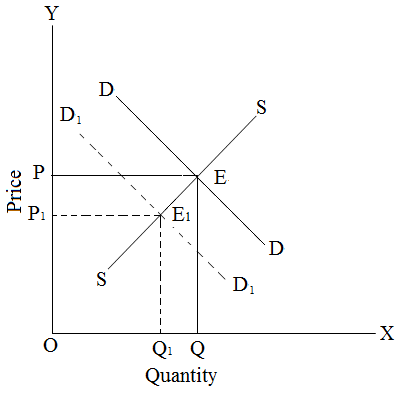
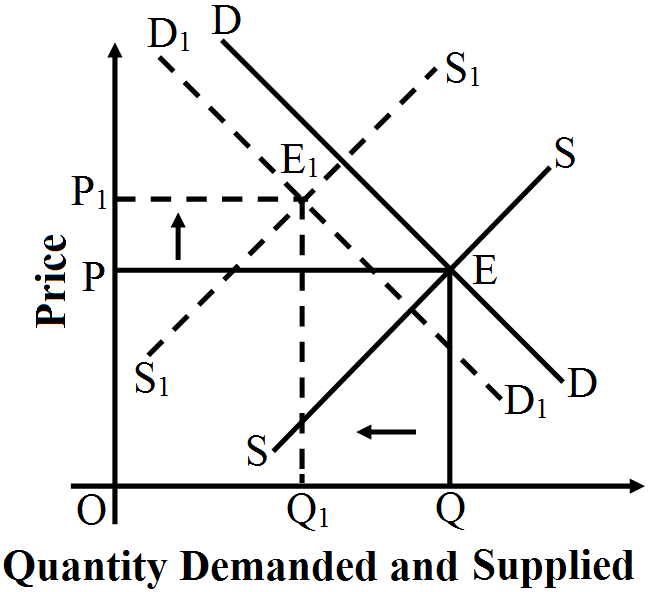
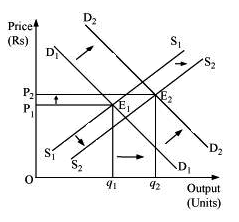
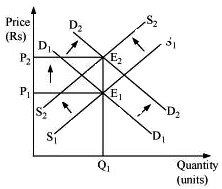
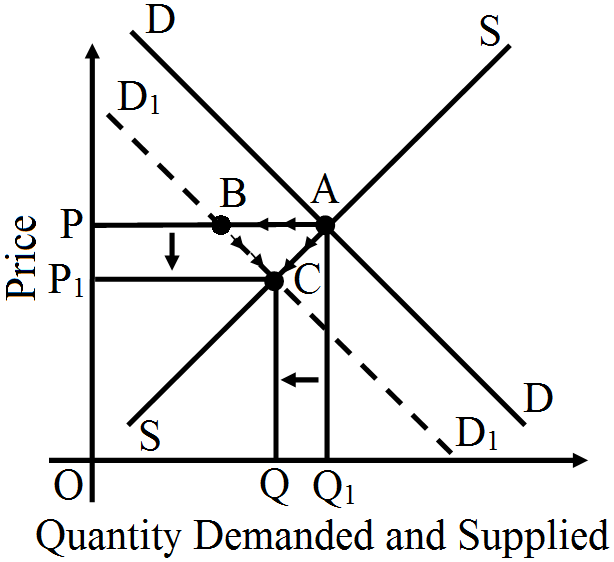
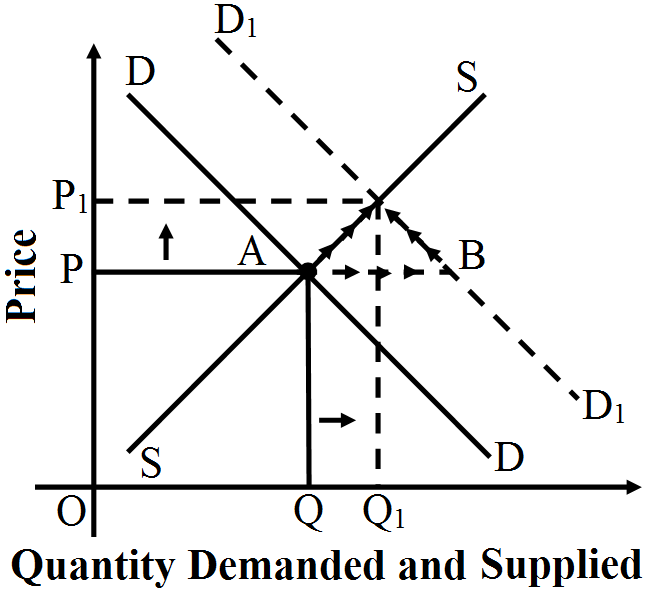
  1. When income of the consumers increase then demand will also increase. But it is possible only in case of normal goods. As result there is an increase in both equilibrium price and equilibrium quantity.
Diagram (i)
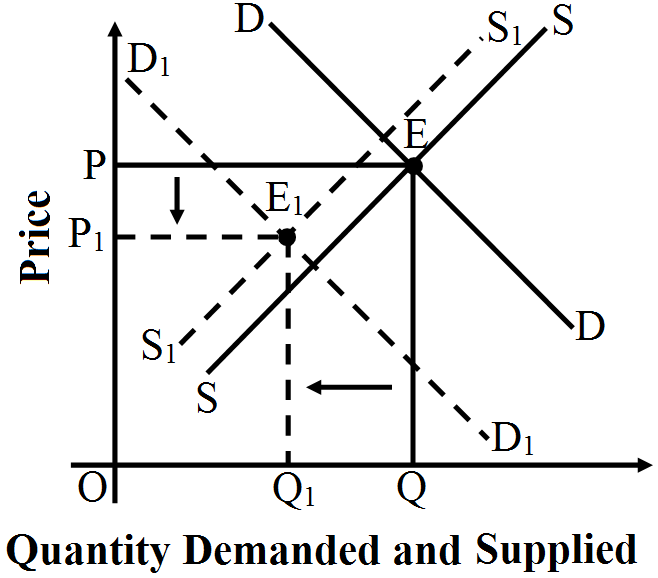
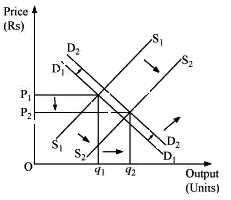
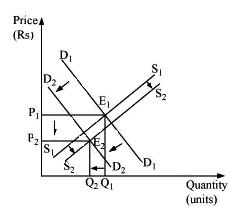
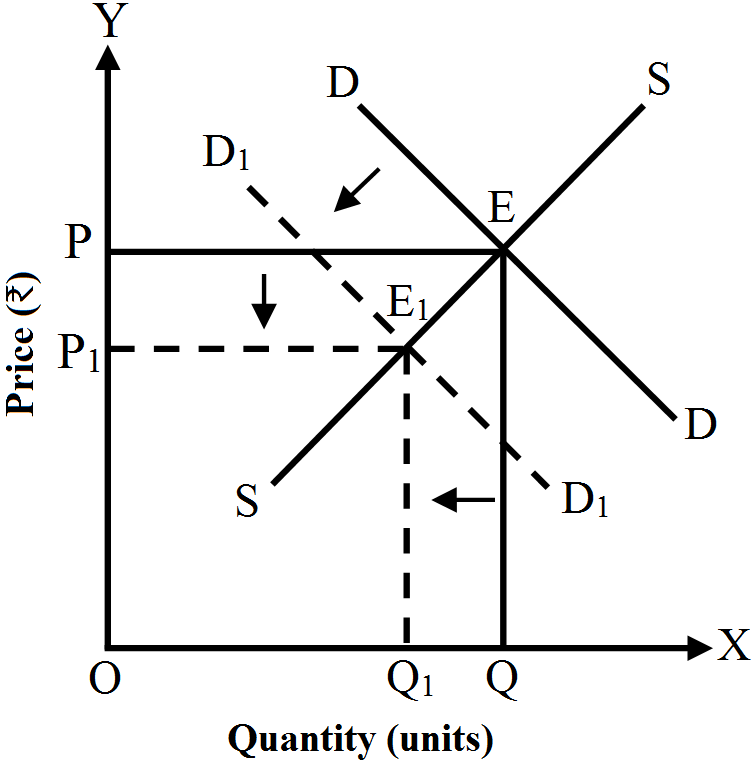
  1. When income of consumer decrease. then demand will also decrease (in case of normal goods only). As a result demand curve shifts leftward and both equilibrium price and quantity will decrease.
Diagram (ii)

View full question & answer
Question 46 Marks
What do you mean by excess demand? Explain with the help of a diagram as to what will be the effect of an excess demand on the price of the commodity.
OR
At a given price of a commodity, there is excess demand. Is this price an equilibrium price? If not, how will the equilibrium price be reached? Use diagram.
Answer
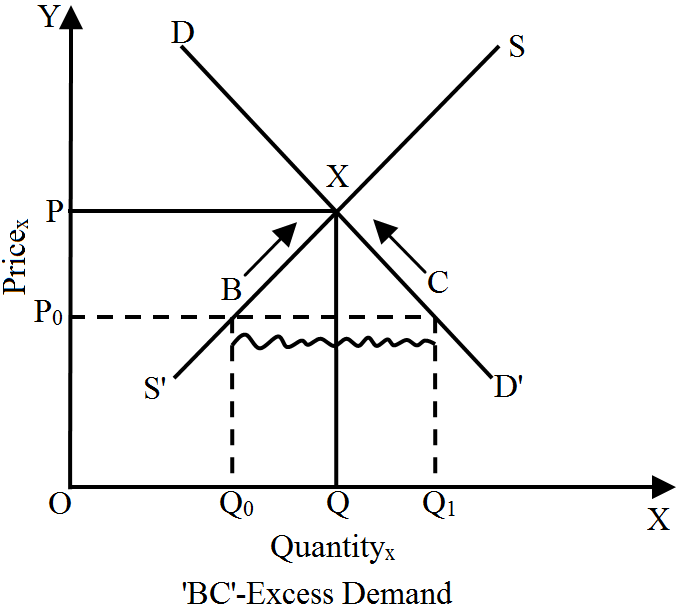
In a perfectly competitive market, at any price lower than the equilibrium price the quantity demanded of a commodity exceeds quantity supplied. It is called a situation of 'excess demand'. When there is excess demand, the equilibrium price will be higher than the price at which there is excess demand. Whenever there is excess demand, the following changes take place:
  1. As demand exceeds supply, all buyers will not be able to buy the total quantity they want to buy. So there will be competition among buyers. This will raise the price.
  2. As the price starts rising, quantity supplied starts rising as the sellers sell more when price rises (Expansion of Supply).
  3. The rise in the price of the commodity causes contraction of demand and contraction of demand will continue till the price reaches the level at which $D = S$.
  4. Thus, the excess demand will be wiped out and equilibrium price and equilibrium quantity are established.

In the given diagram, at the given price $OP_0$, the quantity demanded is $OQ_1$ while the quantity supplied is $OQ_0$. So there is excess demand to the tune of $'BC'$. As a result, buyers compete to buy what they want. So, this will raise the price which will lead to contraction of demand and expansion of supply as shown by the arrows in the diagram and these movements will continue till equilibrium is reached at point $X$ and equilibrium price is $OP$ and equilibrium quantity is $OQ$.
View full question & answer
Question 56 Marks
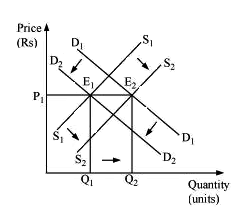
Compare the effect of shift in demand curve on the equilibrium when the number of firms in the market is fixed with the situation when entry-exit is permitted.
Answer
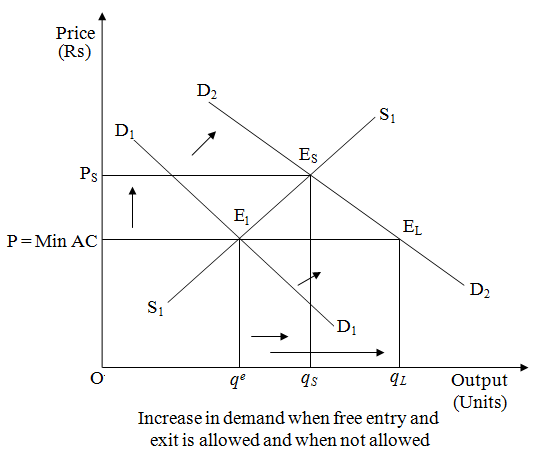
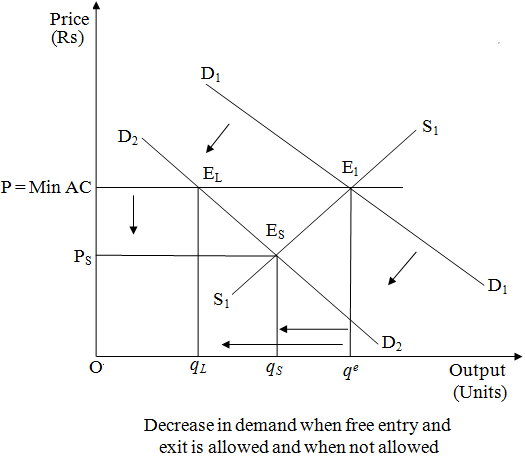
The above figure depicts the cases when the number of firms is fixed (in the short run) and when the number of firms is not fixed (in the long run). 'P = min AC' represents the long run price line, $D_1D_1$ and $D_2D_2$ represent the demands in the short run and the long run. The point $E_1$ represents the initial equilibrium where the demand curve and the supply curve intersect each other. Now, let us suppose that the demand curve shifts under the assumption that the number of firms are fixed; thus, the new equilibrium will be at $E_S$ (in the short run), where the supply curve $S_1S_1$ and the new demand curve $D_2D_2$ intersect each other. The equilibrium price is $P_S$ and equilibrium quantity is $q_S$. Now let us analyses the situation under the assumption of free entry and exit. The increase in demand will shift the demand curve rightwards to $D_2D_2$. The new equilibrium will be at $E_2$. It is the long run equilibrium with equilibrium price (P) = min AC and equilibrium quantity $q_1$. Therefore, on comparing both the cases, we find that when the firms are given the freedom of entry and exit, the equilibrium price remains same and the price is lower than the short run equilibrium price $(P_S)$; whereas, the long run equilibrium quantity $q_L$ is more than that of the short run equilibrium $(q_S)$. Similarly, for leftward demand shift, it can be noted that the short run equilibrium price $(P_S)$ is less than the long run equilibrium price and the short run equilibrium quantity $(q_S)$ is less than the long run equilibrium quantity $q_L​​​​​​​$​​​​​​​.
View full question & answer
Question 66 Marks
Suppose the demand and supply curves of salt are given by:
$q^D = 1,000 - p$
$q^s =700 + 2p$
  1. Find the equilibrium price and quantity.
  2. Now suppose that the price of an input used to produce salt has increased so that the new supply curve is. $q^s = 400 + 2p$ How does the equilibrium price and quantity change? Does the change conform to your expectation?
  3. Suppose the government has imposed a tax of Rs. 3 per unit of sale of salt. How does it affect the equilibrium price and quantity?
Answer
$q^D = 1000 - p - (1)$
$q^s = 700 + 2p - (2)$
  1. At equilibrium $q^d = q^s$​​​​​​​ 
$1000 - p = 700 + 2p$
$300 = 3p$
$100 = p$
$p = Rs. 100$
$q^d = 1000 - 100$ [Substituting the value of p in equation (1)]
$= 900$ units
So, the equilibrium price is Rs. 100 and equilibrium quantity is 900 units.
  1. New quantity supplied $q'_s$
$q'_s= 400 + 2p$
At equilibrium $q^d_= q'_s$
$1000 - p = 400 + 2p$
$600 = 3p$
$200 = p$
$p = Rs. 200$
Prior to the increase in the price of input, the equilibrium price was Rs. 100, and after the rise in input’s price, the equilibrium price is Rs. 200.
So the change in the equilibrium price in Rs. 100 (200 – 100).
$q^d = 1000 - 200$ [Subtitling the value of p in equation (1)]
$= 800$ units
The change in the equilibrium quantity is 100 units (i.e. 900 – 800 units).
Yes, this change is obvious, as due to the change in the input’s price, the cost of producing salt has increased that will shift the marginal cost curve leftward and move the supply curve to the left. A leftward shift in the supply curve results in a rise in the equilibrium price and afall in the equilibrium quantity.
  1. The imposition of tax of Rs. 3 per unit of salt sold will raise the cost of producing salt. This will shift the supply curve leftwards and the quantity supplied equation will become.
$y^s= 700 + 2 (p – 3)$​​​​​​​
At equilibrium
$y^d = y^s$
$1000 - p = 700 + 2 (p - 3)$
$1000 - p = 700 + 2p - 6$
$306 = 3p$
$\frac{306}{3}=\text{p}$
$p = Rs. 102$
Substituting the value of p in equation (1)
$y^d = 1000 - p$
$y^d = 1000 - 102$
$y^d = 898$ units
Thus, the imposition of tax of Rs. 3 per unit of salt sold will result in an increase in the price of salt from Rs. 100 to Rs. 102. The equilibrium quantity falls from 900 units to 898 units.
 
View full question & answer
Question 76 Marks
Market for a good is in equilibrium. There is an 'increase' in demand for this good. Explain the chain of effects of this change. Use diagram.
Answer
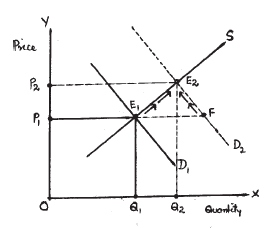
  • ‘Increase ‘ in demand shifts the demand curve from $D1$ to $D2$ to the right leading to excess demand $E_1$ F at the given price $OP_1$.
  • Since the consumers will not be able to buy all they want to buy at this price, there will be competition among buyers leading rise in price.
  • As price rises, demand starts falling (along $D_2$) and supply starts rising (along S) as shows by arrows in the diagram.
  • This change continue till $D$ and $SS$ are equals at $E_2$.
  • The quantity rises to $OQ_2$ and price to $OP_2.$
View full question & answer
Question 86 Marks
Market for a good is in equilibrium. There is simultaneous "increase". both in demand and supply of the good. Explain its effect on market price.
Answer
There are three possibilities:
  1. If the relative (percentage) increase in demand is greater than the increase in supply, price will rise.
The price will rise because of excess demand in the market.
  1. If the relative (percentage) increase in demand is less than the increase in supply, price will fall.
The price will fall because of excess supply in market.
  1. If the relative (percentage) increase in demand is equal to the increase in supply, price will remain unchanged.
The price will remain unchanged because there is neither excess demand nor excess supply in the market.
View full question & answer
Question 96 Marks
Explain the chain of effect of excess demand of a good on its equilibrium price.
Answer
  • Excess demand for goods creates competition among the buyers because the buyers will not be able to buy all they want to buy at the existing price. This will lead to rise in price.
  • Rise in price will lead to fall in demand and rise in supply.
  • The change will continue till demand for the good equals to its supply and the market is in equilibrium again.
View full question & answer
Question 106 Marks
Giving reasons, distinguish between the behaviour of demand curves of firms under perfect competition and monopolistic competition.
Answer
Demand Curve of the Firm under Perfect Competition
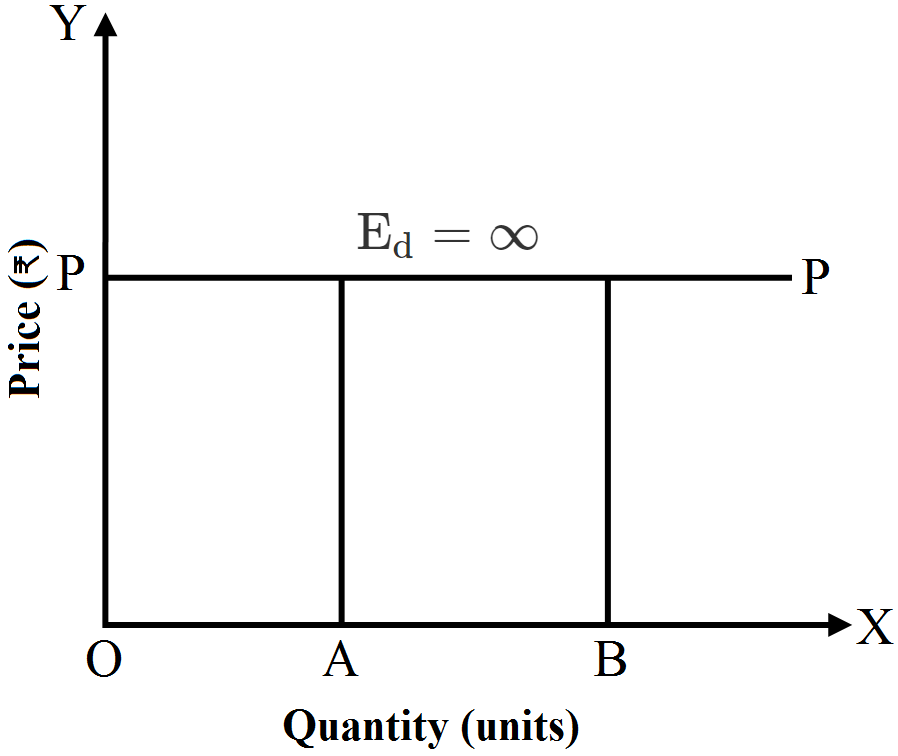
Demand curve is perfectly elastic. It means that a firm can sell any amount of the commodity at the prevailing price. Even a fractional rise in price would wipe out entire demand for the firm's product. Firm's demand curve is indicated by a horizontal straight line parallel to X-axis. Demand Curve of the Firm under Monopolistic Competition
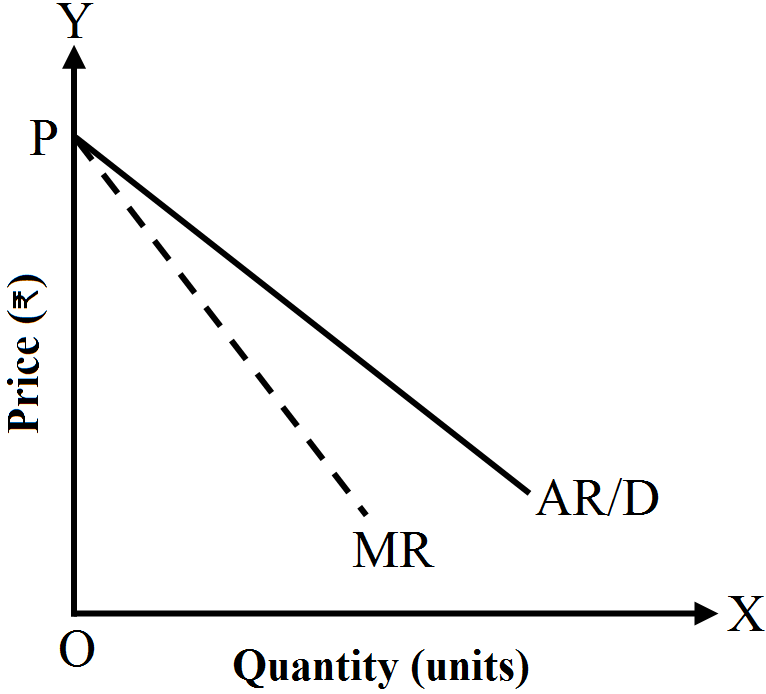
Under monopolistic competition, the firm faces a negatively sloped demand curve. It means that a large quantity of the commodity can be sold only by decreasing its price, the demand curve is also more elastic. It is because of availability of close substitutes in the market.
View full question & answer
Question 116 Marks
How is the equilibrium price and equilibrium quantity of a normal commodity affected by an increase in the income of its buyers? Explain with the help of a diagram.
OR
Explain the effect of increase in income of buyers of a 'normal' commodity on its equilibrium price.
Answer
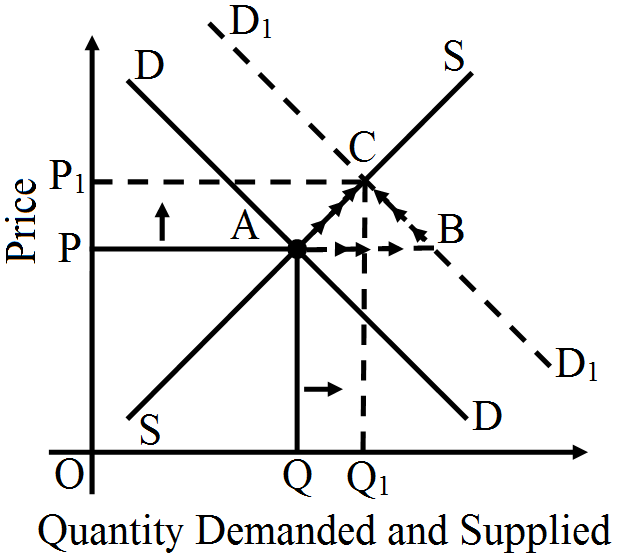
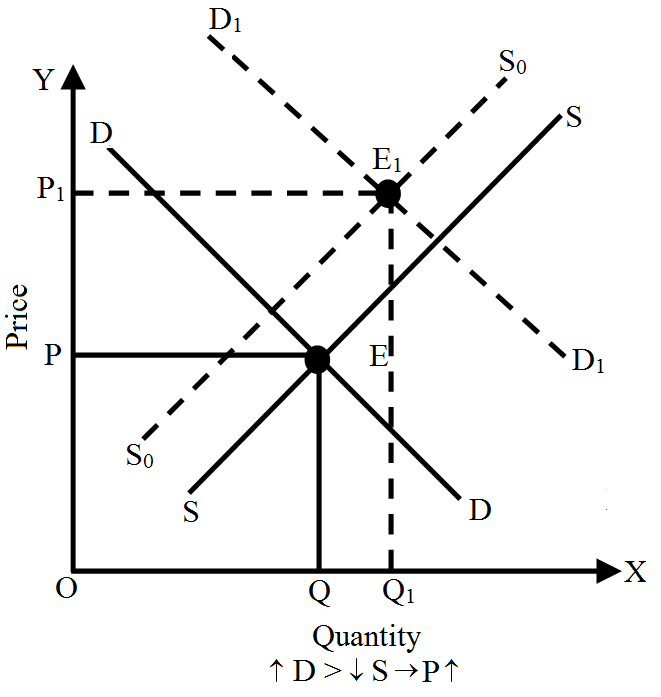
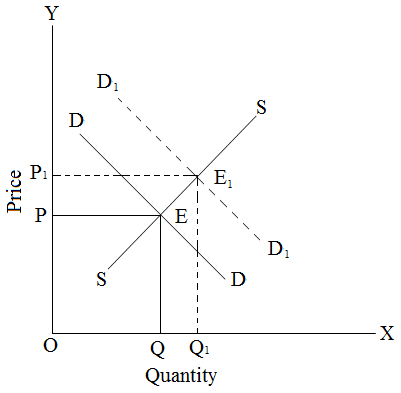
As, we know normal goods are those whose quantity demanded varies positively with the change in income. As given in the examination problem if income of a consumer rises and goods consumed is normal goods equilibrium price and equilibrium quantity both rise. It can be shown with the help of the given figure.
In the given figure, price of normal goods is measured on vertical axis and quantity demanded and supplied is measured on horizontal axis. Initially, the equilibrium price is $OP$ and equilibrium quantity is $OQ$. But as given in the question when income of a consumer rises the demand of normal goods increases shifting the demand curve to the right from $DD$ to $D_1D_1$. With new demand curve $D_1D_1$, there is excess demand at initial price $OP$ because at price $OP$ demand is $PB$ and supply is $PA$; so there is excess demand of $AB$ at price $OP$. Due to this excess demand, competition among the consumer will raise the price. With the rise in price there is upward movement along the demand curve (contraction in demand) from $B$ to $C$ and similarly, there is upward movement along the supply curve (expansion in supply) from $A$ to $C$. So, finally, equilibrium price rises from $OP$ to $OP_1$, and equilibrium quantity also rises from $OQ$ to $OQ_1$. Conclusion: Due to increase in income of a buyer for normal goods,
  1. Equilibrium price rises from $OP$ to $OP_1$.
  2. Equilibrium quantity also rises from $OQ$ to $OQ_1$.
View full question & answer
Question 126 Marks
How will an increase in the income of the buyers of an ‘inferior good’, affect its equilibrium price and equilibrium quantity? Explain with the help of a diagram.
Answer
Increase in the income of buyers of an inferior good will result in decrease in its demand. It means the demand curve will shift to the left as shown in the diagram:
The given equilibrium price and quantity are $OP$ & $OQ$ respectively- Increase in income results in a leftward shift of demand curve $(dd^1)$. At price $OP$ now quantity demanded is $OQ_2$ which is less than the quantity supplied $(OQ)$. This will result in competition among sellers leading to a fall in price. A fall in price will result in downward movement along the demand curve and supply curve as per law of demand and law of supply. This is shown by arrows in the diagram. These changes will continue till the price falls to a level at which quantity demanded and supplied are equal. This price in the diagram is $OP_1$. The new equilibrium price $OP_1$​​​​​​​ is lesser than the old equilibrium price $(OP)$. The new equilibrium quantity $(OQ_1)$ is also less than the old equilibrium quantity $(OQ)$.
View full question & answer
Question 136 Marks
A consumer consumes only two goods $X$ and $Y$. Explain the conditions of consumer’s equilibrium using Marginal Utility Analysis.
Answer
The conditions of consumerto be in equilibrium are:
  1. $\frac{\text{MU}_{\text{x}}}{\text{P}_{\text{x}}}=\frac{\text{MU}_{\text{y}}}{\text{P}_{\text{y}}}$
  2. $MU$ falls as more of a good is consumed.
Explanation:
  1. suppose $MU_x$ is greater than $MU_y$. This shows that per rupee $MU_x$ is higher than per rupee $MU_y$. The consumer is induced to buy more of $X$ and less of $Y$. This continues till falls and $MU_y$​​​​​​​ rises enough to make $\frac{\text{MU}_{\text{x}}}{\text{P}_{\text{x}}}=\frac{\text{MU}_{\text{y}}}{\text{P}_{\text{y}}}$ i.e. to reach back to the equilibrium.
  2. The condition that falls as more of good $X$ is consumed is required because unless it is not so the consumer may end up consuming only one good and not reach equilibrium.
View full question & answer
Question 146 Marks
Market for a good is in equilibrium. There is increase in supply for this goods. Explain the chain of effects of this change. Use diagram.
OR
How will equilibrium price and quantity be affected when there is increase in supply?
OR
Explain the chain effect of increase in supply of a good on its price, supply and demand. Use diagram.
OR
How does an increase in supply of a commodity affect its equilibrium price and equilibrium quantity? Explain with the help of a diagram.
OR
Market for a good is in equilibrium. Supply of the good 'increases'. Explain the chain of effects of this change.
Answer
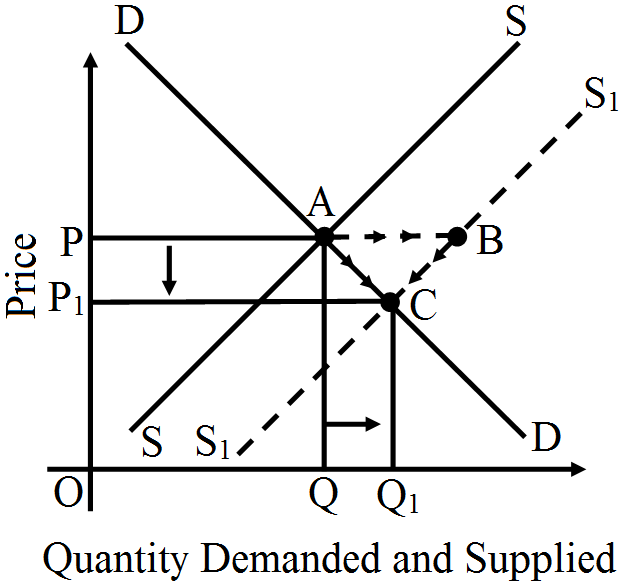
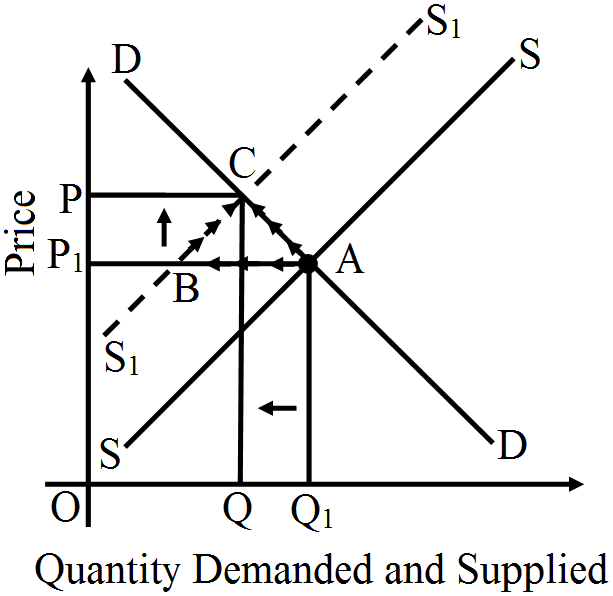
As given in the examination problem that market for a good is in equilibrium. So, we assume that initial price is $OP$ as shown in given figure.
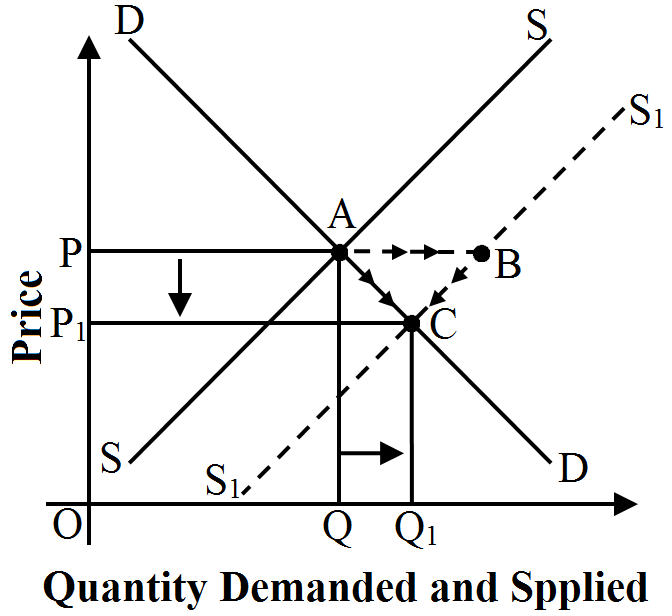
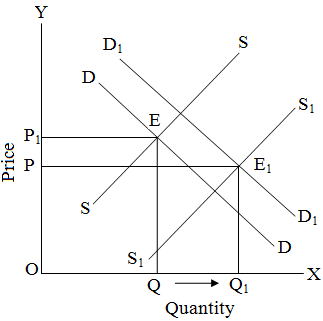
In the given figure price is on vertical axis and quantity demanded and supplied is on horizontal axis. But due to increase in supply the supply curve shifts rightward from $SS$ to $S_1S_1$. With new supply curve $S_1S_1$ there is excess supply at initial price $OP$ because at price $OP$, supply is $PB$ and demand is $PA$, so there is excess supply of $AB$ at price $OP$. Due to this excess supply competition among the producer will make the price fall. Due to this fall in price there is downward movement along the supply curve (Contraction in supply) from $B$ to $C$ and similarly, there is downward movement along the demand curve (Expansion in demand) from A to C. So, finally, equilibrium price falls from $OP$ to $OP$, and equilibrium quantity rises from $OQ$ to $OQ_1$. Conclusion: Due to increase in supply,
  1. Equilibrium price falls from $OP$ to $OP_1$.
  2. Equilibrium quantity rises from $OQ$ to $OQ_1$.
View full question & answer
Question 156 Marks
Market for a good is in equilibrium. There is 'decrease in demand for this good. Explain the chain of effects of this change. Use diagram.
OR
Market for a good is in equilibrium. The demand for the good 'decreases'. Explain the chain of effects of this change.
OR
Market of a good is in equilibrium. If the demand for the good decreases'. Explain the chain of effects of this change.
Answer
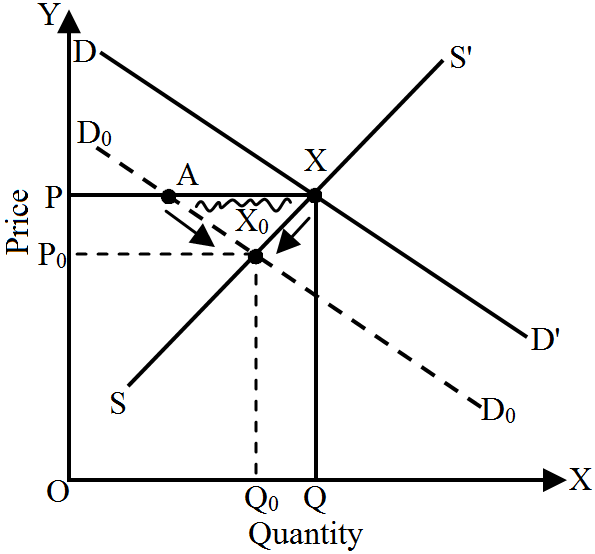
$DD'$ in the diagram shows the original demand curve and $SS'$ shows the original supply curve of the given commodity. Point $X$ denotes the point of equilibrium because both the above curves ($DD'$ and $SS'$) intersect at this point .$\therefore\text{Demand}=\text{Supply}$
$OP$ denotes the original equilibrium price and $OQ$ denotes the original equilibrium quantity. Now, When the demand for the product “decreases", the demand curve shifts to the left from $DD'$ to $D_0D_0$. This creates "excess supply" ‘AX’ at the given price $OP$.
The excess supply leads to a competition between the sellers, which results in a fall in the price from $OP$ to $OP_0$. This fall in price leads to a rise in demand along $D_0D_0$​​​​​​​ and fall in supply along $SS'$ curve (as indicated by the arrows). This trend will continue till the market reaches at the new equilibrium point $X_0$​ and the equilibrium price falls from $OP$ to $OP_0$ and equilibrium quantity also falls from $OQ$ to $OQ_0$​​​​​​​.
View full question & answer
Question 166 Marks
What would be an effect on equilibrium price and equilibrium quantity when demand and supply both shift leftward?
OR
There is simultaneously decrease in demand and supply of a commodity, when it will result in:
  1. No change in equilibrium price (Case I).
  2. A fall in equilibrium price. (Case III).
OR
Market for a good is in equilibrium. There is simultaneous "decrease" in both demand and supply of the goods. Explain its effect on market price.
Answer
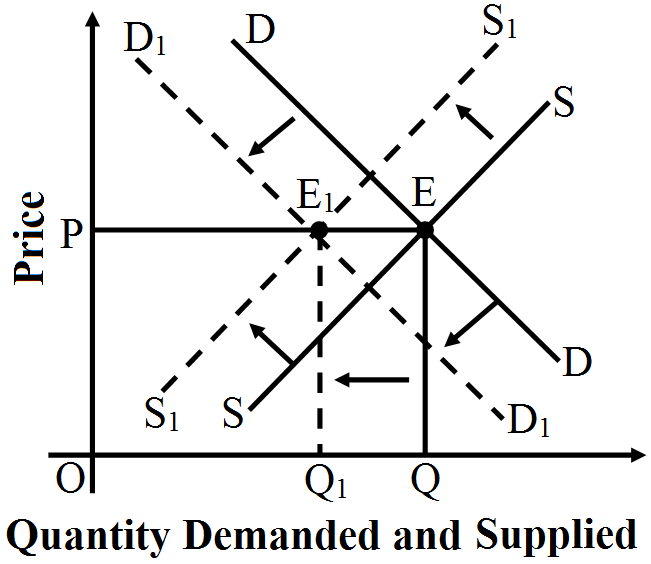
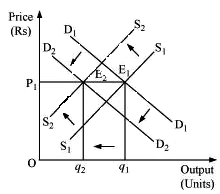
There are following three cases: Case I: When demand and supply both decrease at the same rate The given diagram price is measured on vertical axis and quantity demanded and supplied is measured on horizontal axis. Initially, the equilibrium price is $OP$ and equilibrium quantity is $OQ$. But when "supply decreases and demand also decreases but at a same rate then,
  1. Equilibrium price remains constant at $OP$.
  2. Equilibrium quantity falls from $OQ$ to $OQ_1$.

Case II: When demand decreases, supply also decrease but at a much faster rate In the given diagram price is measured on vertical axis and quantity demanded and supplied is measured on horizontal axis. Initially, the equilibrium price is $OP$ and equilibrium quantity is $OQ$. But when "demand decreases and supply also decreases but at a much faster rate" then,
  1. Equilibrium price rises from $OP$ to $OP_1$.
  2. Equilibrium quantity falls from $OQ$ to $OQ_1$.

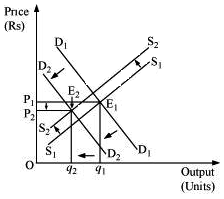
Case III: When supply decreases, demand also decreases but at a must faster rate In the given diagram price is measured on vertical axis and quantity demanded and supplied is measured on horizontal axis. Initially, the equilibrium price is $OP$ and equilibrium quantity is $OQ$. But when "supply decreases and demand also decreases but at a much faster rate" then,
  1. Equilibrium price falls from $OP$ to $OP_1$.
  2. Equilibrium quantity also falls from $OQ$ to $OQ_1​​​​​​​$​​​​​​​.
View full question & answer
Question 176 Marks
How is equilibrium price of commodity determined? What happens if the market price is more than the equilibrium price?
Answer
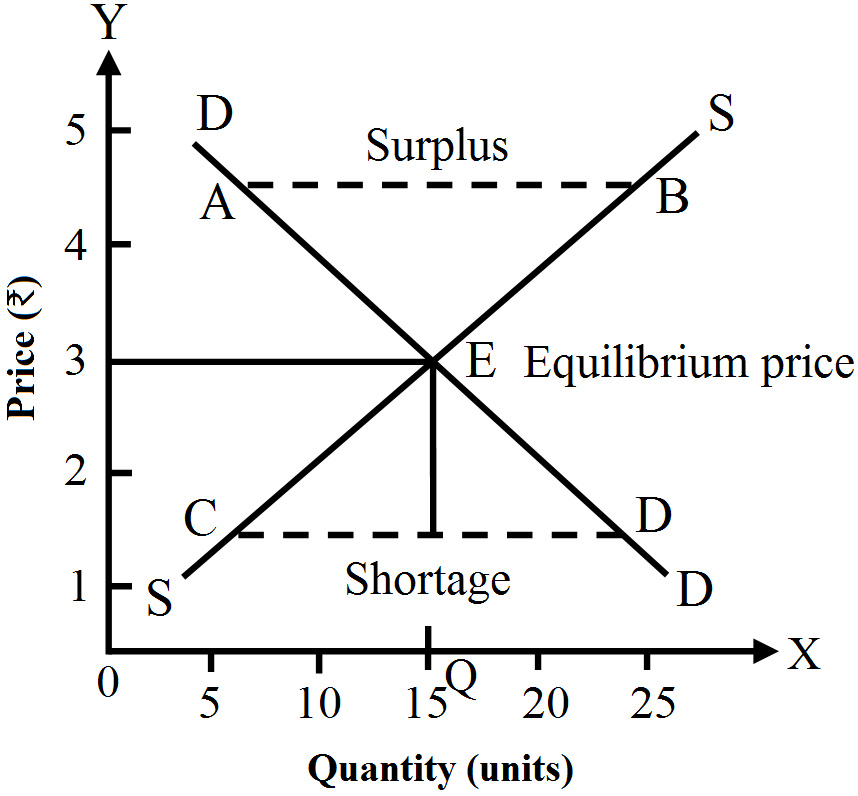
The equilibrium price is the price at which market demand and market supply are equal to each other as shown in following schedule and diagram:
Price (₹) Demand tor X (units) Suppty ol X (untis) Statement
1 25 5 D > S
2 20 10
3 15 15 Equilibrium Price (D = S)
4 10 20 D < S
5 5 25
When price is ₹ 5, the supply of commodity X is 25 units. With a view to increase their sales, the seller will reduce the price. At ₹ 3 demand and supply of commodity X becomes equal to 15. Hence, ₹ 3 is the equilibrium price. In the given figure, demand and supply of commodity X are equal at E point. Equilibrium price is OP at ₹ 3. If market price is ₹ 4, the demand will be (10) less than supply (20), excess supply will force the market price to slide down till the equilibrium between supply and demand is struck. Thus, equilibrium price will be restored in the free market economy.
View full question & answer
Question 186 Marks
With the help of a diagram explain the effect of “decrease” in demand of a commodity on its equilibrium price and quantity.
Answer
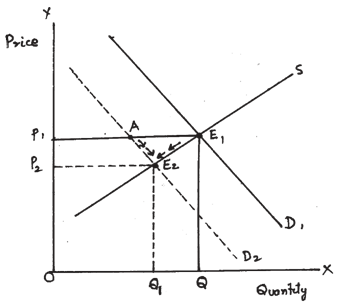
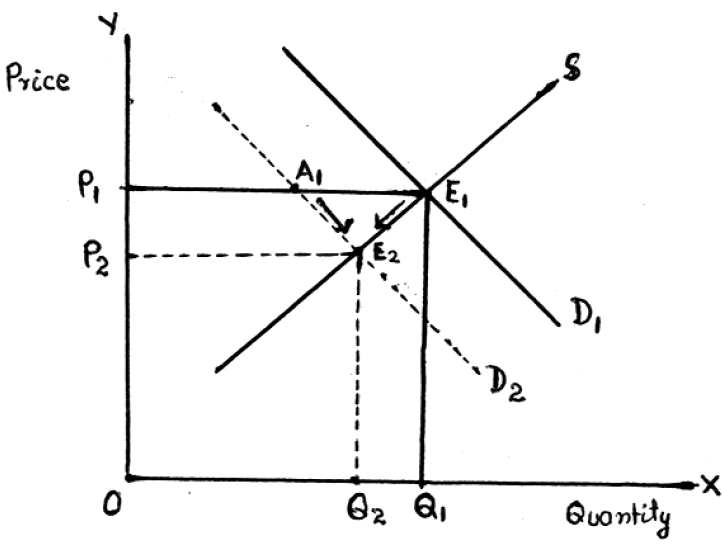
Decrease in demand means less demand at the same price. This leads to shift of demand curve to the left from $D_1$ to $D_2$.
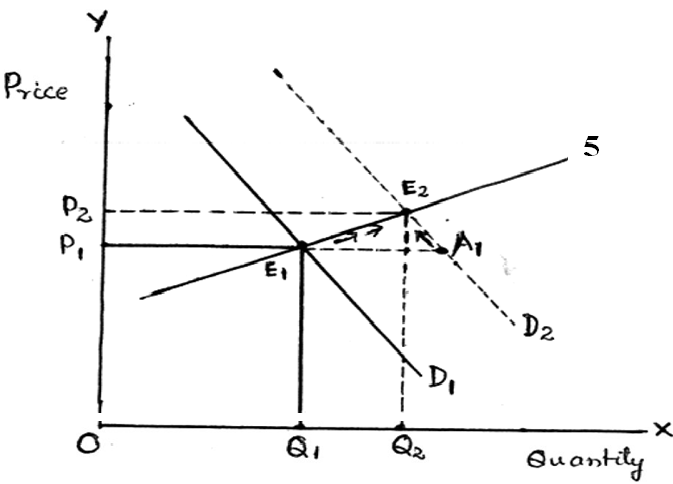
  • Given equilibrium at $E1$ shift of demand curve leads to excess supply $= AE_1$ at price $OP_1$.
  • This creates a situation where producers are not able to sell all they want to sell at price $OP_1$. They start offering lower price. As a result price starts falling.
  • As price falls, supply begins to fall along the supply curve S and demand begins to rise along the demand curve $D_2$​​​​​​​.
This continues till the new equilibrium at $E_2​​​​​​​$.
  • At new equilibrium, price falls to $OP_2$ and quantity falls to $OQ_1​​​​​​​$​​​​​​​.
View full question & answer
Question 196 Marks
Market of a commodity is in equilibrium. Demand for the commodity ‘decreases’. Explain the chain of effects of this change till the market again reaches equilibrium. Use diagram.
Answer

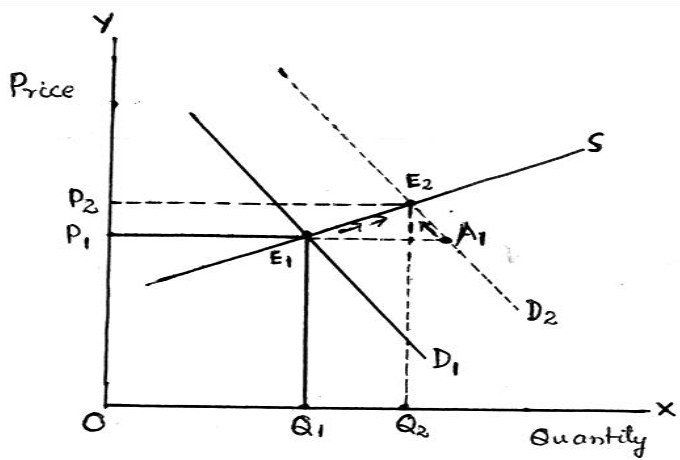
  • $OP_1$ is the equilibrium price and $OQ_1$ is the equilibrium quantity. Demand decreases so that demand curve shifts to the left. The new demand curve is $D_2$.
  • This creates an excess supply $(A_1E_1)$ at the existing price $OP_1$.
  • The excess supply creates competition among sellers, resulting in fall in price.
  • Fall in price leads to rise in demand and fall in supply as indicated by the arrows.
  • These changes continue till the market reaches new equilibrium at $E_2$ with a lower price $OP_2$ and lower quantity $OQ_2$.
View full question & answer
Question 206 Marks
How is the equilibrium price and equilibrium quantity of a normal commodity affected by an increase in the income of its buyers? Explain with the help of a diagram.
Answer
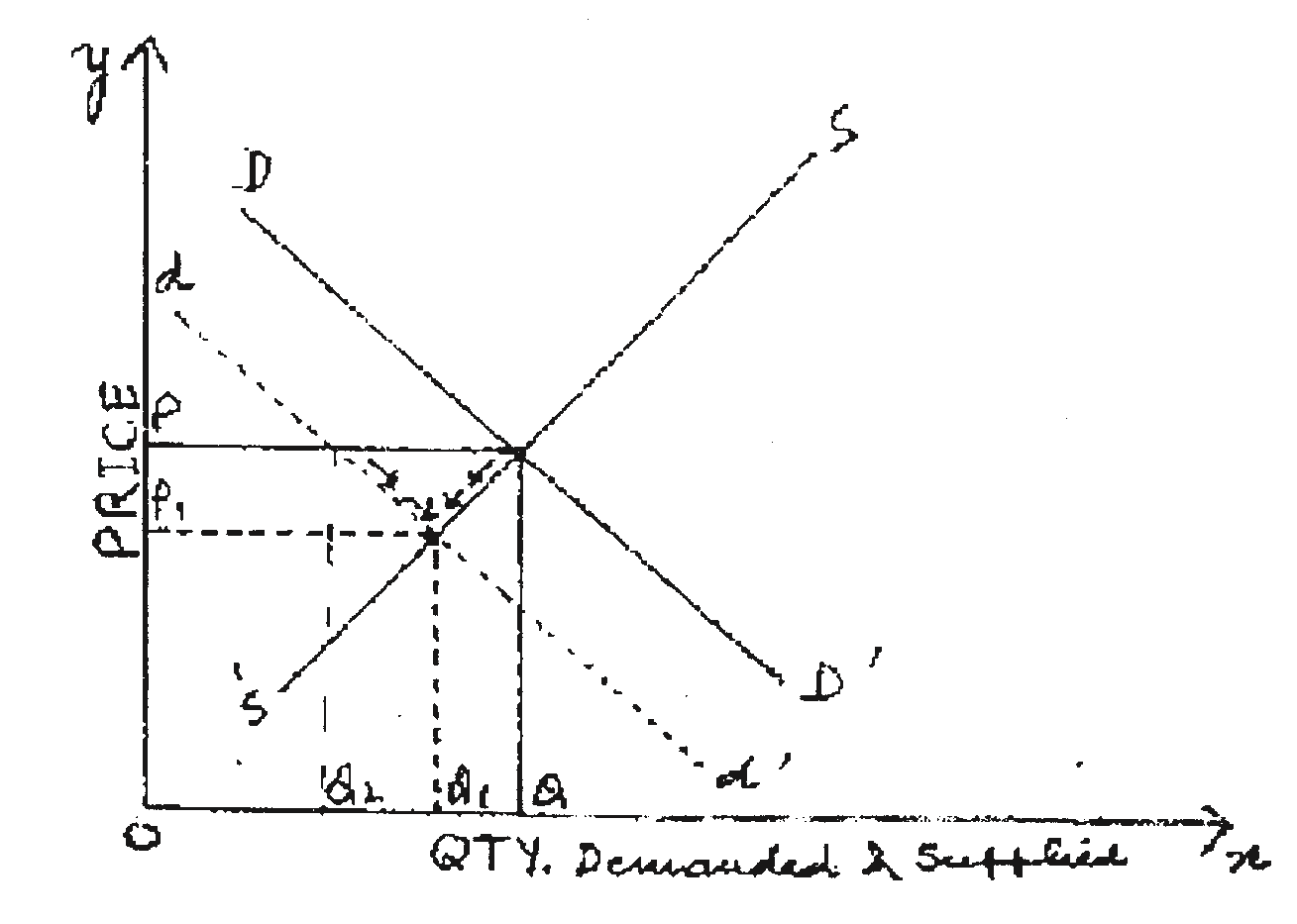
An increase in the income of the buyers of a normal commodity results in an increase in its demand. (more demand at the same price) An increase in demand results in a rightward shift of demand curve as shown by dotted demand curve in the diagram.

Explanation:
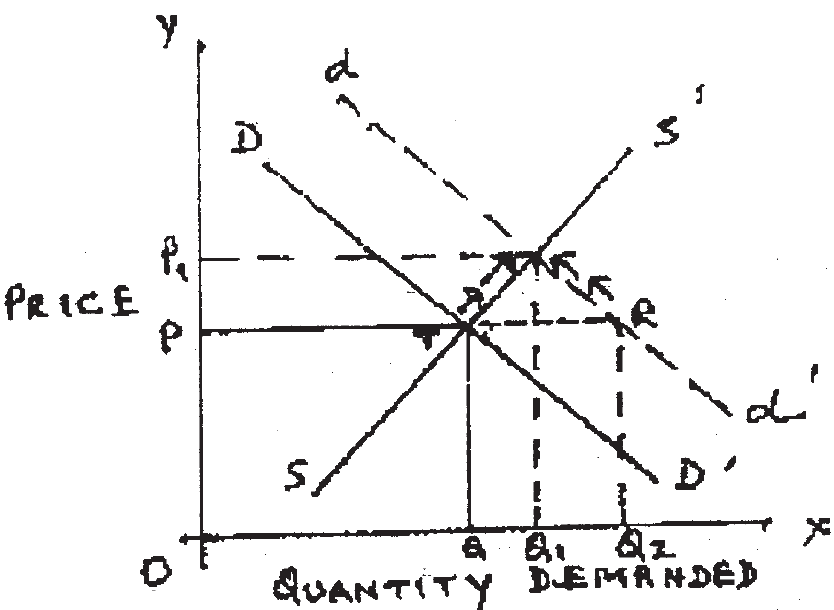
The given equilibrium price and quantity are $OP$ and $OQ$ respectively, Increase in income results in a rightward shift of demand curve $(dd’)$. At price $OP$ now the quantity demanded is $OQ_2$ which is more than the quantity supplied $(OQ)$. This will result in competition among buyers leading to a rise in price. A rise in price will result in an upward movement along the demand curve and supply curve as per the law of demand and law of supply. This is shown by the arrows in the diagram. These changes will continue till the price rises to a level at which quantity demanded and supplied are equal. This price in the diagram is $OP_1$​​​​​​​. The new equilibrium price $(OP_1)$ is greater than old equilibrium price $(OP)$. The new equilibrium quantity $(OQ_1)$ is also greater than old equilibrium quantity $(OQ)$.
View full question & answer
Question 216 Marks
State whether the following statements are true or false. Give reasons for your answer:
  1. When equilibrium price is greater than market price there will be excess supply in the market.
  2. X and Y are complementary goods. A fall in the price of Y will result in a rise in the price of X.
Answer
  1. False, because since market price is lower than equilibrium price, market demand will be higher than market supply leading to excess demand.
  2. True. When price of Y falls,its demand rises. Since X is complementary of Y, and both must be used together, demand for X increases. Since the rise in demand for X is due to a factor other than own price of X, price of X increases.
View full question & answer
Question 226 Marks
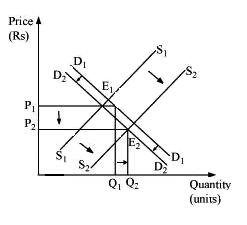
How do the equilibrium price and quantity of a commodity change when price of input used in its production changes?
Answer
The change in the price of input alters the cost of production of a commodity. Let us analyze the two different cases.
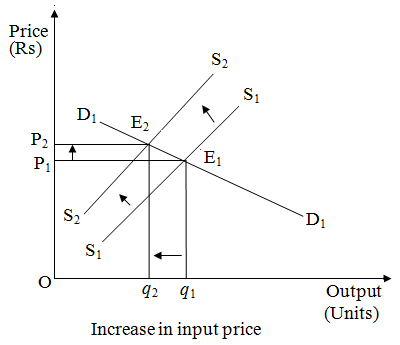
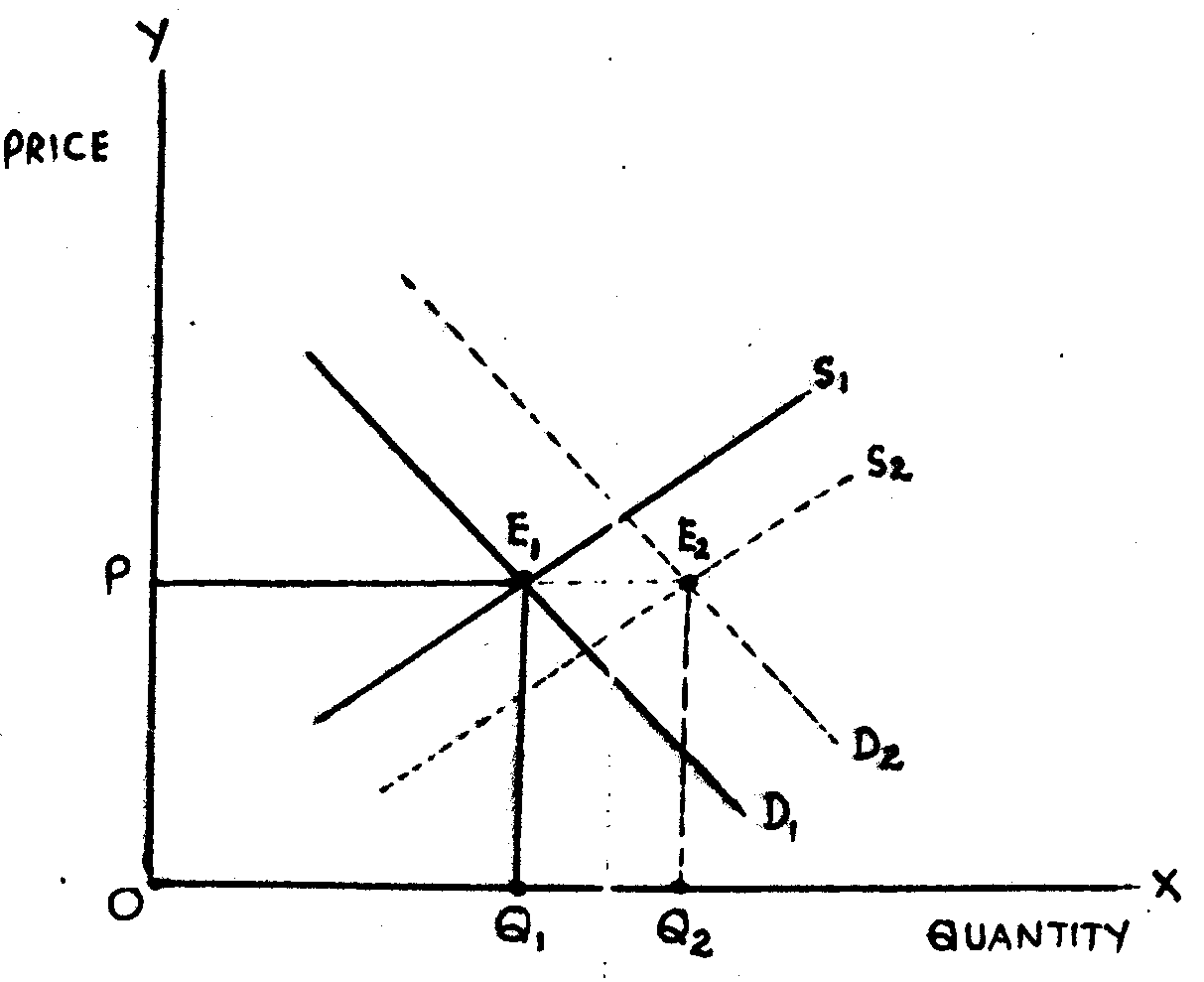
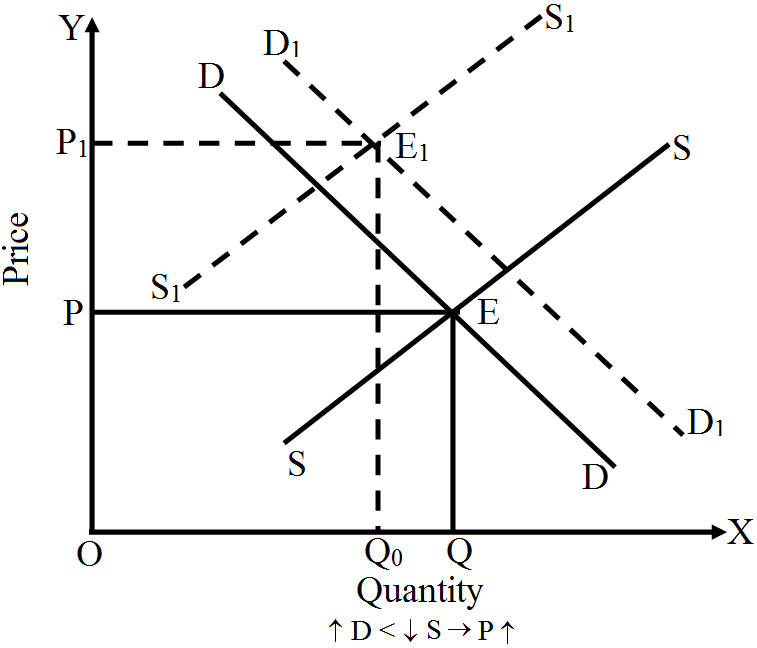
  1. Increase in input price: If the input price of a firm increases, the cost of production will also increase, the supply of product will decrease and the profit margin will also fall which will discourage the firm's incentive to produce and supply the commodity. This will lead to a left upward shift of the marginal cost curve, which further will lead to a leftward parallel shift of an individual firm's supply curve and finally a leftward shift of the market supply curve. The demand curve remaining the same, the new equilibrium will occur at $E_2$ with higher equilibrium price $(P_2)$ and lower quantity of output $(q_2)$.
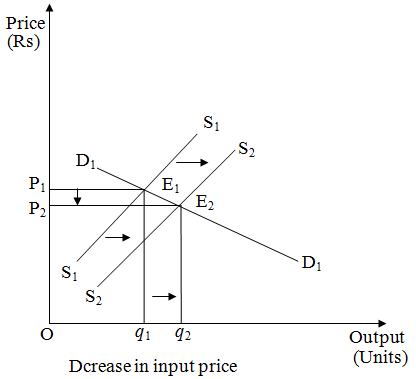
  1. Decrease in input price: If an input price of a firm decreases, then the cost of production will decrease, the supply of product will increase and the profit margin wll also rise. This will shift the marginal cost curve rightward, which implies that the firm's supply curve will also shift rightward. Consequently, the market supply curve will shift rightward parallelly from $S_1S_1$ to $S_2S_2$. Demand curve remaining the same, the new equilibrium will occur at $E_2​​​​​​​$ with lower equilibrium price $(P_2)$ and higher quantity level of output $(q_2)$.
View full question & answer
Question 236 Marks
Market for a good is in equilibrium. There is simultaneous "decrease" both in demand and supply of the good. Explain its effect on market price.
Answer
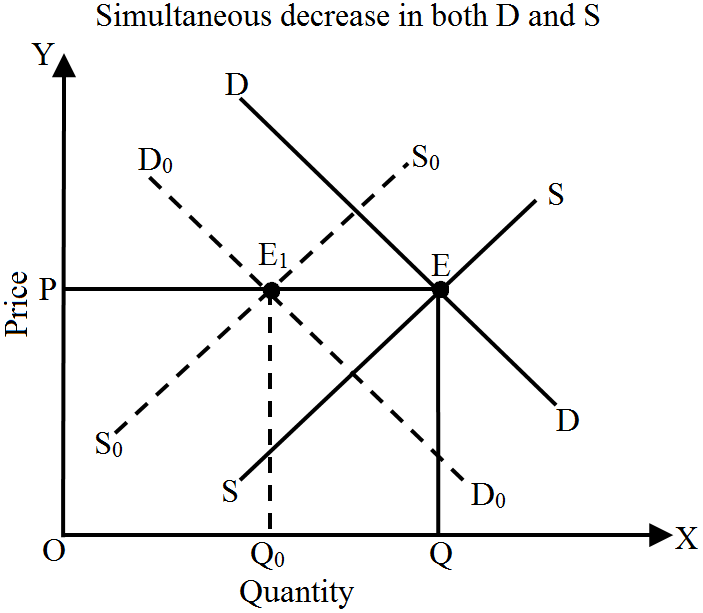
There are three possibilities:
  1. If the relative (percentage) decrease in demand is greater than the decrease in supply, price will fall.
The price will fall because of excess supply in the market.
  1. If the relative (percentage) decrease in demand is less than the decrease in supply price will rise.
The price will rise because of excess demand in the market.
  1. If the relative (percentage) decrease in demand is equal to the decrease in supply, price will remain unchanged.
The price will remain unchanged because there is neither excess demand nor excess supply in the market.
View full question & answer
Question 246 Marks
How are the equilibrium price and quantity affected when:
  1. both demand and supply curves shift in the same direction?
  2. demand and supply curves shift in opposite directions?
Answer
  1. demand and supply curves shift in the same direction.
S.No Cases Equilibrium Price Equilibrium Price Figure
1. Increase in Dd = Increase in supply Unchanged Increases
2. Increase in Dd more than increase SS Increases Increases
3. Increase in Dd less than increase in SS Falls Increases
4. Decrease in Dd = decrease in SS Unchanged Falls
5. Decrease in Dd more than decrease in SS Falls Falls
6. Decrease in Dd less than decrease in SS Increases Falls
  1. demand and supply curves shift in opposite direction.
S.No
Cases
Equilibrium Price
Equilibrium Quantity
Figure
1. Increase in Dd = decrease in SS Increase Unchanged
2. Decrease in Dd = increase in SS Unchanged Increase
3. Decrease in Dd < increase in supply Decrease Increase
4. Decrease in Dd > increase in supply Decrease Decrease
5. Increase in Dd < decrease in SS Increase Decrease
6. Increase in Dd > decrease in SS Increase Increase
View full question & answer
Question 256 Marks
Define price floor. Explain the implications of price floor.
Answer
'Price Floor' is the minimum price fixed by the government below which sellers cannot sell their product.
Since this price is normally set above the equilibrium price, there is excess supply in the market. As the seller may not be able to sell all that he wants to sell, he may illegally attempt to sell the product at a price below the floor price.
View full question & answer
Question 266 Marks
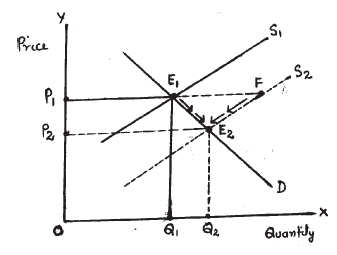
Market for a good is in equilibrium. There is 'increase' in supply of the good. Explain the chain of effects of this change. Use diagram.
Answer

  1. ‘Increase’ in supply shifts the supply curve from $s_1$ to $s_2$ to the right leading to excess supply $E_1F$ at the given price $OP_1$.
  2. Since the firms will not be able to sell all that they want to sell, there will be competition among sellers leading to fall in price.
  3. As price falls, demand starts rising (along D) and supply starts falling(along $s_2$) as shown by arrows in the diagram.
  4. These changes continue till $D=S$ at a new equilibrium at $E_2$.
  5. The quantity rises to $OQ_2$ but price falls to $OP_2$.
View full question & answer
Question 276 Marks
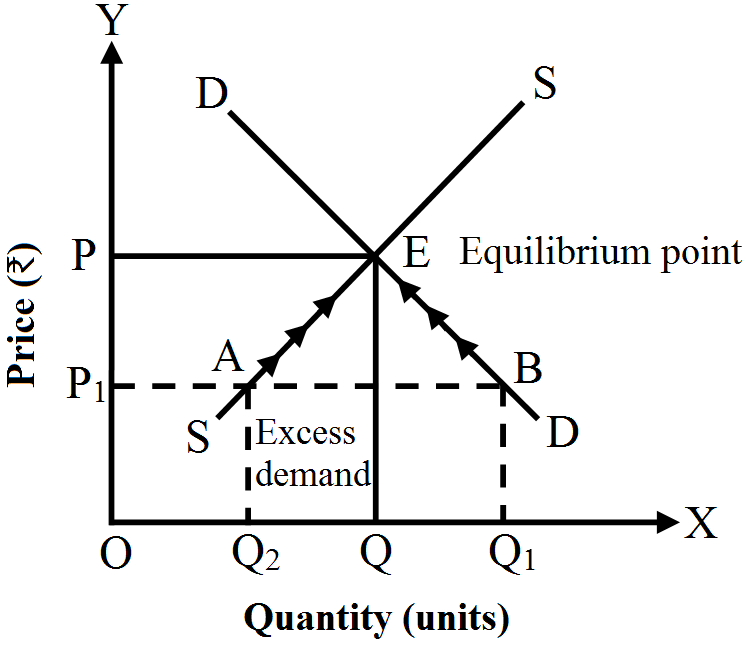
At a given price of a commodity, there is excess demand. Is this price an equilibrium price? If not, how will the equilibrium price be reached?
Answer
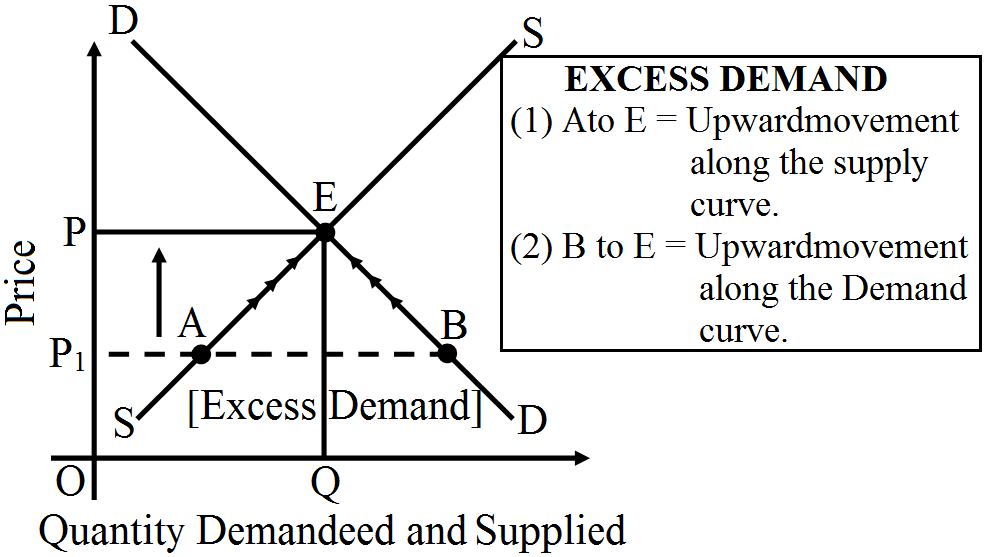
By the definition, equilibrium price refers to the price at which market demand is equal to market supply (i.e. there is no excess demand or excess supply). So, the price with excess demand is not an equilibrium price. This can be illustrated with the help of the given figure

In this figure, at $O P_1$ level of price, $A B$ is equal to $Q_1 Q_1$ i.e. excess demand. With the market demand greater than market supply, the pressure exists to move the price upwards. The quantity supplied tends to expands in correspondence with rising price because producers supply more at higher price and movement along the supply curve $S S$ from point $A$ to point $E$.
At higher price $OP$ , quantity supplied increases from $\mathrm{OQ}_2$ to $OQ$ . Consumers react to rising price by reducing consumptions. Hence, movement along demand curve $D D$ from point $B$ to point $E$. Thus, quantity demanded falls from $\mathrm{OQ}_1$ to $O Q$. The equilibrium is struck at point $E$ with $O P$ and $O Q$ as the equilibrium price and equilibrium quantity respectively. At $OP$ price, there is no excess demand.
View full question & answer
Question 286 Marks
Define equilibrium price of a commodity. How is it determined? Explain with the help of a schedule.
Answer
Demand and supply schedule
Price (per unit)
(Rs.)
Market demand
(units)
Market supply
(units)
3 40 20
4 30 30
5 20 40
Equilibrium price is the price at which market demand and market supply are equal. In the schedule such price is Rs. 4 At any other price i.e. Rs. 3 or Rs. 5, there is excess demand or excess supply. When there is excess demand or excess supply changes in price, demand and supply take place. So the price at which there is excess demand (Rs. 3) or excess supply (Rs. 5) cannot be equilibrium price.
At price of Rs. 3, there is excess demand. There will be competition among buyers leading to rise in price, fall in demand and rise in supply. These changes continue till price rises to Rs. 4 which is equilibrium price. At price of Rs. 5, there is excess supply. There will be competition among sellers resulting in fall in price, rise in demand and fall in supply. These changes continues till price falls to Rs. 4 which is the equilibrium price.
View full question & answer
Question 296 Marks
Market for a product is in equilibrium. Supply of the product "decreases." Explain the chain of effects of this change till the market again reaches equilibrium. Use diagram.
Answer
  • $OP_1$ in equilibrium price & $OQ_1$ equilibrium quantity.
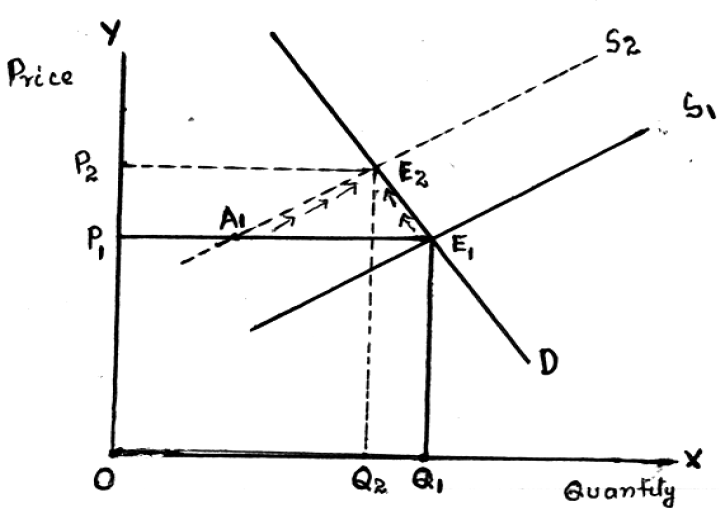
  • When supply decreases, supply curve shifts to the left. $S_2$ is new supply curve.
  • This creates excess demand $A_1E_1$ at the existing price $OP_1$.
  • The excess demand leads to competition among buyers causing price to rise.
  • Rise in price leads to fall in demand along the D– curve and rise in supply along the $S_2$ curve as indicated by the arrows.
  • These changes continue till the market reaches new equilibrium at $E_2$ with a higher price $OP_2$ and lower quantity $OQ_2$.
View full question & answer
Question 306 Marks
What do you mean by excess supply? Explain with the help of a diagram the effect of excess supply on the price of the commodity.
Answer
When at a given price, the quantity supplied of a commodity exceeds its quantity demanded, then it is a situation of “excess supply”. When there is excess supply, the equilibrium price would be lower than the price at which there is excess supply. If there is excess supply of a commodity, the following changes take place to establish equilibrium price:
  1. As supply exceeds demand, all sellers will not be able to sell the total quantity they want to sell at this price. So there will be competition among the sellers. This will reduce the price.
  2. As the price starts falling, its quantity demanded starts rising as the buyers demand more when price falls (Expansion of demand).
  3. As the price starts falling, its quantity supplied starts falling as the sellers sell less when price falls (Contraction of Supply).
  4. The fall in price of the commodity causes expansion of demand and contraction of supply which continues till price reaches a level at which quantity demanded and quantity supplied are equal.
  5. Thus, the excess supply is wiped out and equilibrium price and quantity are established.

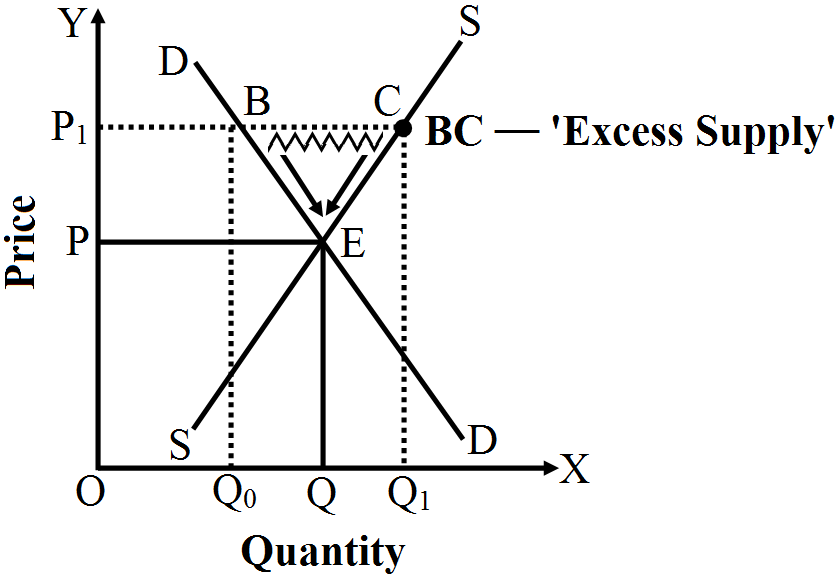
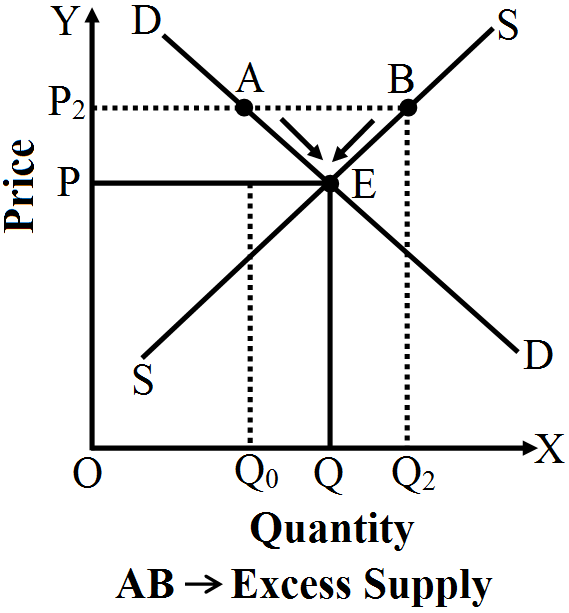
The diagram explains the concept of excess supply and the process by which it is wiped out. In the diagram, when the price is $OP_1$, the quantity supplied is $P_1C/ OQ_1$ but quantity demanded is $P_1B/ OQ_0$. So there is an excess supply equal to $BC$. Competition among the sellers reduces the price. As the price has fallen from $OP_1$ to $OP$, there is expansion of demand and it is shown by a downward movement along the demand curve and there is contraction of supply due to a fall in price. This is shown by a downward movement along the supply curve as shown by arrows. Further downward movement along the supply curve (Contraction of supply) takes us to point $E$. Point $E$ is the equilibrium point and $OP$ denotes equilibrium price and $OQ$ denotes equilibrium quantity.
View full question & answer
Question 316 Marks
Market for a product is in equilibrium. Demand for the product "decreases." Explain the chain of effects of this change till the market again reaches equilibrium. Use diagram.
Answer

  • OP1 is the equilibrium price and OQ1 is the equilibrium quantity. Demand decreases so that demand curve shifts to the left. The new demand curve is D2
  • This creates an excess supply (A1E1) at the existing price OP1.
  • The excess supply creates competition among sellers, resulting in fall in price.
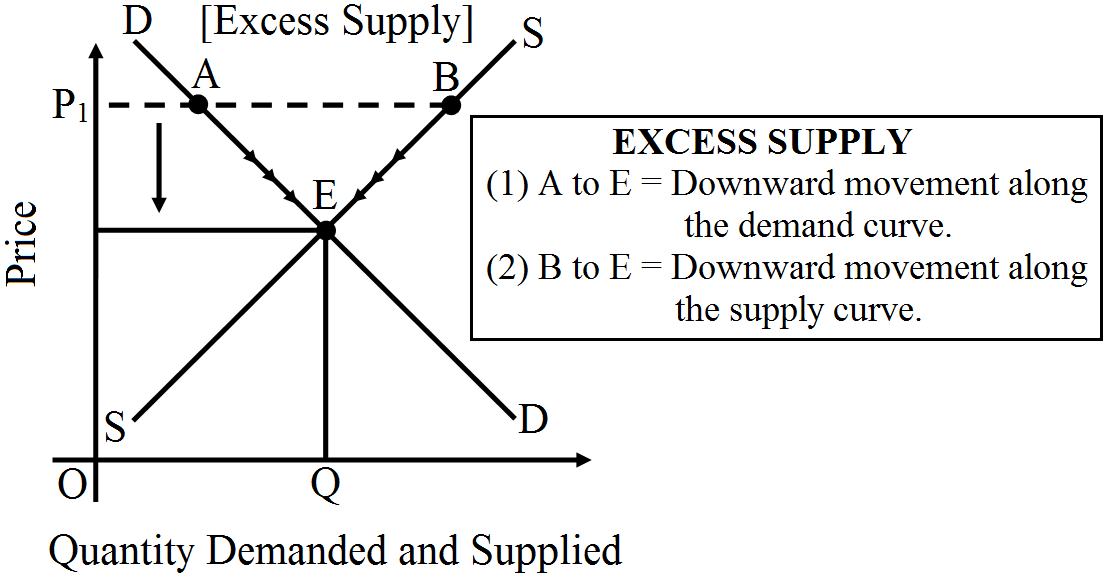
  • Fall in price leads to rise in demand and fall in supply as indicated by the arrows.
  • These changes continue till the market reaches new equilibrium at E2 with a lower price OP2 and lower quantity OQ2.
View full question & answer
Question 326 Marks
  1. Explain briefly the situation of excess demand in a perfectly competitive market. Use diagram.
  2. Explain briefly the situation of excess supply in a perfectly competitive market. Use diagram.
Answer
  1. In a perfectly competitive market, at any price lower than the equilibrium price, the quantity demanded of a commodity exceeds quantity supplied. It is called a situation of “excess demand”. Excess demand pushes up the market price by causing competition among the buyers. Arise in price leads to contraction of demand and expansion of supply. The rise in price continues till it reaches the equilibrium price at which quantity demanded is equal to quantity supplied.

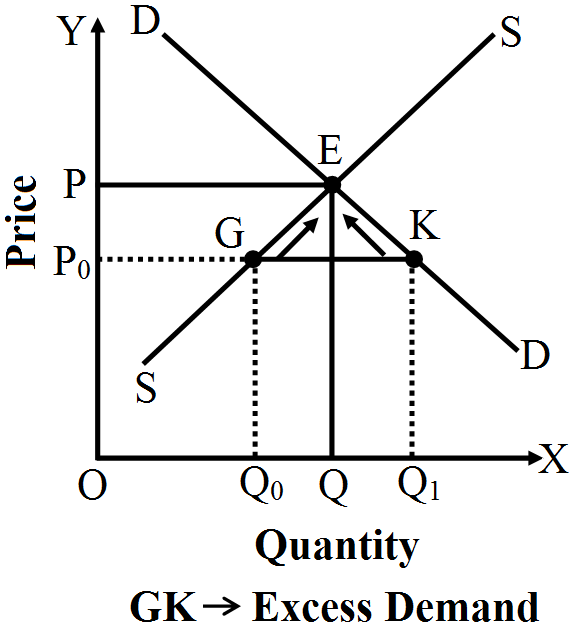
In the diagram, at price $OP_0$, the quantity demanded is $OQ_1$ but quantity supplied is $OQ_0$. So there is excess demand equal to $GK$. As a result of this excess demand, the price will rise till $OP$ is reached which is the equilibrium price at which the qu quantity demanded is equal to quantity supplied at point E in the diagram.
  1. In a perfectly competitive market, at any price higher than the equilibrium price, the quantity supplied of a commodity exceeds quantity demanded. It is called a situation of “excess supply". Excess supply causes a fall in price by causing competition among the sellers. A fall in the price leads to expansion of demand and contraction of supply. The fall in price continues till it reaches the equilibrium price $OP$ at which the quantity demanded is equal to quantity supplied.

In the diagram, at price $OP_2$, the quantity supplied is $OQ_2$ but quantity demanded is $OQ_0$. So there is excess supply equal to $'Q_0Q_2'$ or $AB$. As a result of excess supply, the price will go on declining till $OP$ is reached at which the quantity demanded is equal to the quantity supplied.
View full question & answer
Question 336 Marks
Market of a good is in equilibrium. If the demand for the good 'decreases'. Explain the chain of effects of this change.
Answer
Market of a good is in equilibrium. If the demand for the good decreases this creates an excess supply of the good at the existing price, in the market.
  1. The excess supply creates competition among sellers, resulting in fall in price, because sellers will not be able to sell all that they want to sell at the existing price.
  2. Fall in price leads to rise in demand and fall in supply.
  3. These changes continue till the market reaches new equilibrium.
View full question & answer
Question 346 Marks
What will be the effect on equilibrium price and equilibrium quantity, when:
  1. Number of firms increases.
  2. Price of inputs increases.
Answer
  1. Number of firms increases: When number of firms increase keeping other factors constant, total supply, in the market, also increases due to more producers producing the commodity. It shifts the supply curve towards right. Since an increase in number of firms does not have any impact on demand the demand curve remains unchanged. It can be shown with the help of given diagram.

The supply curve shifts rightward from $SS$ to $S_1S_1$. With new supply curve $S_1S_1$ there is excess supply at initial price OP because at price $OP$ supply is $PB$ and demand is $PA$; so there is excess supply of $AB$ at price $OP$.
Due to this excess supply, competition among the producer will fall the price. Due to this fall in price there is downward movement along the supply curve (Contraction in supply) from $B$ to $C$ and similarly there is downward movement along the demand curve (Expansion in demand) from $A$ to $C$. So, finally, equilibrium price falls from $OP$ to $OP_1$, and equilibrium quantity rises from $OQ$ to $OQ_1$.
Conclusion:
So, due to increase in number of firms,
  1. Equilibrium price falls from $OP$ to $OP$.
  2. Equilibrium quantity rises from $OQ$ to $OQ$.
  1. Price of inputs increases: When price of inputs increases, assuming no change in other factors, then the cost of production rises. As a result, supply decreases due to fall in the profitability level. It shifts the supply curve towards left. Since an increase in the price of inputs does not have any impact on demand, the demand curve remains unchanged. It can be shown with the help of given diagram.

In the given figure price is on vertical axis and quantity demanded and supplied is on horizontal axis.
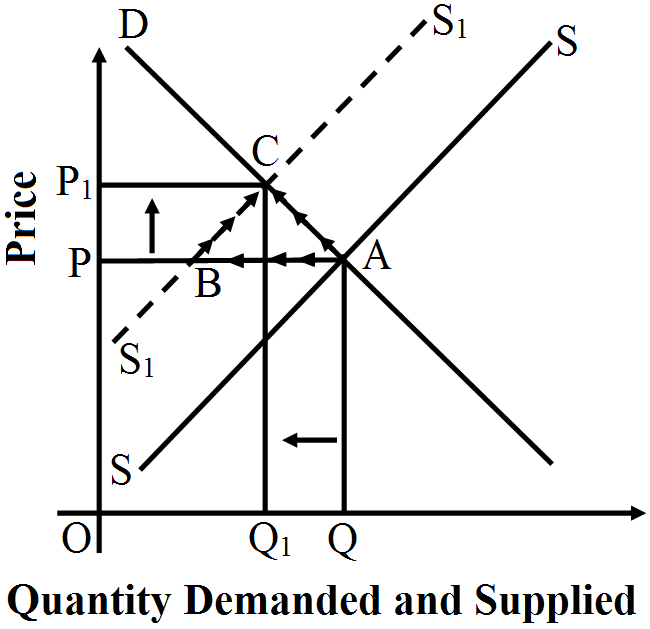
The supply curve shifts leftward from $SS$ to $S_1S_1$. With new supply curve $S_1S_1$ there is excess demand at initial price $OP$ because at price $OP$, supply is $PB$ and demand is $PA$, so there is excess demand of $AB$ at price $OP$.
Due to this excess demand, competition among the consumer will rise the price. Due to this rise in price, there is upward movement along the supply curve (Expansion in supply) from $B$ to $C$ and similarly, there is upward movement along the demand curve (Contraction in demand) from $A$ to $C$. So, finally, equilibrium price rises from $OP$ to $OP_1$ and equilibrium quantity falls from $OQ$ to $OQ_1$.
Conclusion:
Due to increase in input price,
  1. Equilibrium price rises from $OP$ to $OP_1$.
  2. Equilibrium quantity also falls from $OQ$ to $OQ_1$.
View full question & answer
Question 356 Marks
If equilibrium price of a good is greater than its market price, explain all the changes that will take will place in the market. Use diagram.
Answer


$OP$ is the equilibrium price and $OP_1$ is the market price. At $OP_1$ price there is excess demand equal to $AB$. This will result in competition among buyers. Price will rise, supply will rise, demand will fall. Arrows along $DD$ and $SS$ curves indicates this. These changes will continue till price rises to $OP$, the equilibrium price.
View full question & answer
Question 366 Marks
If at a given price of the commodity there is excess supply, how will the equilibrium price be reached? Explain with the help of a diagram.
OR
How will equilibrium price be reached when there is excess supply? Explain with a diagram.

OR
Explain the series of changes that will take place if market price is higher than equilibrium price.

OR
At a given price of a commodity there is excess supply. Is it an equilibrium price? If not, how will the equilibrium price be reached? (use diagram)

OR
Suppose price of a good is higher than equilibrium price. Explain changes that will establish equilibrium supply.

OR
Explain the chain of effect of excess supply of a good on its equilibrium price.
Answer
If at a given price there is excess supply as shown in the given figure.
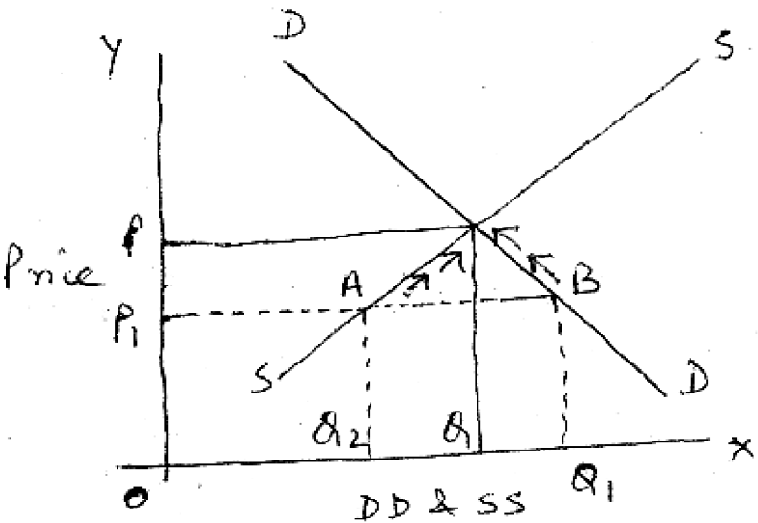
In the given figure, the excess supply of AB at price $P_1$ will create a competition among the producers, which will reduce the price from $P_1$ to P. It can be explained in the following cases:
  1. Downward movement along the supply curve (Contraction in supply): Due to excess supply of AB, the competition among the producers will reduce the price. As we know, positive relationship exists between price and quantity supplied. So fall in price $P_1$ to P leads to fall in supply from B to E.
  2. Downward movement along the demand curve (Expansion in demand): Due to excess supply of AB, the competition among the producers will reduce the price. As we know inverse relationship exists between price and quantity demanded. So, fall in price from $P_1$ to P, leads to rise in demand from A to E.
It can be explained with the help of the following schedule.
Price ( )
Demand
Supply
Resulting tendency
5
1
5
Excess Demand
4
2
4
Excess Demand
3
3
3
Equilibrium
In the above schedule at price 5, E there is excess supply. This excess BEST supply, leads to fall in price till we reach the equilibrium at price 3. Note: Contraction in supply and expansion in demand have to be done simultaneously to reach the equilibrium.
View full question & answer
Question 376 Marks
If at a given price of the commodity there is excess demand, how will the equilibrium price be reached? Explain with the help of a diagram.
OR
If equilibrium price of a good is greater than its market price, explain all the changes that will take place in the market. Use diagram.

OR
Explain the changes that will take place in the market for a commodity if the prevailing market price is less than the equilibrium price.

OR
Explain the chain of effect of excess demand of a good on its equilibrium price.
Answer
If at a given price let at $P_1$, there is excess demand as shown in the given figure.
In the given diagram the excess demand of AB at price $P_1,$ creates a competition among the buyers, which will increase the price from $P_1$ to P. It can be explained in the following two cases:
Case I: Upward movement along the supply curve (Expansion in Supply) Due to excess demand of AB, competition among the buyers, will rise the price from $P_1$ to P. As we know positive relationships exist between price and quantity supplied. So, the rise in price from $P_1$ to P will rise the supply from A to E.
Case II: Upward movement along the demand curve (Contraction in Demand) Due to excess demand of AB, the price rises. As we know Inverse relationship exists between price and quantity demanded. So, due to rise in price from $P_1$ to P the quantity demanded falls from B to E. It can also be explained with the help of the schedule that follows:
Price ()
Demand
Supply
Resulting tendency
1
5
1
Excess Demand
2
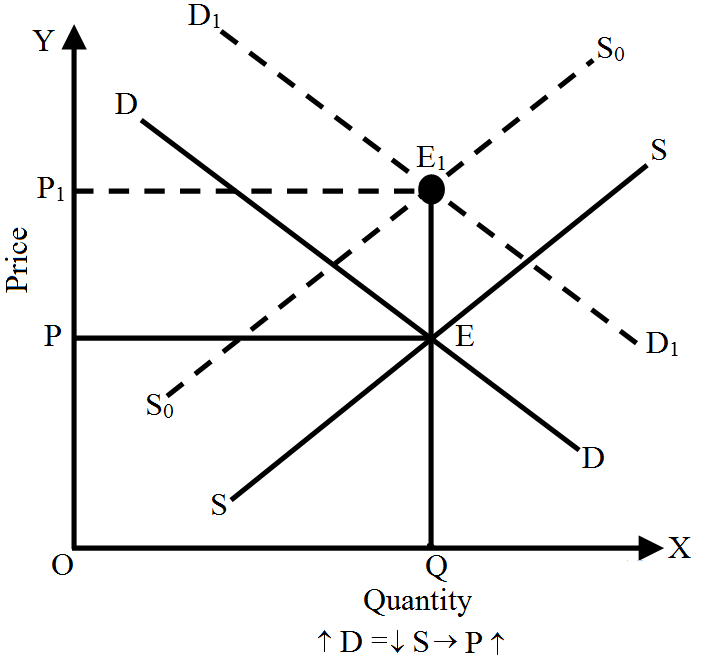
4
3
Excess Demand
3
3
3
Equilibrium
In the above schedule, at price 1 there is an excess demand. Due to this excess demand price will rise till we reach the equilibrium at price 3. Note: Expansion in supply and contraction in demand has to be done simultaneously to reach the equilibrium price.
View full question & answer
Question 386 Marks
Market for a good is in equilibrium. There is increase in demand for goods. Explain the chain of effects of this change. Use diagram.
OR
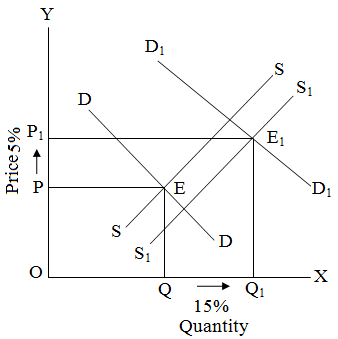
How does an increase in demand of a commodity affect its equilibrium price and equilibrium quantity? Explain with the help of a diagram.
OR
How will equilibrium price and quantity be affected when there is rightward shift of demand curve?
OR
$X$ and $Y$ are complementary goods. The price of $Y$ falls. Explain the chain of effects of this change in the market of $X$.
Answer
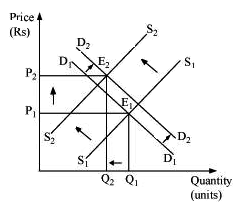
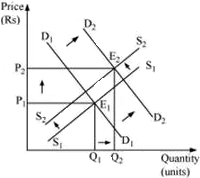
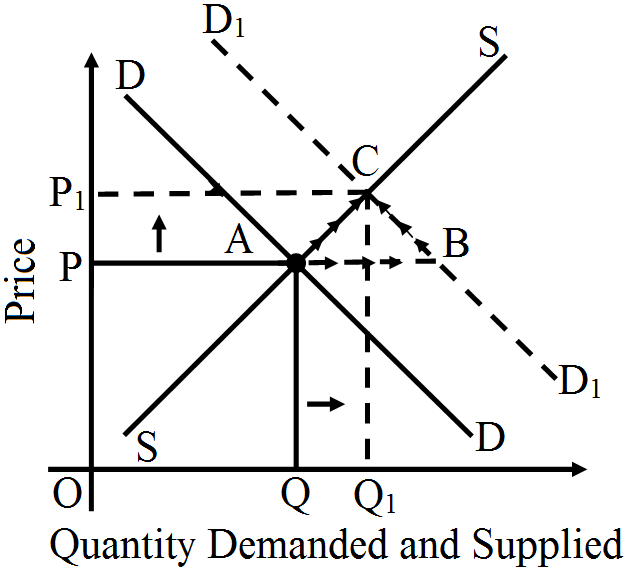
As given in the examination problem that market for a good is in equilibrium. So, we assume that initial price is $OP$ as shown in the figure.
In the given figure price is on vertical axis and quantity demanded and supplied are on horizontal axis. Bui due to increase in demand, demand curve shifts rightward from $DD$ to $D_1D_1$. With new demand curve $D_1D_1$, there is excess demand at initial price $OP$ because at price $OP$, demand is $PB$ and supply is $PA$, so there is excess demand of $AB$ at price $OP$. Due to this excess demand, competition among the consumer will rise the price. With the rise in price, there is upward movement along the demand curve (contraction in demand) from $B$ to $C$ and similarly, there is upward movement along the supply curve (expansion in supply) from $A$ to $C$. So, finally equilibrium price rises from $OP$ to $OP_1$, and equilibrium quantity also rises from Step $OQ$ to $OQ_1$, Conclusion: Due to increase in demand,
  1. Equilibrium price rises from $OP$ to $OP_1$.
  2. Equilibrium quantity also rises from $OQ$ to $OQ$,
View full question & answer
Question 396 Marks
Market for a good is in equilibrium. The supply of good "decreases". Explain the chain of effects of this change.
Answer
  • Given equilibrium, Supply 'decreases.'
  • Price remaining unchanged, excess demand emerges.
  • Excess demand leads to competition between buyers causing price to rise.
  • Rise in price causes fall (contraction) in demand and rise (expansion) in supply.
  • Rise in price continues till the market is in equilibrium again at a higher price.
View full question & answer
Question 406 Marks
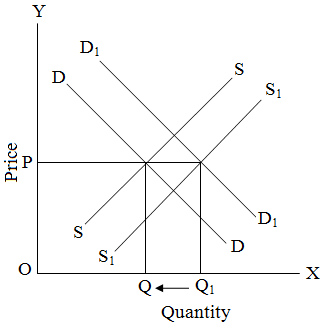
Explain through a diagram the effect of a rightward shift of both the demand and supply curves on equilibrium price and quantity.
Answer
As a result equilibrium price remains unchanged. When both demand and supply of a commodity increase the equilibrium quantity will increase but equilibrium price mayor may not be affected. There may be following three situations.
  1. The equilibrium price will remain the same, If demand and supply of a commodity increase in equal ratio.
Diagram as
  1. Equilibrium price will rise, if both demand and supply increase but Increase in demand is more than the increase in supply.
Diagram as

  1. Equilibrium price will fall, if both demand and supply increase but the increase in demand is less than increase in supply.
Diagram as

View full question & answer
Question 416 Marks
Market for a good is in equilibrium. The demand for the good 'decreases'. Explain the chain of effects of this change.
Answer
  • Given equilibrium, demand ‘decreases’.
  • Price remaining unchanged, excess supply emerges.
  • Excess supply leads to competition among sellers causing price to fall.
  • Fall in price causes rise (expansion) in demand and fall (contraction) in supply.
  • The price continues to fall till the market is in equilibrium again at a lower price.
View full question & answer
Question 426 Marks
Market for a good is in equilibrium. Supply of the good 'increases'. Explain the chain of effects of this change.
Answer
  • Given equilibrium, demand increases.
  • Price remaining unchanged, excess supply emerges.
  • Excess supply leads to competition among sellers causing price to fall.
  • Fall in price causes rise (expansion) in demand and fall (contraction) in supply.
  • These changes continue till the market is in equilibrium again at a lower price.
View full question & answer
Question 436 Marks
Market for a good is in equilibrium. Explain the chain of reactions in the market if the price is (i) higher than equilibrium price and (ii) lower than equilibrium price.
Answer
  1. When price is higher than equilibrium price:
  • There is excess supply and producers are not in a position to sell all they want to sell at the given price.
  • This leads to competition between producers.
  • Competition between producers leads to lowering of price.
  • Lowering of price raises demand while reduces supply. This continues till demand is equal to supply again at the orginal equilibrium.
  1. When price is lower than the equilibrium price:
  • There is excess demand and consumers are not in a position to buy all they want to buy at the given price. This leads to competition between consumers.
  • Competition leads to rise in price.
  • Rise in price reduces demand while raises supply. This continues till demand is equal to supply again at the original equilibrium.
View full question & answer
Question 446 Marks
Make a difference between perfect competition, monopoly and monopolistic competition.
Answer
Difference among perfect competition, monopoly and monopolistic competition are:
S .No
Basis
Perfect competition
Monopoly
Monopolistic competition
1.
Number of sellers
There are very large number of sellers and no individual seller has control over market supply.
There is a single seller and the monopolist has full control over the supply.
There are large number of sellers. So, a firm does not have much impact on the market supply.
2.
Nature of product
The product is homogeneous. It is identical in all respect.
There are no close substitutes of the product.
Products are differentiated on the basis of brand, size, colour, shape, etc.
3.
Entry and exit
There is freedom of entry and exit. It leads to absence of abnormal profits and losses in long-run.
There is restriction on entry and exit. So a firm can earn abnormal profit and loss in the long-run.
There is freedom of entry and exit. So, a firm earns only normal profits in the long-run.
4.
Price
Firm is a price-taker as price is determined by the industry.
Monopolist is a price-maker as firm and industry are one and the same thing.
Firm has partial control over price due to product differentiation.
5.
Level of knowledge
Buyers and sellers have perfect knowledge about market condition.
Buyers and sellers do not have perfect knowledge about market condition.
Buyers and sellers do not have perfect knowledge due to product differentiation and selling cost incurred by seller.
6.
Selling cost
No selling costs are incurred.
Selling costs are incurred.
Heavy selling costs are incurred.
View full question & answer
Question 456 Marks
At a given price of a commodity, there is excess supply. Is it an equilibrium price? If not, how will the equilibrium price be reached? (Use diagram).
Answer


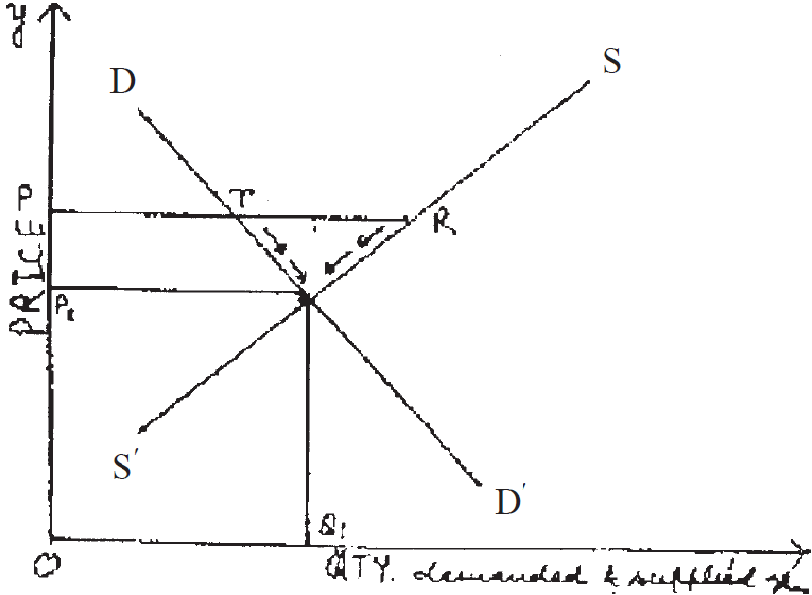
At $OP$ price, excess supply is $TR$. It is not equilibrium price, because at equilibrium price both quantity demanded and supplied must be equal.
Excess supply will result in competition among sellers causing a fall in price. A fall in price would result in downward movements along demand curve and supply curve as per the law of demand and law of supply. This is shown by arrows in the diagram. This reduces the excess supply. These changes will continue till the price falls to a level at which excess supply is whiped out, Such a price is $OP_1$ at which quantity demanded and supplied both are equal to $OQ_1 ~OP_1$ is the equilibrium price.
View full question & answer
Question 466 Marks
Market for a good is in equilibrium. What is the effect on equilibrium price and quantity if both market demand and market supply of the good increase in the same proportion? Use diagram.
Answer

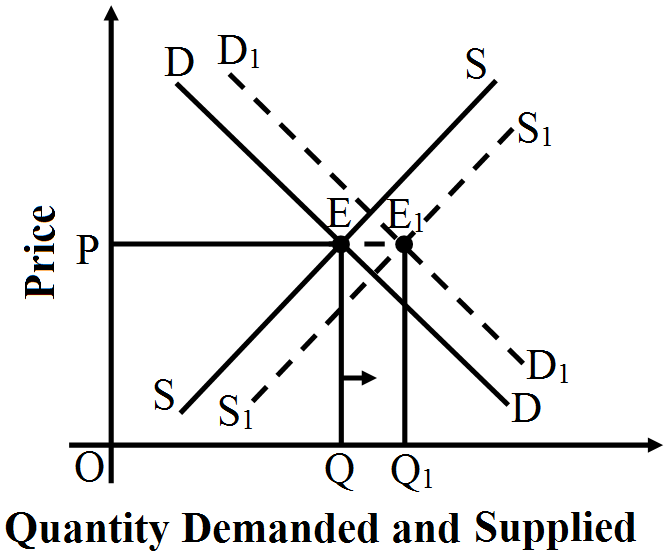
Since both demand and supply increase both demand curve and supply curve shift to the right. Since both increase in the same proportion, price remains unchanged at $OP$ but equilibrium quantity increases from $OQ_1$ to $OQ_2$​​​​​​​.
View full question & answer
Question 476 Marks
If the demand curve of a commodity shifts to the right and the supply curve shifts to the left, what will be the effect on equilibrium price and quantity? Illustrate with a diagram.
Answer
When demand of a commodity increases and supply decreases (i.e., when demand curve shifts to the right and supply curve shifts to the left), the equilibrium price will always increase but the equilibrium quantity may or may not be affected. There may be three situations:
  1. When increase in demand is more than the decrease in supply, both equilibrium price and equilibrium quantity will rise.
  1. When increase in demand is equal to decrease in supply, then the equilibrium price will rise but the equilibrium quantity remains the same.
  1. When increase in demand is less than the decrease in supply, then the equilibrium price will rise but equilibrium quantity will fall.
View full question & answer
Question 486 Marks
When will $(a)$ simultaneous increase and $(b)$ simultaneous decrease in both demand and supply, not affect the equilibrium price? Explain with the help of diagrams.
Answer
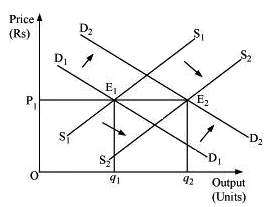
Case I: (When both demand and supply of a commodity simultaneously increase) When both demand and supply of a commodity increase in equal proportion, then there is no change in equilibrium price but the equilibrium quantity will increase.
In the diagram, supply increases, so, the supply curve shifts from $SS$ to $S_1S_1$ and demand increases, so, the demand curve shifts from $DD$ to $D_1D_1$ Both demand and supply increase in equal proportion, therefore equilibrium price remains unchanged at $OP$ but equilibrium quantity increases from $OQ$ to $OQ_1$. Case II: (When both demand and supply of a commodity simultaneously decrease). When both demand and supply of a commodity decrease in equal proportion, then there is no change in equilibrium price but the equilibrium quantity will decrease.
In the diagram, supply decreases, so, the supply curve shifts from $SS$ to $S_0S_0$ and demand decreases, so, the demand curve shifts from $DD$ to $D_0D_0$. Both demand and supply decrease in equal proportion, therefore, the equilibrium price remains unchanged at $OP$ but the equilibrium quantity decreases from $OQ$ to $OQ_0$.
View full question & answer
Question 496 Marks
Explain the meaning and implications of maximum price ceiling and minimum price ceiling.
Answer
When the government imposes upper limit on the price of a good it is called maximum price ceiling. It is fixed below the equilibrium price.
Implication (maximum price ceiling): It will lead to excess demand. This in turn may lead to black marketing of goods. When the government imposes lower limit on the price of a good, it is called minimum price ceiling.
Implication (minimum price ceiling): It leads to excess supply.This in turn may lead to illegal selling below the ceiling price as the producers are not able to sell what they desire to sell.
View full question & answer
Question 506 Marks
Market of a commodity is in equilibrium, demand for the commodity decreases'. Explain the chain of effects of this change till the market again reaches equilibrium. Use diagram.
Answer
Effect of decrease in demand of a commodity on equilibrium price and quantity is discussed below with reference to the given figure.
In the given figure, $DD$ and $SS$ are the initial demand curve and supply curve respectively. $E$ is the initial equilibrium point, $OQ$ is the equilibrium quantity and $OP$ is the equilibrium price. Decrease in demand implies a shift in demand curve to the left. It is indicated by $D_1D_1$. This sets in the following chain of effects.
Decrease in demand implies that less is supplied at the existing price. Given the supply, price of the commodity will tend to decrease from $OP$ to $OP_1$. Fall in price will cause extension of demand and contraction of supply. Hence, equilibrium quantity decreases from $OQ_1$ to $OQ_1$​​​​​​​.
View full question & answer
Question 516 Marks
Explain the meaning of excess demand and excess supply with the help of a schedule. Explain their effect on equilibrium price.
Answer
Market demand and market supply schedu
Price Quantity demanded Quantity supplied
5 40 30
6 35 35
7 30 40
At price of Rs 6 the quantity demanded and supplied are equal, so it is the equilibrium price.
When the market price is less than the equilibrium price, quantity demanded will be more than quantity supplied as shown in the schedule. This is the situation of "excess demand". At a price of Rs 5, there is excess demand. This leads to competition among buyers resulting in price rise. When price rises demand falls and supply rises.These changes continue till demand and supply are equal. Similarly, at a price of Rs 7, there is "excess supply". This will result in competition among sellers. This will reduce price. When price falls demand will rise and supply will fall ultimately equilibrium is reached when price falls to Rs 6.
View full question & answer
Question 526 Marks
Given market equilibrium of a good, what are the effects of simultaneous increase in both demand and supply of that good on its equilibrium price and quantity?
Answer
3 possibilities:
  1. Price may rise.
  2. Remain same.
  3. May fall.
View full question & answer
Question 536 Marks
Under what condition increase in demand would not make any effect on equilibrium quantity?
Answer
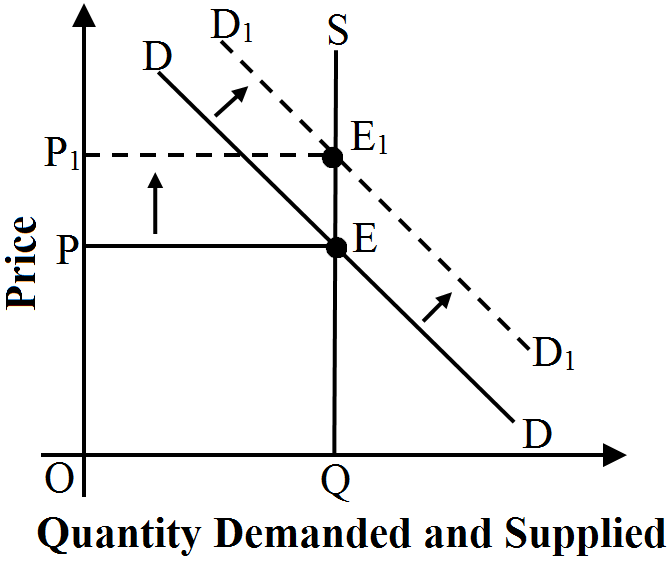
Case I: When supply decreases at the same rate as the demand increase In the given diagram price is measured on vertical axis and quantity demanded and supplied is measured on horizontal axis. Initially, the equilibrium price is $OP$ and equilibrium quantity is $OQ$. But when, "demand increases and supply decreases but at the same rate", then,
  1. Equilibrium price rises from $OP$ to $OP_1$.
  2. Equilibrium quantity remains constant at $OQ$.

Case II: When supply becomes perfectly inelastic In the given diagram price is measured on vertical axis and quantity demanded and supplied is measured on horizontal axis. Initially, the equilibrium price is $OP$ and equilibrium quantity is $OQ$. But when "supply becomes perfectly inelastic and demand increase" then,
  1. Equilibrium price rises from $OP$ to $OP_1$.
  2. Equilibrium quantity remains constant at $OQ$.
View full question & answer
Question 546 Marks
Market for a good is in equilibrium. The demand for the good 'increases'. Explain the chain of effects of this change.
Answer
  • Given equilibrium, demand increases.
  • Price remaining unchanged, excess demand emerges.
  • This leads to competition among buyers causing price to rise.
  • Rise in price causes fall (contraction) in demand and rise (expansion) in supply.
  • The price continues to rise till the market is in equilibrium again at a higher price.
View full question & answer
Question 556 Marks
How will a fall in price of tea affect the equilibrium price of coffee? Explain the chain of effects.
Answer
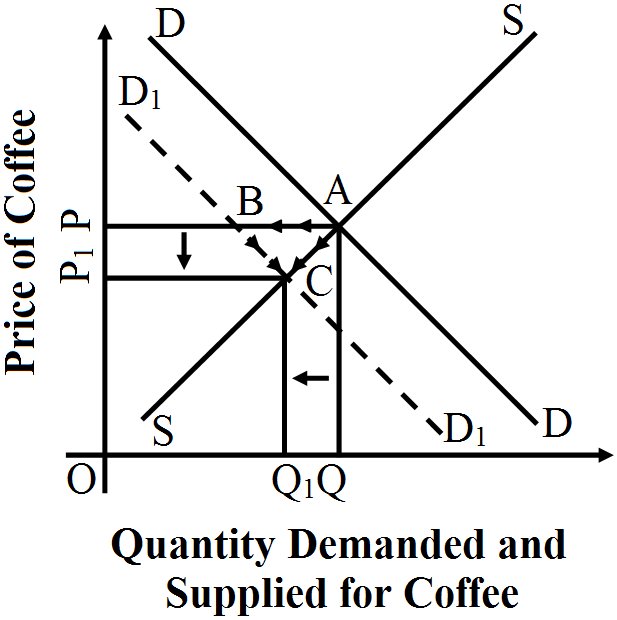
Due to fall in price of tea the demand curve for coffee shifts leftward as shown in the given figure.
In the given diagram price of coffee is on vertical axis and quantity demanded and supplied is on horizontal axis. Initially, the equilibrium price is $OP$ and equilibrium quantity is $OQ$. But due to fall in price of tea the demand curve of coffee shifts leftward from $DD$ to $D_1D_1$. With new demand curve $D_1D_1$ there is excess supply at initial price $OP$ because at price $OP$ demand is $PB$ and supply is $PA$; so, there is excess supply of $AB$ at price $OP$. Due to this excess supply competition among the producer will make the price fall. Due to fall in price, there is a downward movement along the demand curve (Expansion in demand) from $B$ to $C$, and similarly there is a downward movement along the supply curve (Contraction in supply) from $A$ to $C$. So, finally, the equilibrium price falls from $OP$ to $OP_1$, and equilibrium quantity also falls from $OQ$ to $OQ_1$. So, due to fall in price of Tea,
  1. Equilibrium price of coffee falls from $OP$ to $OP_1$,
  2. Equilibrium quantity of coffee also falls from $OQ$ to $OQ_1$.
View full question & answer
Question 566 Marks
Market for a good is in equilibrium. There is decrease in supply for this good. Explain the chain of effects of this change. Use diagram.
OR
Explain the chain effects of decrease in supply of a good on its price, supply and demand.
Answer
As given in the examination problem that market for a good is in equilibrium. So, we assume that initial price is OP as shown in the given figure.

In the given figure price is on vertical axis and quantity demanded and supplied is on horizontal axis. But due to decrease in supply the supply curve shifts leftward from SS to $S_1S_1$. With new supply curve $S_1S_1,$ there is excess demand at initial price OP because at price OP, supply is PB and demand is PA, so there is excess demand of AB at price OP. Due to this excess demand competition among the consumer will rise the price. Due to this rise in price there is upward movement along the supply curve (Expansion in supply) from B to C and similarly, there is upward movement along the demand curve (Contraction in demand) from A to C. So, finally, equilibrium price rises from OP to $OP_1$ and equilibrium quantity falls from $OQ$ to $OQ_1.$
Conclusion: Due to decrease in supply,
  1. Equilibrium price rises from OP to $OP_1$.
  2. Equilibrium quantity falls from OQ to $OQ_1.$
View full question & answer
Question 576 Marks
X and Y are complementary goods. The price of Y falls. Explain the chain of effects of this change in the market of X.
Answer
  • Good X and Y are complementary goods.
  • Price of Y falls leading to rise in its demand.
  • Since X is Complementary of Y, demand for X also increases.
  • Increase in demand for X leads to excess demand for X at the existing price.This creates competition among buyers, because they will not be able to buy all they want to buy at the existing price.As a result price will rise.
  • Rise in price of X will lead to fall in demand for X and rise in its supply.
  • The change will continue till demand for X equals to supply of X at a higher price.
View full question & answer
Question 586 Marks
Market for a good is in equilibrium. There is simultaneous "decrease" both in demand and supply but there is no change in market price. Explain with the help of a schedule how it is possible.
Answer
Price D S After Simultaneous decrease
      D S
3 100 200 50 100
2 150 150 75 75
1 200 100 100 50
The market is in equilibrium when price is Rs. 2 per unit because at this price demand equals supply. For price to remain unchanged after "decreases", the decrease in both must be by the same percentage. In, the above table there is 50 percent decrease both in demand and supply. Therefore new equilbrium is also at a price of Rs. 2 per unit.
View full question & answer
Question 596 Marks
Market for a good is in equilibrium. There is decrease in demand for this good. Explain the chain of effects of this change. Use diagram.
OR
How will equilibrium price and quantity be affected when there is decrease in demand? Explain with diagram.

OR
How will equilibrium price and quantity be affected when there is leftward shift of demand curve?

OR
Explain the chain effects on demand, supply and price caused by leftward shift of demand curve.

OR
Market for a good is in equilibrium. The demand for the good ‘decreases’. Explain the chain of effects of this change.

OR
Good Y is a substitute of good X. The price of Y falls. Explain the chain of effects of this change in the market of X.
Answer
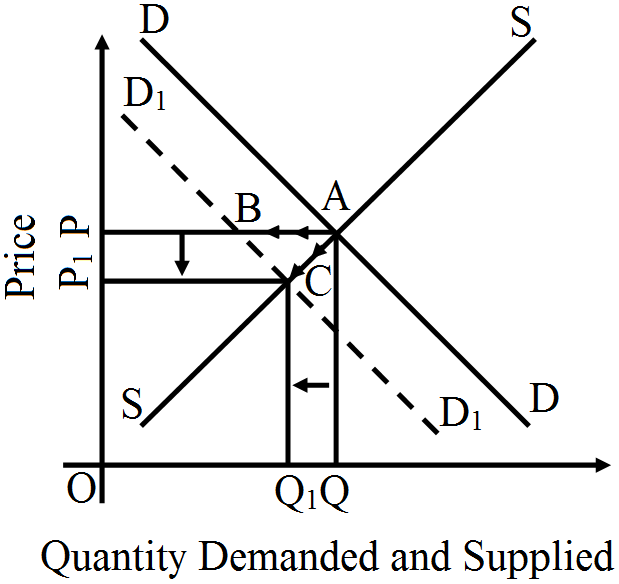
As given in the examination problem that market for a good is in equilibrium. So, we assume that initial price is OP as shown in given figure. In the given figure price is on vertical axis and quantity demanded and supplied are on horizontal axis. But due to decrease in demand, the demand curve shifts leftward from DD to $D_1D_1.$ With new demand curve $D_1D_1,$ there is excess supply at initial price OP because at price OP demand is PB and supply is PA so there is excess supply of AB at price OP. Due to this excess supply, competition among the producer will make the price fall. Due to fall in price there is downward movement along the demand curve (Expansion in demand) from B to C and similarly there is downward movement along the supply curve (contraction in supply) from A to C. So, finally, the equilibrium price falls from OP to OP, and equilibrium quantity also falls from OQ to $OQ_1.$
​​​​​​​
Conclusion: Due to decrease in demand,
  1. Equilibrium price falls from OP to $OP_1.$
  2. Equilibrium quantity also falls from OQ to $OQ_1.$
View full question & answer
Question 606 Marks
Consider the following demand and supply functions for a good:
Quantity demanded = 160 - 2p
Quantity supplied = -40 + 2p
  1. Calculate the equilibrium price and quantity.
  2. Find out a price at which there is excess demand.
  3. Find out a price at which there is excess supply.
Answer
  1. Quantity demanded = 160 - 2p
Quantity supplied = -40 + 2p

Equilibrium is attained at a point where market demand is equal to market supply, i.e. Quantity demanded = Quantity supplied

Hence, 160 - 2p = -40 + 2p

160 + 40 = 2p +2p

$200=4\text{p,p}=\frac{200}{4}=50$

Hence, equilibrium price =₹ 50 Equilibrium quantity will be,

Quantity demanded = Quantity supplied

= 160 - 2p = 160 - 2 × 50

= 160 - 100 = ₹ 60
  1. At any price below the equilibrium price there will be excess demand.
Let us take at price ₹ 20

p = ₹ 20 Quantity demanded = 160 - 2p

= 160 - 2 × 20 = 160 - 40

= ₹ 120 Quantity supplied = - 40 + 2p

= - 40 + 2 × 20 = -40 + 40 = 0

Quantity demanded > Quantity supplied [excess demand] Also it can be concluded that at ₹ 20 there will be no supply of the commodity, hence between 20 < p < 50, there will be excess demand.
  1. At any price above equilibrium, there will be excess supply.
Let us take at price ₹ 80

Quantity demanded = 160 - 2p

= 160 - 2 × 80 = 160 - 160 = 0

Quantity supplied = -40 + 2p

= -40 + 2 × 80 = -40 + 160 = 120

Quantity demanded < Quantity supplied [excess supply]

Also, it can be concluded that at p = ₹ 80 demand will be zero, hence there will be excess supply between 50 < p < 80.
View full question & answer
Question 616 Marks
Explain the chain of effects of excess supply of a good on its equilibrium price.
Answer
  • Excess supply of a good creates competition among the sellers of the good, because the sellers will not be able to sell all they want to sell at the existing price. This leads to fall in price of the good.
  • Fall in price leads to rise in demand and fall in supply of the good.
  • The change continues till demand for the good equals to its supply and the market is in equilibrium again.
View full question & answer
Question 626 Marks
Good Y is a substitute of good X. The price of Y falls. Explain the chain of effects of this change in the market of X.
Answer
  • Good Y is a substitute of good X.
  • Price of Y Falls.
  • Since X becomes relatively costlier, demand for X decreases.
  • This creates excess supply of X at its existing price.
  • Excess supply of X creates competition among sellers of X. This leads to fall in price of X.
  • Fall in price of X leads to increase in demand for X and decrease in supply.
  • The change continues till demand for X equals to supply of X at a lower price of X.
View full question & answer
Question 636 Marks
Market of a commodity is in equilibrium. Demand for the commodity ‘increases’. Explain the chain of effects of this change till the market again reaches equilibrium. Use diagram.
Answer
  • OP1 is the equilibrium price and OQ1 is equilibrium quantity. When demand increases, the demand curve shifts to the right. D2 is new demand curve.
  • This creates an excess demand E1A1 at the existing price OP1.
  • The excess demand causes competition among buyers resulting in rise in price .
  • Rise in price leads to fall in demand and rise in supply as indicated by the arrows.
  • These changes continue till the market reaches new equilibrium at E2 with a higher price OP2 and higher quantity OQ2.
View full question & answer
Question 646 Marks
Demand for electrical appliances like induction chulazas, heaters etc have increased due to increase in the price of LPG. However, in short run supply of these appliances remains constant. What will be the effect on the equilibrium price of these electrical appliances in the given scenario? In this case, which values are being highlighted by the demanders of electrical appliances?
Answer
As given in the examination problem that market for a good is in equilibrium. So, we assume that initial price is OP as shown below:

In the above figure price is on vertical axis and quantity demanded and supplied are on horizontal axis. But due to increase in the price of LPG, the demand of electrical appliances like induction chulazas, heaters etc increases and demand curve shifts rightward from DD to $D_1D_1$. With new demand curve $D_1D_1,$ there is excess demand at initial price OP because at price OP, demand is PB and supply is PA, so there is excess demand of AB at price OP. Due to this excess demand, competition among the consumer will rise the price. With the rise in price, there is upward movement along the demand curve (contraction in demand) from B to C and similarly, there is upward movement along the supply curve (expansion in supply) from A to C. So, finally equilibrium price rises from OP to OP, and equilibrium quantity also rises from OQ to $OQ_1.$
​​​​​​​Conclusion: Due to increase in demand,
  1. Equilibrium price rises from OP to $OP_1.$
  2. Equilibrium quantity also rises from OQ to $OQ_1.$
View full question & answer
Question 656 Marks
What would be an effect on equilibrium price and quantity when demand and supply both shifts rightward?
OR
What would be an effect on equilibrium price and quantity when there is simultaneous increase in demand and supply?

OR
"If the demand and supply of a commodity both increase, the equilibrium price may not change, may increase, may decrease." Explain using diagrams.

OR
Market for a good is in equilibrium. There is simultaneous "increase" both in demand and supply of the good. Explain its effect on market price.
Answer
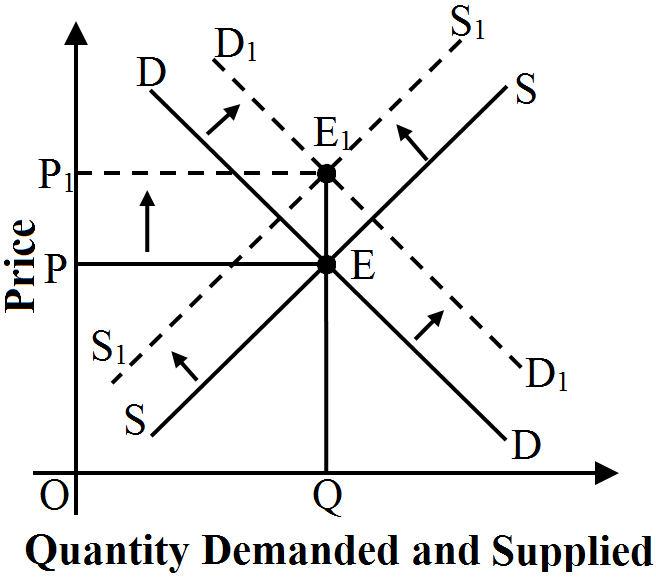
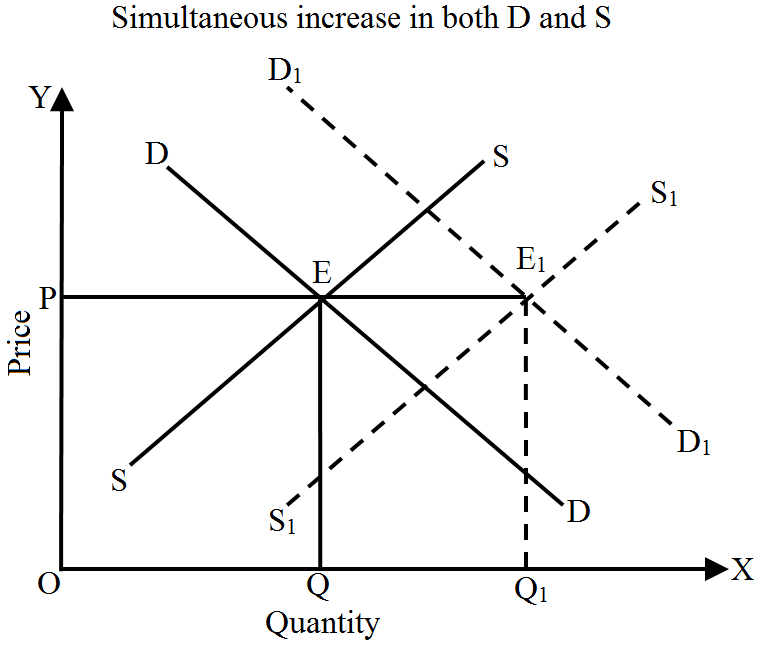
There are three cases: Case I: When demand and supply both increase at the same rate In the given diagram price is measured on vertical axis and quantity demanded and supplied is measured on horizontal axis. Initially, the equilibrium price is OP and equilibrium quantity is OQ. But when "demand and supply both increase at the same rate" then,
  1. Equilibrium price remains constant at OP.
  2. Equilibrium quantity rises from OQ to $OQ_1$.

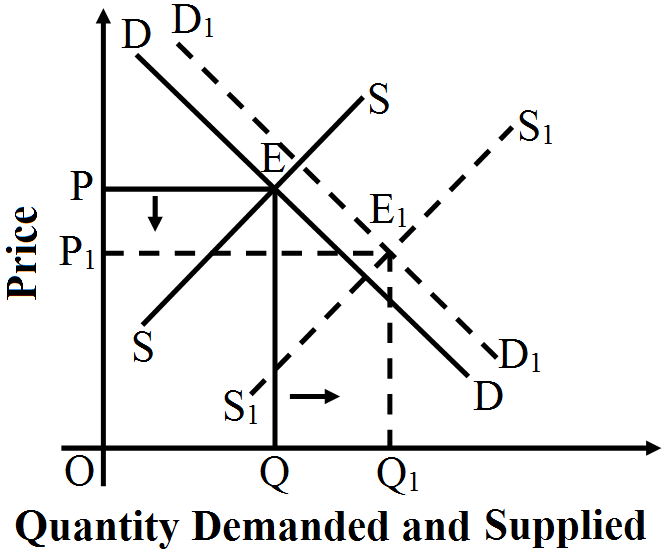
Case II: When demand increases, supply also increases but at a much faster rate In the given diagram price is measured on vertical axis and quantity demanded and supplied is measured on horizontal axis. Initially, the equilibrium price is OP and equilibrium quantity is OQ. But when "demand increases and supply also increases but at a much faster rate", then,
  1. Equilibrium price falls from OP to $OP_1$
  2. Equilibrium quantity rises from OQ to $OQ_1​​​​​​​$​​​​​​​.

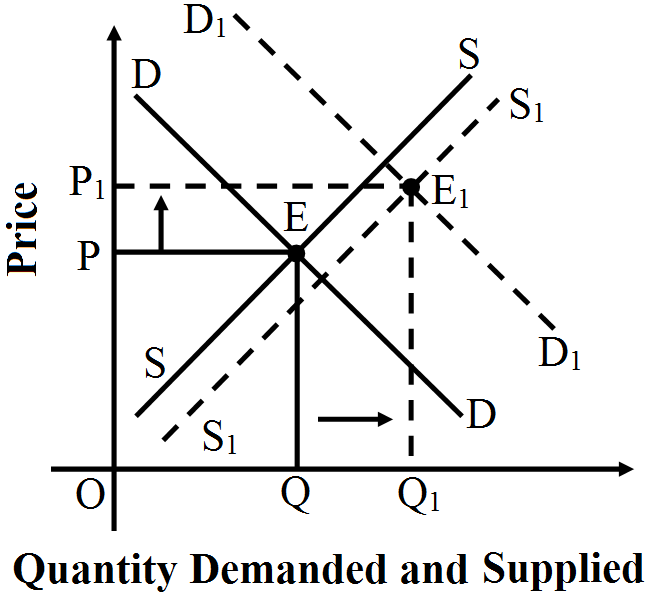
Case III: When supply increases, demand also increases but at a much faster rate In the given diagram price is measured on vertical axis and quantity demanded and supplied is measured on horizontal axis. Initially, the equilibrium price is OP and equilibrium quantity is OQ. But when "supply increases and demand also increases but at a much faster rate" then,
  1. Equilibrium price rises from OP to $OP_1$​​​​​​​.
  2. Equilibrium quantity also rises from OQ to $OQ_1$​​​​​​​.
View full question & answer
Question 666 Marks
Market for a good is in equilibrium. Demand for the good "increases". Explain the chain of effects of this change.
Answer
  • Given equilibrium, demand'increases.'
  • Price remaining unchanged, excess demand emerges.
  • This leads to competition between buyers causing price to rise.
  • Rise in price causes fall (contraction) in demand and rise (expansion) in supply.
  • The price continues to rise till the market is in equilibrium again.
View full question & answer
Question 676 Marks
How will increases in the income of buyers of an 'inferior goods', affect its equilibrium price and equilibrium e quantity? Explain with the help of a E diagram.
Answer
As we know inferior goods are those whose quantity demanded varies inversely with the change in income. As given in the examination problem if income of a consumer increases and good consumed is inferior good, equilibrium price and equilibrium quantity both fall. It can be shown with the help of the following figure. In the given figure price of inferior goods is measured on vertical axis and quantity demanded and supplied is measured on horizontal axis. Initially, the equilibrium price is $OP$ and equilibrium quantity is $OQ$.
But as given in the examination problem when income of a consumer increases, the demand of inferior goods also falls shifting the demand curve to the left from $DD$ to $D_1D_1$. With new demand curve $D_1D_1$, there is excess supply at initial price $OP$ because at price $OP$ demand is $PB$ and supply is $PA$; so, there is excess supply of $AB$ at price $OP$. Due to this excess supply, competition among the producer the price fall. Due to fall in price, there is downward movement along the demand curve (Expansion in demand) from B to C and similarly, there is downward movement along the supply curve (Contraction in supply) from $A$ to $C$. So, finally, the equilibrium price falls from $OP$ to $OP$,, and equilibrium quantity also falls from $OQ$ to $OQ_1$. Conclusion: Due to increase in income of buyer for inferior goods,
  1. Equilibrium price falls from $OP$ to $OP_1$​​​​​​​.
  2. Equilibrium quantity also falls from $OQ$ to $OQ_1$.
View full question & answer