MCQ
When work is done on a body by an external force, its
  • A
    Only kinetic energy increases
  • B
    Only potential energy increases
  • Both kinetic and potential energies may increase
  • D
    Sum of kinetic and potential energies remains constant

Answer

Correct option: C.
Both kinetic and potential energies may increase
c
An external force can change the kinetic energy or potential energy of an object without doing work on the object$-$ that is, without transferring energy to the object. Instead, the force is responsible for transfers of energy from one type to another inside the object.

Need a full question paper?

Generate a complete, print-ready paper with questions like this in minutes — across 16+ boards, with answer keys.
Start Generating Free

Similar questions

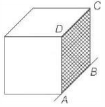
A solid cube of wood of side $2 a$ and mass $M$ is resting on a horizontal surface as shown below. The cube is free to rotate about the fixed axis $A B$. A bullet of mass $m ( < M)$ and speed $v$ is shot horizontally at the face opposite to $A B C D$ at a height $h$ above the surface to impart the cube an angular speed $\omega_{c}$, so that the cube just topples over. Then, $\omega_{c}$ is (Note the moment of inertia of the cube about an axis perpendicular to the face and passing through the centre of mass is $2 M a^{3} / 3$ )
For a given angle of the projectile if the initial velocity is doubled the range of the projectile becomes
A particle starts with an initial velocity of $10.0\,ms ^{-1}$ along $x$-direction and accelerates uniformly at the rate of $2.0\,ms ^{-2}$. The time taken by the particle to reach the velocity of $60.0\,ms ^{-1}$ is $.......\,s$
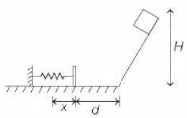
A block of mass $m$ slides from rest at a height $H$ on a frictionless inclined plane as shown in the figure. It travels a distance $d$ across a rough horizontal surface with coefficient of kinetic friction $\mu$ and compresses a spring of spring constant $k$ by a distance $x$ before coming to rest momentarily. Then the spring extends and the block travels back attaining a final height of $h$. Then,
If the moment of inertia of a rigid body is numerically equal to its mass, its radius of gyration is:
A soap bubble, having radius of $1\; \mathrm{mm}$, is blown from a detergent solution having a surface tension of $2.5 \times 10^{-2}\; N / m$. The pressure inside the bubble equals at a point $Z_{0}$ below the free surface of water in a container. Taking $g=10\; \mathrm{m} / \mathrm{s}^{2}$ density of water $=10^{3} \;\mathrm{kg} / \mathrm{m}^{3},$ the value of $\mathrm{Z}_{0}$ is......$cm$
A projectile has initially the same horizontal velocity as it would acquire if it had moved from rest with uniform acceleration of $3\, ms^{-2}$ for $ 0.5\, minutes$. If the maximum height reached by it is $80\, m$, then the angle of projection is (Take $g = 10\, ms^{-2}$)
A body of mass $0.5 \,kg$ is projected under gravity with a speed of $98 \,m/s$ at an angle of ${30^o}$ with the horizontal. The change in momentum (in magnitude) of the body is ......... $N-s$
As the temperature of a conductor increases, its resistivity and conductivity change. The ratio of resistivity to conductivity:
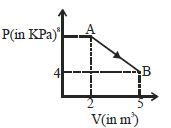
A mole of an ideal diatomic gas undergoes a transition from $A$ to $B$ along a path $AB$ as shown in the figure, The change in internal energy of the gas during the transition is ...... $kJ$