MCQ
When yellow light is incident on a surface, no electrons are emitted while green light can emit. If red light is incident on the surface, then
  • No electrons are emitted
  • B
    Photons are emitted
  • C
    Electrons of higher energy are emitted
  • D
    Electrons of lower energy are emitted
Answer

Correct option: A.
No electrons are emitted
 No electrons are emitted

Need a full question paper?

Generate a complete, print-ready paper with questions like this in minutes — across 16+ boards, with answer keys.

Start Generating Free

Similar questions

A triode has a plate resistance of $10 k \Omega$ and amplification factor $24$. If the input signal voltage is $0.4\, V$ $(r.m.s.)$, and the load resistance is $10\, k$ ohm, then, the output voltage $(r.m.s.)$ is......$V$
In a double slit experiment, instead of taking slits of equal widths, one slit is made twice as wide as the other. Then in the interference pattern :
The depletion layer in silicon diode is $11\mu m$ wide and the knee potential is $0.6\, V$, then the electric field in the depletion layer will be
A block of mass m slides down a smooth vertical circular track. During the motion, the block is in:
The 21 cm radio wave emitted by hydrogen in interstellar space is due to the interaction called the hyperfine interaction is atomic hydrogen. the energy of the emitted wave is nearly
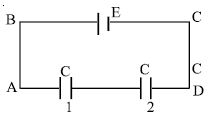
In the adjoining figure, capacitor $(1)$ and $(2)$ have a capacitance $‘C’$ each. When the dielectric of dielectric consatnt $K$ is inserted between the plates of one of the capacitor, the total charge flowing through battery is
An electron of charge ‘e’ coulomb passes through a potential difference of V volts. Its energy in ‘joules’ will be
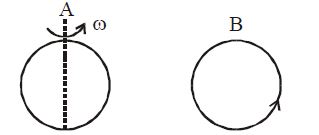
There are two coils $A$ and $B$ as shown in figure. No current flows in $B$ if $A$ is at rest. Now the coil $A$ is made to rotate about a vertical axis. At the shown instant $(t = 0)$ what will be the current in coil $A$,  hen the current in $B$ is counterclockwise?
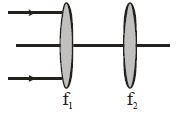
A parallel beam of light is incident on a system of two convex lenses of focal lengths $f_1 = 20\, cm$ and $f_2 = 10\, cm$. What should be the distance between the two lenses so that rays after refraction from both the lenses pass undeviated ?........$cm$
Two very long straight parallel wires, parallel to $y-$ axis,carrycurrents $4I$ and $I,$ along $+y$ directionand$-y$ direction, respectively. The wires are passes through the $x-$axis at the points $(d, 0, 0)$ and $(- d, 0, 0)$ respectively.The graph of magnetic field $z-$component as one moves along the $x-$axis from $x=- d$ to $x= +d,$ is best given by