MCQ
Whenever a hydrogen atom emits a photon in the Balmer series
  • A
    It need not emit any more photon
  • B
    It may emit another photon in the Paschen series
  • It must emit another photon in the Lyman series
  • D
    It may emit another photon in the Balmer series
Answer

Correct option: C.
It must emit another photon in the Lyman series
c
(c)Since in spectral series of hydrogen atom, Lymen series lies lower Balmer series.

Need a full question paper?

Generate a complete, print-ready paper with questions like this in minutes — across 16+ boards, with answer keys.

Start Generating Free

Similar questions

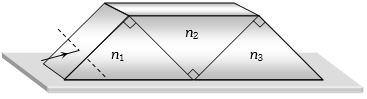
Three right angled prisms of refractive indices ${n_1},{n_2}$ and ${n_3}$ are fixed together using an optical glue as shown in figure. If a ray passes through the prisms without suffering any deviation, then
The de-Broglie wavelength of an electron is the same as that of a photon. If velocity of electron is $25 \%$ of the velocity of light, then the ratio of $K.E.$ of electron and $K.E.$ of photon will be:
Angular width ($\beta$) of central maximum of a diffraction pattern on a single slit does not depend upon
Radioactive element decays to form a stable nuclide, then the rate of decay of reactant $\left( {\frac{{dN}}{{dt}}} \right)$ will vary with time $(t) $ as shown in figure
A constant current is flowing through a long straight conductor, then the graph showing change in produced magnetic field B with distance r is:
A coil of wire of a certain radius has $600$ turns and a self inductance of $108 \ mH$. The self inductance of a $2nd$ similar coil of $500$ turns will be
Equivalent energy of mass equal to 1 a.m.u. is
An electric dipole is placed at the centre of a sphere. Mark the correct options:
A radioactive substance is being produced at a constant rate of $10\, nuclei/s.$ The decay constant of the substance is $1/2\, sec^{-1}.$ After what time the number of radioactive nuclei will become $10$ $?$ Initially there are no nuclei present. Assume decay law holds for the sample.
A square loop of side l is moving with a constant velocity v in a uniform magnetic field. The magnitude of induced emf is: