MCQ
Whenever current is changed in a coil, an induced e.m.f. is produced in the same coil, This property of the coil is due to.
- Amutual induction
- Bself induction
- Ceddy currents
- Dhysteresis
Explanation:
The property of induction of e.m.f. in the same coil when there is a change in current in it is called selfinduction.
Generate a complete, print-ready paper with questions like this in minutes — across 16+ boards, with answer keys.
When light is incident on a doubly refracting crystal, two refracted rays-ordinary ray (O-ray) and extra ordinary ray (E-ray) are produced. Then
|
(a) Both O-ray and E-ray are polarised perpendicular to the plane of incidence |
|
(b) Both O-ray and E-ray are polarised in the plane of incidence |
|
(c) E-ray is polarised perpendicular to the plane of incidence and O-ray in the plane of incidence |
|
(d) E-ray is polarised in the plane of incidence and O-ray perpendicular to the plane of incidence |
The V-i graphs A and B drawn for two voltameters. Identify each graph
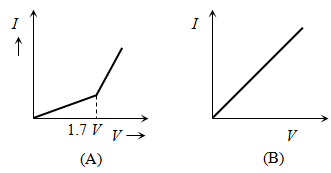
|
(a) A for water voltameter and B for Cu voltameter |
|
(b) A for Cu voltameter and B for water voltameter |
|
(c) Both A and B represents Cu voltameter |
|
(d) None of these |
The idea of matter waves was given by
|
(a) Davisson and Germer |
(b) de-Broglie |
(c) Einstein |
(d) Planck |