MCQ
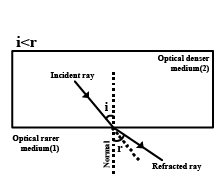
Whenever light travels from denser medium to a rarer medium:
- AIt bends away from the normal
- BIt bends towards the normal
- CIt passes undeviated
- DIt always reflects back
Whenever light travels from denser medium to a rarer medium:
Explanation:
Whenever light travels from a denser medium to a rarer medium, it bends away from the normal due to refraction.
Generate a complete, print-ready paper with questions like this in minutes — across 16+ boards, with answer keys.
If two bulbs of wattage 25 and 100 respectively each rated at 220 volt are connected in series with the supply of 440 volt, then which bulbs will fuse
|
(a) 100 watt bulb |
(b) 25 watt bulb |
(c) None of them |
(d) Both of them |
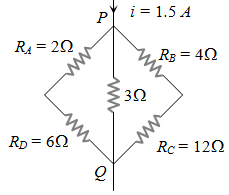
Potential difference between the points P and Q in the electric circuit shown is
|
(a) 4.5 V |
(b) 1.2 V |
(c) 2.4 V |
(d) 2.88 V |
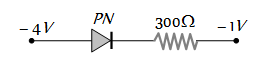
What is the current in the circuit shown below
| (a) 0 amp |
(b)  amp amp
|
(c) 1 amp |
(d) 0.10 amp |
Indicate which one of the following system is digital
|
(a) Pulse position modulation |
(b) Pulse code modulation |
|
(c) Pulse width modulation |
(d) Pulse amplitude modulation |
$\frac{1}{8}$
$\frac{1}{4}$
$4$
$8$
A coil has an area of 0.05 m2 and it has 800 turns. It is placed perpendicularly in a magnetic field of strength 4  , it is rotated through 90° in 0.1 sec. The average e.m.f. induced in the coil is
|
(a) 0.056 V |
(b) 0.046 V |
(c) 0.026 V |
(d) 0.016 V |
$\text{y}=\text{a}_1\sin\omega\text{t}$
$\text{y}=\text{a}_2\sin(\omega\text{t}+\in)$
$\text{y}=\text{a}_1\sin2\omega\text{t}$
$\text{y}=\text{a}_2\sin2(\omega\text{t}+\in)$
Interference fringes may be observed due to superposition of: