MCQ
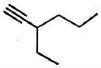
Which alkyne will give $3$ -ethylhexane on catalytic hydrogenation ?
  • A

  • B

  • C

  • All of these

Answer

Correct option: D.
All of these
d
$(d)$ All alkyne on catalytic hydrogenation give $3$ -ethylhexane.

Need a full question paper?

Generate a complete, print-ready paper with questions like this in minutes — across 16+ boards, with answer keys.

Start Generating Free

Similar questions

Which of the following isoelectronic ion has the lowest ionization energy?
The boiling points of methanol, water and dimethyl ether are respectively $65\,^oC, 100\,^oC$ and $34.5\,^oC$. Which of the following best explains these wide  variations in $b.p.$?
Which atom can have more than eight valence electrons when it is forming covalent bonds?
The number of electrons in an atom of an element is equal to its
In which of the following solutions, ions are present
$5\ moles$ each of hydrogen and iodine were heated in a sealed $10\ litre$ vessel. At equilibrium, $2\ moles$ of $HI$ were found. The equilibrium constant for the reaction

${H_2}(g)\, + \,{I_2}(g)\, \rightleftharpoons \,2HI(g)$ is

What will be the correct order of vapour pressure of water, acetone and ether at 30°C. Given that among these compounds, water has maximum boiling point and ether has minimum boiling point?
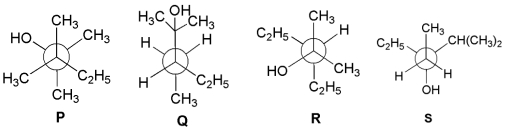
Newman projections $P , Q , R$ and $S$ are shown below :

Which one of the following options represents identical molecules?
For the reaction $(1)$ and $(2)$ :
$A \rightleftharpoons  B + C ....(1)$
$D \rightleftharpoons  2E ....(2)$
Given $K_{P_1} : K_{P_2} : : 9 : 1$
If the degree dissociation of $A$ and $D$ be same then the total pressure at equilibria $(1)$ and $(2)$ are in the ratio (Assume reaction are started with equal number of moles of $A$ and $D$).
According to Le-chatelier's principle, an increase in the temperature of the following reaction will

${N_2} + {O_2}$ $\rightleftharpoons$ $2NO - 43,200\,kcal$