MCQ
Which among the following is an example of a semiconductor?
- ACuprous oxide
- BIron
- CCopper
- DAluminium
Explanation:
Iron, Copper, Aluminium are metals and are therefore conductors whereas Cuprous oxide is a semiconductor.
Generate a complete, print-ready paper with questions like this in minutes — across 16+ boards, with answer keys.
Three capacitors of 2.0, 3.0 and 6.0 μF are connected in series to a 10 V source. The charge on the 3.0 μF capacitor is
|
(a) 5 μC |
(b) 10 μC |
(c) 12 μC |
(d) 15 μC |
The ratio of the magnetic field at the centre of a current carrying circular wire and the magnetic field at the centre of a square coil made from the same length of wire will be
|
(a) |
(b) |
(c) |
(d) |
4 eV is the energy of the incident photon and the work function in 2eV. What is the stopping potential
|
(a) 2V |
(b) 4V |
(c) 6V |
(d) 2 |
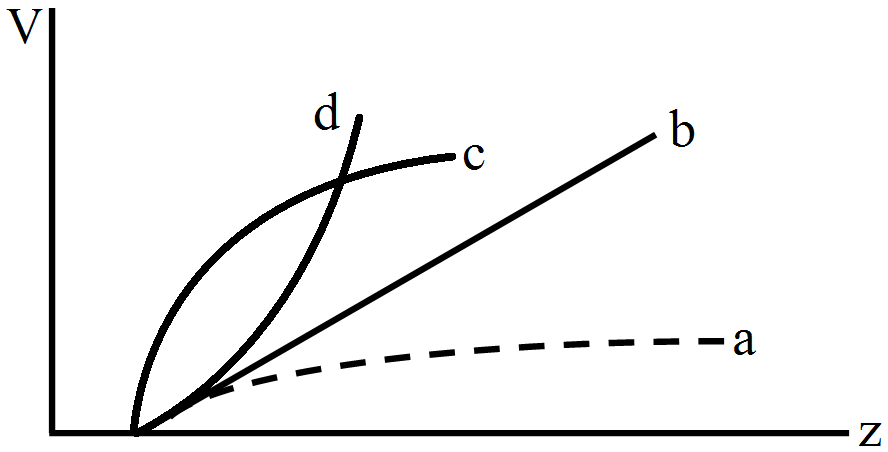
In the following circuits PN-junction diodes D1, D2 and D3 are ideal for the following potential of A and B, the correct increasing order of resistance between A and B will be

(i) – 10 V, – 5V (ii) – 5V, – 10 V (iii) – 4V, – 12V
|
(a) (i) < (ii) < (iii) |
(b) (iii) < (ii) < (i) |
(c) (ii) = (iii) < (i) |
(d) (i) = (iii) < (ii) |


