MCQ
Which among the following is an example of a semiconductor?
  • Cuprous oxide
  • B
    Iron
  • C
    Copper
  • D
    Aluminium

Answer

Correct option: A.
Cuprous oxide

Iron, Copper, Aluminium are metals and are therefore conductors whereas Cuprous oxide is a semiconductor.

Need a full question paper?

Generate a complete, print-ready paper with questions like this in minutes — across 16+ boards, with answer keys.
Start Generating Free

Similar questions

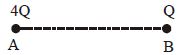
Force between $A$ and $B$ is $F$. If $75\%$ charge of $A$ is transferred to $B$ then force between $A$ and $B$ is
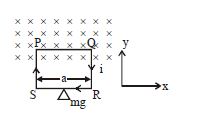
A rectangular loop of wire, supporting a  mass $m$, hangs with one end in a uniform magnetic field $\vec B$  pointing into the plane of the paper. $A$ clockwise current is set up such that  $i> mg/Ba,$ where $a$ is the width of the loop. Then
A blackbody does not:
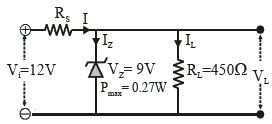
A $9\,V$ stabilised voltage supply is required to run a car stereo system from the car's $12\,V$ battery. A zener diode with $V_z = 9\,V$ and $P_{max} = 0.27\, W$ is to be used as the voltage regulator. The load resistance is $450\,\Omega $. The value of series resistor is....$\Omega $
A short magnet of moment $6.75 \mathrm{Am}^2$ produces a neutral point on its axis. If horizontal component of earth's magnetic field is $5 \times 10^{-5} \mathrm{wb} / \mathrm{m}^2$ , then the distance of the neutral point should be
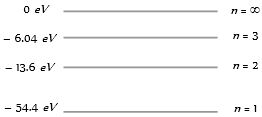
The energy level diagram for an hydrogen like atom is shown in the figure. The radius of its first Bohr orbit is
A thin rectangular magnet suspended freely has a period of oscillation equal to $T.$ Now it is broken into two equal halves (each having half of the original length) and one piece is made to oscillate freely in the same field. If its period of oscillation is $T',$ the ratio $T'/T$ is :-
The input signal given to a $CE$ amplifier having a voltage gain of $150$ is $V_{in}=2cos(15t+$$\frac{\pi }{3}$ $ )V $  The corresponding output signal will be
Two lenses of power $-15\ D$ and $+5\ D$ are in contact with each other. The focal length of the combination is.......$cm$
The $i - v$ curve for anti-resonant circuit is