MCQ
Which can exist both as diastereoisomer and enantiomer?
- A[Pt(en)3]4+
- B[Pt(en)2ClBr]2+
- C[Ru(NH3)4Cl2]0
- D[PtCl2Br2]0
Explanation:
It exists as lis trans which is diastereomer and its cis form is optically active and exits as enantiomer also, where as only exists as enantiomers.
Generate a complete, print-ready paper with questions like this in minutes — across 16+ boards, with answer keys.
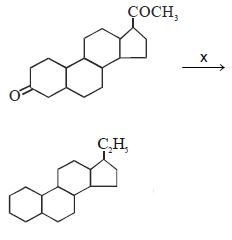
Identify $B$ in the reaction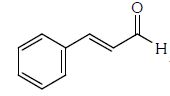
| Rate $mol\,L^{-1}\,s^{-1}$ | $[A]$ $mol\,L^{-1}$ | $[B]$ $mol\,L^{-1}$ |
| $0.10$ | $20$ | $0.5$ |
| $0.40$ | $x$ | $0.5$ |
| $0.80$ | $40$ | $y$ |
What is the value of $x$ and $y ?$
$(I)\,\,La(OH)_3$ is the least basic among hydroxides of lanthanides.
$(II) \,\,Zr^{4+}$ and $Hf^{4+}$ posses almost the same ionic radii.
$(III)\,\,Ce^{4+}$ can as an oxidizing agent
Which of the above is/are true ?
$(en = NH_2CH_2CH_2NH_2)$