MCQ
Which compound is soluble in ${H_2}O$
  • A
    $HCHO$
  • B
    $C{H_3}CHO$
  • C
    $C{H_3}COC{H_3}$
  • $All$

Answer

Correct option: D.
$All$
d
(d) Due to $H - $bonding all are soluble in water.

Need a full question paper?

Generate a complete, print-ready paper with questions like this in minutes — across 16+ boards, with answer keys.
Start Generating Free

Similar questions

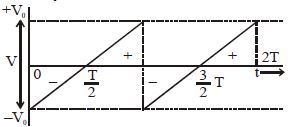
Find the rms value for the saw-tooth voltage of peak value $V_0$ from $t = 0$ to $t = 2T$ as shown in figure
If no external voltage is applied across $ P-N$  junction, there would be
The height of liquid column raised in a capillary tube of certain radius when dipped in liquid A vertically is, $5 cm$. If the tube is dipped in a similar manner in another liquid $B$ of surface tension and density double the values of liquid $A$, the height of liquid column raised in liquid $B$ would be $........m$.
The frequency of light ray having the wavelength $3000 Å$ is
An $emf$ of $0.08\,V$ is induced in a metal rod of length $10\,cm$ held normal to a uniform magnetic field of $0.4\,T$, when moves with a velocity of ...........$ms^{-1}$
Let $l$ be the moment of inertia of an uniform square plate about an axis $AB$ that passes through its centre and is parallel to two of its sides. $CD$ is a line in the plane of the plate that passes through the centre of the plate and makes an angle $\theta $ with $AB$. The moment of inertia of the plate about the axis $CD$ is then equal to 
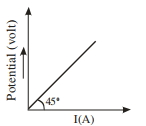
The variation of applied potential and current flowing through a given wire is shown in figure. The length of wire is $31.4 \,cm$. The diameter of wire is measured as $2.4 \,cm$. The resistivity of the given wire is measured as $x \times 10^{-3} \,\Omega cm$. The value of $x$ is_______ [Take $\pi=3.14]$
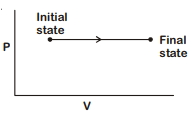
The $P-V$ diagram for an ideal gas in a piston cylinder assembly undergoing a thermodynamic process is shown in the figure. The process is
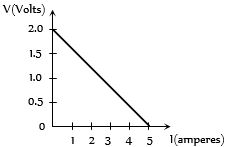
For a cell, the graph between the potential difference $(V) $ across the terminals of the cell and the current $(I)$ drawn from the cell is shown in the figure. The $e.m.f.$ and the internal resistance of the cell are
A particle of mass $1\, mg$ has the same wavelength as an electron moving with a velocity of $3\times10^6\, m\,s^{-1}$. The velocity of the particle is (Mass of electron $= 9.1 \times 10^{-31}\, kg$ )