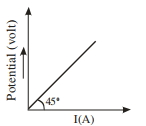
The variation of applied potential and current flowing through a given wire is shown in figure. The length of wire is $31.4 \,cm$. The diameter of wire is measured as $2.4 \,cm$. The resistivity of the given wire is measured as $x \times 10^{-3} \,\Omega cm$. The value of $x$ is_______ [Take $\pi=3.14]$
JEE MAIN 2022, Medium
Download our app for free and get started
$1=\rho \frac{\ell}{ A }$$1=\frac{\rho \times 31.4}{\frac{\pi(2.4)^{2}}{4}}$
$\frac{\pi(2.4)^{2}}{4}=\rho \times 314$
$\frac{2.4 \times 2.4}{4}=\rho \times 10$
$\frac{0.6 \times 2.4}{10}=\rho$
$\frac{1.44}{10}=\rho$
$0.144=\rho$
$144 \times 10^{-3}=\rho$
$\frac{\pi(2.4)^{2}}{4}=\rho \times 314$
$\frac{2.4 \times 2.4}{4}=\rho \times 10$
$\frac{0.6 \times 2.4}{10}=\rho$
$\frac{1.44}{10}=\rho$
$0.144=\rho$
$144 \times 10^{-3}=\rho$

Download our appand get started for free
Experience the future of education. Simply download our apps or reach out to us for more information. Let's shape the future of learning together!No signup needed.*
Similar Questions
- 1View SolutionAssertion : In a simple battery circuit, the point of the lowest potential is negative terminal of the battery.
Reason : The current flows towards the point of the higher potential, as it does in such a circuit from the negative to the positive terminal.
- 2A resistance of $2 \Omega$ is comnected across one gap of a metre-bridge (the length of the wire is $100 \mathrm{~cm}$ ) and an unknown resistance, greater than $2 \Omega$, is connected across the other gap. When these resistance are interchanged, the balance point shifts by $20 \mathrm{~cm}$. Neglecting any corrections, the unknown resistance isView Solution
- 3A cell having an emf $\varepsilon$ and internal resistance $r$ is connected across a variable external resistance $R.$ As the resistance $R$ is increased, the plot of potential difference $V$ across $R$ is given byView Solution
- 4View SolutionThe resistivity of a wire
- 5An unknown resistance $R_1$ is connected in series with a resistance of $10 \,\Omega$. This combinations is connected to one gap of a meter bridge while a resistance $R_2$ is connected in the other gap. The balance point is at $50\, cm$. Now, when the $10 \,\Omega$ resistance is removed the balance point shifts to $40\, cm$. The value of $R_1$ is (in $ohm$)View Solution
- 6View SolutionFor measurement of potential difference, potentiometer is preferred in comparison to voltmeter because
- 7View SolutionThe fact that the conductance of some metals rises to infinity at some temperature below a few Kelvin is called
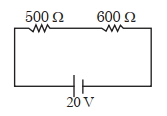
- 8Two resistors are connected in series across a battery as shown in figure. If a voltmeter of resistance $2000 \,\Omega$ is used to measure the potential difference across $500 \,\Omega$ resister, the reading of the voltmeter will be ............... $V$View Solution
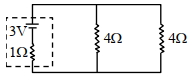
- 9View SolutionIn the given circuit, the terminal potential difference of the cell is:
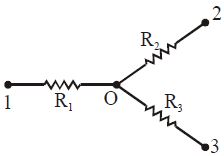
- 10.............. $A$ the current flowing through the resistance $R_2$ of the circuit shown in fig if the resistance are equal to $R_1 = 20\ \Omega, R_2 = 30 \ \Omega$ and $R_3 = 60 \ \Omega$ and potentials of points $1, 2$ and $3$ are equal to $V_1= 20\, V,$ $V_2 = 30\ V$ and $V_3 = 60\ V$View Solution