MCQ
Which condition don't favours the bond formation:
  • A
    Maximum attraction and maximum potential energy.
  • B
    Minimum attraction and minimum potential energy.
  • C
    Minimum potential energy and maximum attraction.
  • D
    Minimum attraction and maximum potential energy.

Answer

  1. Minimum attraction and maximum potential energy.

Need a full question paper?

Generate a complete, print-ready paper with questions like this in minutes — across 16+ boards, with answer keys.

Start Generating Free

Similar questions

The amount of energy required to break one mole of bonds of a particular type between two atoms in a gaseous state is called:
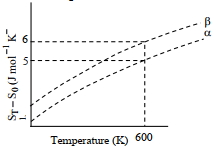
The entropy versus temperature plot for phases $\alpha$ and $\beta$ at 1 bar pressure is given. $S_{\mathrm{T}}$ and $S_0$ are entropies of the phases at temperatures $\mathrm{T}$ and $0 \mathrm{~K}$, respectively.

(image)

The transition temperature for $\alpha$ to $\beta$ phase change is $600 \mathrm{~K}$ and $C_{p, \beta}-C_{p, \alpha}=1 \mathrm{~J} \mathrm{~mol}^{-1} \mathrm{~K}^{-1}$. Assume $\left(C_{p, \beta}-C_{p, \alpha}\right)$ is independent of temperature in the range of 200 to $700 \mathrm{~K} . \mathrm{C}_{p, \alpha}$ and $C_{p, \beta}$ are heat capacities of $\alpha$ and $\beta$ phases, respectively.

($1$)The value of entropy change, $\mathrm{S}_\beta-\mathrm{S}_\alpha$ (in $\mathrm{J} \mathrm{mol}^{-1} \mathrm{~K}^{-1}$ ), at $300 \mathrm{~K}$ is. . . . . . .

[Use : $\ln 2=0.69$  Given : $S_\beta-S_\alpha=0$ at $\left.0 \mathrm{~K}\right]$

($2$) The value of enthalpy change, $\mathrm{H}_\beta-\mathrm{H}_\alpha$ (in $J$ mol ${ }^{-1}$ ), at $300 \mathrm{~K}$ is

Give the answer quetion ($1$) and ($2$)
What is the number of unpaired electron(s) in the highest occupied molecular orbital of the following species : $N _2: N _2^{+} ; O _2 ; O _2^{+}$?
Ionic reactions with organic compounds proceed through:

$(A)$ Homolytic bond cleavage

$(B)$ Heterolytic bond cleavage

$(C)$ Free radical formation

$(D)$ Primary free radical

$(E)$ Secondary free radical

Choose the correct answer from the options given below:

The compound in which carbon uses only its $s{p^3}$ hybrid orbitals for bond formation is
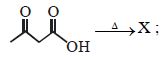
(image) $X$ can also be formed by
When the principal quantum number $(n = 3)$, the possible values of azimuthal quantum number ($l$) is
Which is least soluble in water
The correct order of bond dissociation energy among $N_2, O_2, O_2^-$ is shown in which of the following arrangements?
$4.4\;g$ of an unknown gas occupies $2.24\,L$ of volume at standard temperature and pressure. The gas may be