MCQ
Which diagram of ionization energy is correct ?
- A
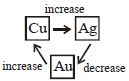
- B
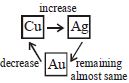
- C
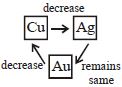
- ✓
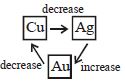
Generate a complete, print-ready paper with questions like this in minutes — across 16+ boards, with answer keys.
$\begin{array}{*{20}{c}}
{Ph - C{H_2} - CH - C{H_3}} \\
{\,\,\,\,\,\,\,\,\,\,\,\,|\,\,\,\,} \\
{\,\,\,\,\,\,\,\,\,\,\,\,\,OH\,}
\end{array}$ $>$ $\begin{array}{*{20}{c}}
{Me - C{H_2} - CH - C{H_3}} \\
{\,\,\,\,\,\,\,\,\,\,\,\,\,\,|\,\,\,\,} \\
{\,\,\,\,\,\,\,\,\,\,\,\,\,\,\,OH\,}
\end{array}$
${N_2}(g)\, + 3{H_2}(g)\, \rightleftharpoons \,2N{H_3}(g)$
The equilibrium constant of the above reaction is $K_3$. If pure ammonia is left to dissociate, the partial pressure of ammonia at equilibrium is given by (Assume that $P_{NH_3}<\,< P_{total}$ at equilibrium)
$\frac{2}{3}A{l_2}{O_3} \to \frac{4}{3}Al + {O_2},{\Delta _r}G = + 940\,kJ\,mo{l^{ - 1}}$
The potential difference needed for the electrolytic reduction of aluminium oxide ............... $\mathrm{V}$