MCQ
Which electronic configuration is not observing the ($n + l$) rule
  • A
    $1{s^2},\,2{s^2}2{p^6},\,3{s^2}3{p^6}3{d^1},\,4{s^2}$
  • B
    $1{s^2},\,2{s^2}s{p^6},\,3{s^2}3{p^6}3{d^7},\,4{s^2}$
  • $1{s^2},\,2{s^2}2{p^6},\,3{s^2}3{p^6}3{d^5},\,4{s^1}$
  • D
    $1{s^2},\,2{s^2}2{p^6},\,3{s^2}3{p^6}3{d^8},\,4{s^2}$

Answer

Correct option: C.
$1{s^2},\,2{s^2}2{p^6},\,3{s^2}3{p^6}3{d^5},\,4{s^1}$
c
(c) $3d$ subshell filled with $5$ electrons (half-filled) is more stable than that filled with $4 $ electrons. $1,\,4s$ electrons jumps into $3d$ subshell for more sability.

Need a full question paper?

Generate a complete, print-ready paper with questions like this in minutes — across 16+ boards, with answer keys.

Start Generating Free

Similar questions

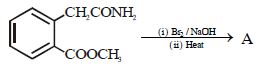
The following sequence of reaction on ''$A$'' gives
$9.3 \mathrm{~g}$ of pure aniline is treated with bromine water at room temperature to give a white precipitate of the product ' $\mathrm{P}$ '. The mass of product ' $\mathrm{P}$ ' obtained is $26.4 \mathrm{~g}$. The percentage yield is ......... $%$.
Red phosphorus is less reactive than yellow phosphorus because
The number of moles present in $2\,litre$ of $0.5\,M$ $NaOH$ is
Which of the following metal does not react with the solution of copper sulphate
Which process converts olefins into parafins
Which one of the following characteristics apply to both ethene and ethyne
The ionization energy of nitrogen is larger than that of oxygen because of
For each of the following pairs of $E_2$ reaction, select the one that occurs with  the greater rate constant.

$(1)$ $C{H_3}C{H_2}C{H_2}Cl + $ $\begin{array}{*{20}{c}}
  {\,\begin{array}{*{20}{c}}
  {\,\,\,\,\,\,\,\,\,\,C{H_3}} \\ 
  {\,\,\,|} 
\end{array}} \\ 
  {C{H_3} - C - {O^ - }} \\ 
  {\,\,\,|} \\ 
  {\,\,\,\,\,\,\,\,\,\,C{H_3}} 
\end{array}$                      $(2)$  $C{H_3}C{H_2}C{H_2}I + $$\begin{array}{*{20}{c}}
  {\,\begin{array}{*{20}{c}}
  {\,\,\,\,\,\,\,\,\,\,C{H_3}} \\ 
  {\,\,\,|} 
\end{array}} \\ 
  {C{H_3} - C - {O^ - }} \\ 
  {\,\,\,|} \\ 
  {\,\,\,\,\,\,\,\,\,\,C{H_3}} 
\end{array}$

$(3)$  $\begin{array}{*{20}{c}}
  {{H_3}C - CH - C{H_3}} \\ 
  {|\,\,\,\,} \\ 
  {Br\,\,\,} 
\end{array}$  $+CH_3O^-$                      $(4)$  $\begin{array}{*{20}{c}}
  {{H_3}C - CH - C{H_3}} \\ 
  {|\,\,\,\,} \\ 
  {Br\,\,\,} 
\end{array}$ $+CH_3S^-$

Ammonia with excess of $Cl_2$, forms