MCQ
Which element exist as a solid at $25\,^oC$ and $1$ atmospheric pressure among the following
- A$Br$
- B$Cl$
- C$Hg$
- ✓$P$
Generate a complete, print-ready paper with questions like this in minutes — across 16+ boards, with answer keys.
The limiting ionic conductivity ( $\Lambda 0$ ) values (in $mS m ^2 mol ^{-1}$ ) for different ions in aqueous solutions are given below:
| Ions | $Ag ^{+}$ | $K ^{+}$ | $Na ^{+}$ | $H ^{+}$ | $NO _3^{-}$ | $CI ^{-}$ | $SO _4^{2-}$ | $OH ^{-}$ | $CH_3COO ^{-}$ |
| $\Lambda_0$ | $6.2$ | $7.4$ | $5.0$ | $35.0$ | $7.2$ | $7.6$ | $16.0$ | $19.9$ | $4.1$ |
For different combinations of titrates and titrants given in $List-l$, the graphs of 'conductance' versus 'volume of titrant' are given in $List-II$.
Match each entry in $List-I$ with the appropriate entry in $List-II$ and choose the correct option.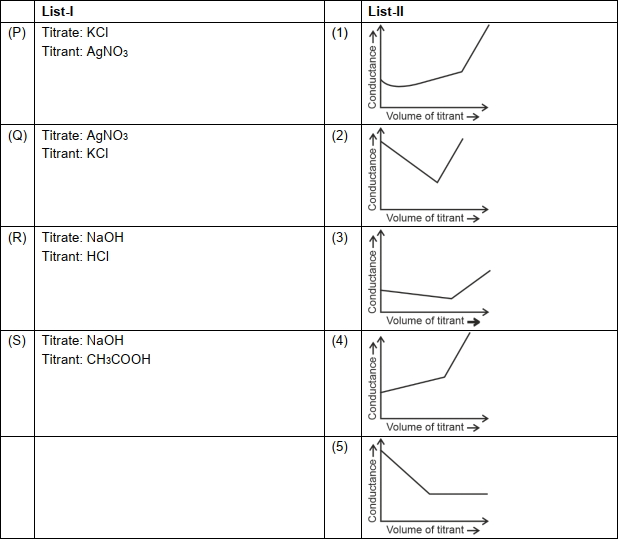
| Exp | $[A]_0$ | $[B]_0$ | initial rate |
| $1$ | $0.012$ | $0.035$ | $0.10$ |
| $2$ | $0.024$ | $0.035$ | $0.80$ |
| $3$ | $0.012$ | $0.070$ | $0.10$ |
| $4$ | $0.024$ | $0.070$ | $0.80$ |
Product $(A)$ is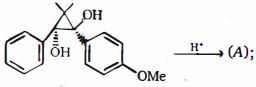
$ {I_2} + 2{e^ - } \to \,2{I^ - }\,;\,\,{E^o}\, = \,\,0.54\,\,V $
$ MnO_4^ - \, + \,8{H^ + }\, + \,5{e^ - } \to \,M{n^{2 + }}\, + \,4{H_2}O\,;\,{E^{o\,}} = 1.52\,\,V $
$ F{e^{3 + }} + {e^ - } \to \,\,F{e^{2 + }}\,;\,\,{E^o}\, = \,\,0.77\,\,V $
$ S{n^{4 + }} + 2{e^ - } \to \,\,S{n^{2 + }}\,;\,\,{E^o}\, = \,\,0.1\,\,V $
The strongest reducant and oxidant respectively are
$A + O_2 \to B$
$B + O_2+ H_2O \to C$
$A,\, B$ and $C$ are