Question
Which element has:
  1. Two shells, both of which are completely filled with electrons?
  2. The electronic configuration 2, 8, 2?
  3. A total of three shells, with four electrons in its valence shell?
  4. A total of two shells, with three electrons in its valence shell?
  5. Twice as many electrons in its second shell as its first shell?
Answer

  1. Neon (2, 8).
  2. Magnesium.
  3. Silicon (2, 8, 4).
  4. Boron (2, 3).
  5. Carbon (2, 4).

Need a full question paper?

Generate a complete, print-ready paper with questions like this in minutes — across 16+ boards, with answer keys.

Start Generating Free

Similar questions

While conducting experiments to study the effect of various stimuli on the plants, it was observed that the roots of a plant X grow and bend towards two stimuli A and B but bend away from a third stimulus C. The stem of the plant X, however, bends away from stimuli A and B but bends towards the stimulus C. The stimulus B is known to act on the roots due to too much weight of the earth. Keeping these points in mind, answer the following question:
  1. What could stimulus A be?
  2. Name the stimulus B.
  3. What could stimulus C be?
  4. The branches of a fallen tree in a forest grow straight up in response to two stimuli. What could be these two stimuli out of A, B and C? Also name these two stimuli.
A scientist removed some cells from the growing point of a plant and placed it in a suitable medium leading to the formation of a shapeless lump of mass X. X is then transferred to another medium which stimulates it to develop roots. When X with developed roots is placed in a yet another medium, then it develops shoots to form tiny plantlets. These plantlets can then be transplanted in pots or soil where they can grow to form mature plants.
  1. What is the shapeless lump of mass X known as?
  2. What name is given to this method of producing new plants?
  3. The growth medium used in this method contains plant nutrients in the form of a 'jelly'. Name this jelly.
  4. What is the general name of chemicals used to stimulate the growth of plant cells and development of roots and shoots?
  5. Name any two plants which are produced by this method.
  6. State any two advantages of this method of producing plants.
  7. What is the other name of this method [other then that given in (b) above]?
With the help of suitable diagram, explain the various steps of budding in Hydra.
A black metal oxide XO is used as a catalyst in the preparation of oxygen gas from potassium chlorate. The oxide XO is also used in ordinary dry cells. The metal oxide XO cannot be reduced satisfactorily with carbon to form metal X.
  1. Name the metal X.
  2. Name the metal oxide XO.
  3. Which reducing agent can be used to reduce XO to obtain metal X?
  4. Name another metal which can also be extracted by the reduction of its oxide with the above reducing agent.
When water is added gradually to a white solid X, a hissing sound is heard and a lot of heat is produced forming a product Y. A suspension of Y in water is applied to the walls of a house during white washing. A clear solution of Y is also used for testing carbon dioxide gas in the laboratory.
  1. What could be solid X? Write its chemical formula.
  2. What could be product Y? Write its chemical formula.
  3. What is the common name of the solution of Y which is used for testing carbon dioxide gas?
  4. Write chemical equation of the reaction which takes place on adding water to slid X.
  5. Which characteristic of chemical reactions is illustrated by this example?
  1. Define the following terms in the context of spherical mirrors:
  1. Pole.
  2. Centre of curvature.
  3. Principal axis.
  4. Principal focus.
  1. Draw ray diagrams to show the principal focus of a:
  1. Concave mirror.
  2. Convex mirror.
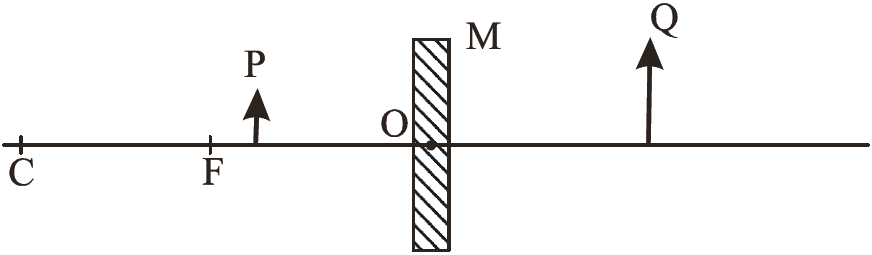
  1. Consider the following diagram in which M is a mirror and P is an object and Q is its magnified image formed by the mirror.


State the type of the mirror M and one characteristic property of the image Q.
Draw a labelled diagram of an electric motor. Explain its principle and working. What is the function of a split ring in an electric motor?
What is the difference in colours of the Sun observed during sunrise/ sunset and noon? Give explanation for each.
  1. Given below are the steps for extraction of copper from its ore. Write the reaction involved.
    1. Roasting of copper (1) sulphide.
    2. Reduction of copper (1) oxide with copper (1) sulphide.
    3. Electrolytic refining.
  2. Draw a neat and well labelled diagram for electrolytic refining of copper.
Draw a diagram to show why distant objects cannot be seen distinctly by a myopic eye. List two reasons due to which this defect of vision may be caused. A person with a myopic eye
cannot see objects clearly beyond a distance of 2 m. Name the type of corrective lens that would be needed to correct the defect of vision and draw a ray diagram to show how the defect
gets corrected.