Question
  1. Given below are the steps for extraction of copper from its ore. Write the reaction involved.
    1. Roasting of copper (1) sulphide.
    2. Reduction of copper (1) oxide with copper (1) sulphide.
    3. Electrolytic refining.
  2. Draw a neat and well labelled diagram for electrolytic refining of copper.
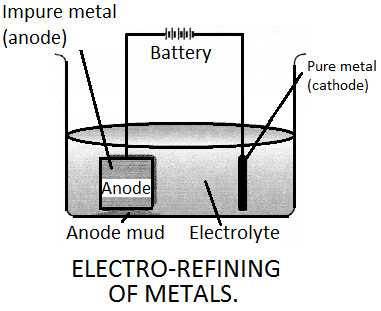
Answer

  1. Given below are the steps.
  1. Roasting:
$2\text{Cu}_2\text{S(s) + 3O}_2\text{(g)}\xrightarrow{\text{heat}}2\text{Cu}_2\text{O(s) + 2SO}_2\text{(g)}$
  1. Reduction:
$2\text{Cu}_2\text{O(s) + Cu}_2\text{S(s)}\xrightarrow{\text{heat}}6\text{Cu}\text{(s) + SO}_2\text{(g)}$
This reaction in which one of the reactants $\left( Cu _2 S\right)$ carries the reduction of the product $\left( Cu _2 O \right)$ is known as auto-reduction.
3. Reactions taking place in electrorefensing are:

At cathode (reduction): $Cu ^{2+}( aq )+2 e ^{-} \rightarrow Cu ( s )$

At anode (oxidation): $Cu ( s ) \rightarrow Cu ^{2+}( aq )+2 e ^{-}$
  1. For the diagram of electro-refining,

Need a full question paper?

Generate a complete, print-ready paper with questions like this in minutes — across 16+ boards, with answer keys.

Start Generating Free

Similar questions

Which element has:
  1. Two shells, both of which are completely filled with electrons?
  2. The electronic configuration 2, 8, 2?
  3. A total of three shells, with four electrons in its valence shell?
  4. A total of two shells, with three electrons in its valence shell?
  5. Twice as many electrons in its second shell as its first shell?
A forest ecosystem having a lot of green plants has some foxes, lions and rabbits in it.
  1. Write a food chain comprising all the four organisms mentioned above.
  2. Name (i) one herbivore, and (ii) two carnivores, in this food chain.
  3. Name the link which is a predator as well as a prey.
  4. Name (i) second trophic level, and (ii) third trophic level.
  5. Which link of this food chain can feed on second trophic level as well as third trophic level, independently?
  6. If the sun provides 1000 J of energy to the plants, then how much energy will be transferred to fox through the food chain.
When a person puts food in his mouth, then teeth cut it into small pieces, chew and grind it. The glands A in the mouth secrete a substance B which is mixed with the food by tongue. The substance B contains an enzyme C which starts the digestion of food in the mouth. The slightly digested food from the mouth goes down a tube D. The special type of movements E in the walls of tube D push the food into stomach for further digestion. The stomach wall secretes gastric juice containing three substance F, G and H. One of the functions of F is to kill bacteria which may enter the stomach with food. The substance G protects the inside layer of stomach from the damaging effect of substance F whereas substance H is and enzyme for digestion. The partially digested food then enters into small intestine for further digestion.
  1. What is Gland A, Substance B and Enzyme C?
  2. Name the tube D.
  3. What is the movement E known as?
  4. What are F, G and H?
Draw a diagram of the human heart and label its parts.
With the help of a circuit diagram, deduce the equivalent resistance of two resistances connected in series. Two resistances are connected in series as shown in the diagram:
  1. What is the current through the 5 ohm resistance?
  2. What is the current through R?
  3. What is the value of R?
  4. What is the value of V?
An element X (atomic number 17) reacts with an element Y (atomic number 20) to form a divalent halide.
  1. Where in the periodic table are elements X and Y placed?
  2. Classify X and Y as metal (s), non-metal (s) or metalloid (s)
  3. What will be the nature of oxide of element Y? Identify the nature of bonding in the compound formed.
  4. Draw the electron dot structure of the divalent halide.
A and B are two pairs of glands that are present in the human endocrine system. The pair A is found only in females, whereas B is present only in males. Glands A make and secrete two hormones C and D, whereas glands B make and secrete only one hormone E. In addition to hormones, Glands A make gametes F, whereas glands B make gametes G.
  1. What are the glands A?
  2. What are the hormones C and D?
  3. What are the glands B? Name the hormone E.
  4. What are the gametes F and G?
  5. Which event in the life of males and females is associated with the secretion of the hormones C, D and E?
How will you conclude that the same potential difference (voltage) exists across three resistors connected in a parallel arrangement to a battery?
What are the various ways in which a chemical equation can be made more informative? Give examples to illustrate your answer.
If a person holds his breath after expiration for about 25sec, would there be occurrence of any exchange of respiratory gases in the lungs during this period? Explain.