MCQ
Which force is dissipative force?
  • A
    Electrostatic force.
  • B
    Magnetic force.
  • C
    Gravitational force.
  • Frictional force.

Answer

Correct option: D.
Frictional force.
Frictional force is a non$-$conservative force because work done by it is dissipated $($wasted$)$ as heat energy. This is not the case with other forces.

Need a full question paper?

Generate a complete, print-ready paper with questions like this in minutes — across 16+ boards, with answer keys.
Start Generating Free

Similar questions

A wheel is rotating about an axis through its centre at $720\, rpm$. It is acted on by a constant torque opposing its motion for $8\, seconds$ to bring it to rest finally. The value of torque (in $N-m$) is  (Given $I = \frac{{24}}{\pi }kg - {m^2}$ )
Two sources are called coherent if they produce waves:
$A$ block of mass $m$ slides down a plane inclined at an angle $\theta$ . Which of the following will $NOT$ increase the energy lost by the block due to friction?
The first overtone of a stretched wire of given length is $320 Hz$. The first harmonic is  .... $Hz$
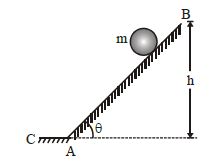
A sphere of mass $m$ comes down on a smooth inclined plane from a point $B$ at a height of $h$ from rest. The magnitude of change in momentum of the particle between the position $A$ and $C$ (assuming the angle of inclination of the plane as $\theta $ with respect to the horizontal) is
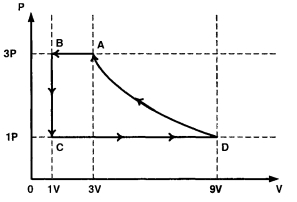
One mole of a monatomic ideal gas is taken through a cycle $ABCDA$ as shown in the $P-V$ diagram. Column $II$ gives the characteristics involved in the cycle. Match them with each of the processes qiven in Column $I$
Column $I$ Column $II$
$(A)$ Process $A \rightarrow B$ $(p)$ Internal energy decreases.
$(B)$ Process $B \rightarrow C$ $(q)$ Internal energy increases.
$(C)$ Process $C \rightarrow D$ $(r)$ Heat is lost.
$(D)$ Process $D \rightarrow A$ $(s)$ Heat is gained.
  $(t)$ Work is done on the gas.

Frequency of a sonometer wire is $n.$ Now its tension is increased $4$ times and its length is doubled then new frequency will be
Surface of the lake is at $2°C$ . Find the temperature of the bottom of the lake..... $^oC$
A uniform cube is subjected to volume compression. If each side is decreased by $1\%,$ then bulk strain is
The velocity of projection of a body is increased by $2 \% .$ Other factors remaining unchanged, what will be the percentage change in the maximum height attained ? (in $\%$)