MCQ
The first overtone of a stretched wire of given length is $320 Hz$. The first harmonic is  .... $Hz$
  • A
    $320$
  • $160$
  • C
    $480$
  • D
    $640$

Answer

Correct option: B.
$160$
b
(b) Frequency of first overtone or second harmonic $(n_2)  = 320\,Hz$.

So, frequency of first harmonic ${n_1} = \frac{{{n_2}}}{2} = \frac{{320}}{2} = 160Hz$

Need a full question paper?

Generate a complete, print-ready paper with questions like this in minutes — across 16+ boards, with answer keys.
Start Generating Free

Similar questions

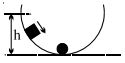
$A$ block of mass $m$ starts from rest and slides down $a$ frictionless semi-circular track from $a$ height $h$ as shown. When it reaches the lowest point of the track, it collides with a stationary piece of putty also having mass $m$. If the block and the putty stick together and continue to slide, the maximum height that the block-putty system could reach is:
Function $x$ = $A sin^2 wt + B cos^2 wt + C sin wt \  cos wt$ does not represents $SHM$ for this condition
$A$ particle with constant total energy $E$ moves in one dimension in a region where the potential energy is $U(x)$. The speed of the particle is zero where
In an elliptical orbit under gravitational force, in general
A physcial quantity $x$ depends on quantities $y$ and $z$ as follows: $x = Ay + B\tan Cz$, where $A,\,B$ and $C$ are constants. Which of the following do not have the same dimensions
A ball falls vertically downward and bounces off a horizontal floor.The speed of the ball just before reaching the floor $\left(u_1\right)$ is equal to the speed just after leaving contact with the floor $\left(u_2\right), u_1=u_2$. The corresponding magnitudes of accelerations are denoted respectively by $a_1$ and $a_2$. The air resistance during motion is proportional to speed and is not negligible. If $g$ is acceleration due to gravity, then
A rocket is launched with velocity $10\, km/s$. If radius of earth is $R$, then maximum height attained by it will be
$A$ cylinder and a ring of same mass $M$ and radius $R$ are placed on the top of a rough inclined plane of inclination $\theta$ . Both are released simultaneously from the same height $h$. When these bodies roll down to the foot of the inclined plane, then
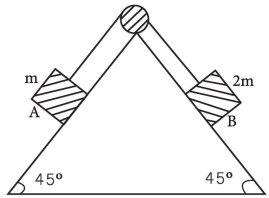
Consider the diagram shown below in which two masses of $m$ and $2 m$ are placed on a fixed triangular wedge. The coefficient of friction between block $A$ and the wedge is $2 / 3$, while that for block $B$ and the wedge is $1 / 3$
One mole of an ideal monatomic gas undergoes a process described by the equation $PV^3 =$ constant. The heat capacity of the gas during this process is