MCQ
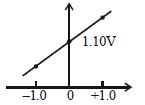
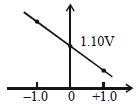
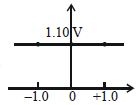
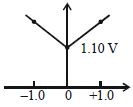
Which graph correct correlates $E_{cell}$ as a function of concentrations for the cell (for different values of $M$ and $M'$) :-

$Zn(s) + Cu^{2+}(M) \to Zn^{2+}(M') + Cu(s);$    $E^o _{cell} = 1.10\,V$

$X$-axis :$log_{10}$ $\frac{{[Z{n^{2 + }}]}}{{[C{u^{2 + }}]}}$,  $Y$ -axis : $E_{cell}$

  • A


  • C

  • D

Answer

Correct option: B.

b
${{\text{E}}_{\text{cell }}}=\text{E}_{\text{cell }}^{0}-\frac{0.059}{2}\log \frac{\left[ \text{Z}{{\text{n}}^{+2}} \right]}{\left[ \text{C}{{\text{u}}^{+2}} \right]}$

Need a full question paper?

Generate a complete, print-ready paper with questions like this in minutes — across 16+ boards, with answer keys.

Start Generating Free

Similar questions

$2.5 \mathrm{~g}$ of a non-volatile, non-electrolyte is dissolved in $100 \mathrm{~g}$ of water at $25^{\circ} \mathrm{C}$. The solution showed a boiling point elevation by $2^{\circ} \mathrm{C}$. Assuming the solute concentration in negligible with respect to the solvent concentration, the vapour pressure of the resulting aqueous solution is . . . . . .  $\mathrm{mm}$ of $\mathrm{Hg}$ (nearest integer)

[Given : Molal boiling point elevation constant of water $\left(\mathrm{K}_{\mathrm{b}}\right)=0.52 \mathrm{K.} \mathrm{kg} \mathrm{mol}^{-1}$,

$1 \mathrm{~atm}$ pressure $=760 \mathrm{~mm}$ of $\mathrm{Hg}$, molar mass of water $\left.=18 \mathrm{~g} \mathrm{~mol}^{-1}\right\rfloor$

Which one of the following is the reagent used to identify glucose
Which anion can undergo both oxidation and reduction?
Metals generally melt at very high temperature. Amongst the following, the metal with the highest melting point will be $......$
Variable valency is characteristic of:
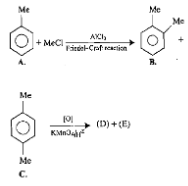
Product $(C)$ of the above reaction is
Match the electronic configurations in List-$I$ with appropriate metal complex ions in List-$II$ and choose the correct option.

[Atomic Number: $\mathrm{Fe}=26, \mathrm{Mn}=25, \mathrm{Co}=27$ ]

List-$I$ List-$II$
($P$) $ t_{2 g}^6 e_g^0$ ($1$)$\left[\mathrm{Fe}\left(\mathrm{H}_2 \mathrm{O}\right)_6\right]^{2+}$
($Q$) $t_{2 g}^3 e_g^2$ ($2$) $\left[\mathrm{Mn}\left(\mathrm{H}_2 \mathrm{O}\right)_6\right]^{2+}$
($R$) $e^2 t_2^3$ ($3$)$\left[\mathrm{Co}\left(\mathrm{NH}_3\right)_6\right]^{3+}$
($S$) $t_{2 g}^{+} e_g^2$ ($4$)$\left[\mathrm{FeCl}_4\right]^{-}$
  $\left[\mathrm{CoCl}_4\right]^{2-}$


In chromic acid oxidation of alcohol, the chromium is
Consider the following reaction: The compound $D$ is an ortho$-$isomer and $E$ is a $p−$isomer. The compounds $D$ and $E,$ respectively are:
Match each of the reactions given in Column $I$ with the corresponding product$(s)$ given in Column $II$.
Column $I$ Column $II$
$(A)$ $\mathrm{Cu}+$ dil $\mathrm{HNO}_3$ $(p)$ NO
$(B)$ $\mathrm{Cu}+$ conc $\mathrm{HNO}_3$ $(q)$ $\mathrm{NO}_2$
$(C)$ $\mathrm{Zn}+$ dil $\mathrm{HNO}_3$ $(r)$ $\mathrm{N}_2 \mathrm{O}$
$(D)$ $\mathrm{Zn}+$ conc $\mathrm{HNO}_3$ $(s)$ $\mathrm{Cu}\left(\mathrm{NO}_3\right)_2$
  $(t)$ $ \mathrm{Zn}\left(\mathrm{NO}_3\right)_2$