MCQ
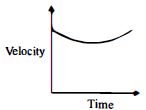
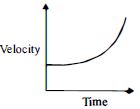
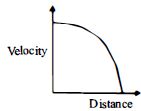
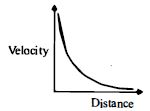
Which graph corresponds to an object moving with a constant negative acceleration and a positive velocity?
  • A

  • B


  • D

Answer

Correct option: C.

c
$\begin{array}{l}
According\,to\,question,\,object\,is\,moving\,with\\
{\rm{constant}}\,nagative\,acceleration\,i.e.,a =  - {\rm{constant}}\left( C \right)\\
\frac{{vdv}}{{dx}} =  - C\\
vdv =  - Cdx\\
\frac{{{v^2}}}{2} =  - Cx + k\\
x =  - \frac{{{v^2}}}{{2C}} + \frac{k}{C}\\
Hence\,graph\,\left( 3 \right)\,represents\,correctly
\end{array}$

Need a full question paper?

Generate a complete, print-ready paper with questions like this in minutes — across 16+ boards, with answer keys.

Start Generating Free

Similar questions

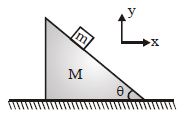
Consider the shown arrangement. Assume all surfaces to be smooth. If $N$ represents magnitudes of normal reaction between block and wedge, then acceleration of $M$ along horizontal equals
A stone of mass $900 \mathrm{~g}$ is tied to a string and moved in a vertical circle of radius $1 \mathrm{~m}$ making $10\  \mathrm{rpm}$. The tension in the string, when the stone is at the lowest point is (if $\pi^2=9.8$ and $g=9.8 \mathrm{~m} / \mathrm{s}^2$ )
A standing wave pattern of amplitude $A$ in a string of length $L$ shows $2$ nodes (plus those at two ends). If one end of the string corresponds to the origin and $v$ is the speed of progressive wave, the disturbance in the string, could be represented (with appropriate phase) as: 
A body of mass $4\  kg$ collides head-on elastically with another body of mass $2\  kg$ kept at rest in free space. Time of collision is $0.02\  sec$ and average impulse force acted on each bodies is $100\  N$. Find the velocity of the $2\  kg$ body after the impact
Consider a drop of rain water having mass $1\, g$ falling from a height of $1\, km.$ It hits the ground with a speed of $50\, m s^{-1}$. Take $g$ constant with a value $10 \, m s^{-1}$. The work done by the $(i)$ gravitational force and the $(ii)$ resistive force of air is
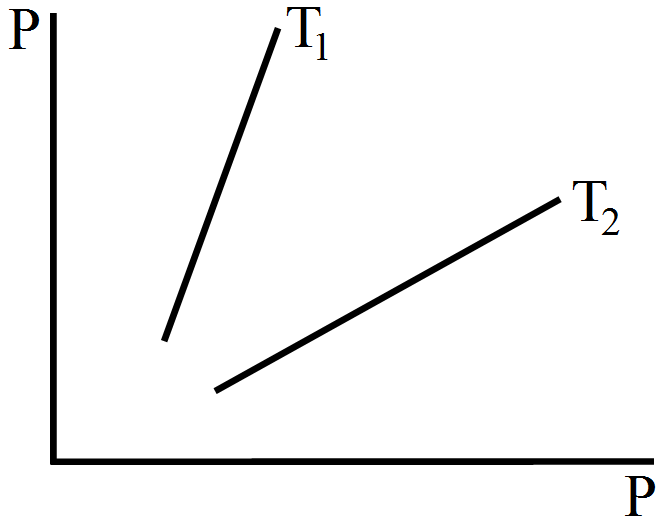
Figure. shows graphs of pressure vs density for an ideal gas at two temperatures T1 and T2.
  1. T1 > T2
  2. T1 = T2
  3. T1 < T2
  4. Any of the three is possible.

A vertical mass-spring system executes simple harmonic oscillations with a period of $2\,s$. A quantity of this system which exhibits simple harmonic variation with a period of $1\, s$ is
In an explosion a body breaks up into two pieces of unequal masses. In this
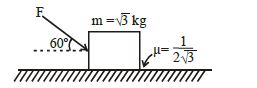
What is the maximum value of the force $F$ such that the block shown in the arrangement does not move ....... $N$
Galileo writes that for angles of projection of a projectile at angles $(45 + \theta )$ and $(45 - \theta )$, the horizontal ranges described by the projectile are in the ratio of (if $\theta \le 45)$