Question
Which group of elements could be placed in Mendele′ ev's Periodic Table without disturbing the original order? Give reason.

Answer

Inert gases could be placed in Mendeleev’s Periodic Table without disturbing the original order.
Noble gases; like Helium, Neon and Argon had been mentioned by various scientists even before Mendeleev. But these gases could be grouped together as noble gases much later than Mendeleev’s discovery. Mendeleev used 63 elements till his periodic table because these were the only known elements till his time. However, he was bold enough to leave gaps in his periodic table. He had predicted that that more elements would be discovered in times to come.
Mendeleev’s Periodic Table was the first comprehensive attempt to classify elements on the basis of their chemical properties. This is the main reason that new elements could be easily placed in Mendeleev’s Periodic Table without disturbing the original order.

Need a full question paper?

Generate a complete, print-ready paper with questions like this in minutes — across 16+ boards, with answer keys.
Start Generating Free

Similar questions

How would you distinguish between baking powder and washing soda by heating?
Explain why, a salt which does not conduct electricity in the solid state becomes a good conductor in molten state.
Raina while doing certain reactions observed that heating of substance ' $X$ ' with vinegar like smell with a substance ' $Y$ ' (which is used as an industrial solvent) in presence of conc. Sulphuric acid on a water bath gives a sweet-smelling liquid ' $Z$ ' having molecular formula $C _4 H _8 O _2$. When heated with caustic soda $( NaOH )$, ' $Z$ ' gives back the sodium salt of and the compound ' $Y$ '
Identify ' $X$ ', ' $Y$ ', and ' $Z$ '. Illustrate the changes with the help of suitable chemical equations.
State the reason why carbon can neither form $\text{C}^{4+}$ cations nor $\text{C}^{4-}$ anions, but forms covalent compounds. Also state reasons to explain why covalent compounds:
  1. Are bad conductors of electricity?
  2. Have low melting and boiling points?
Compounds such as alcohol and glucose also contain hydrogen but are not categorised as acids. Describe an activity to prove it.
A metal which exists as a liquid at room temperature is obtained by heating its sulphide ore in the presence of air.
  1. Name the metal and write its chemical symbol.
  2. Write the name and formula of the sulphide ore.
  3. Give the equations of chemical reactions involved in the production of metal from its sulphide ore.
  4. Name a common device in which this metal is used.
  5. Can this metal displace copper from copper sulphate solution? Why?
  1. List in tabular from three chemical properties on the basis of which we can differentiate between a metal and a non-metal.
  2. Give reasons for the following:
  1. Most metals conduct electricity well.
  2. The reaction of iron (III) oxide [Fe2O3] with heated aluminium is used to join cracked machine parts.
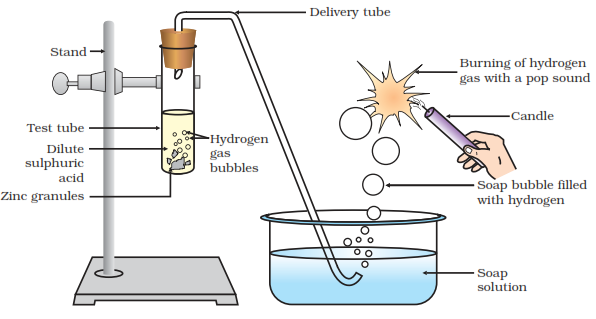
In the following schematic diagram for the preparation of hydrogen gas as shown in Figure, what would happen if following changes are made?

  1. In place of zinc granules, same amount of zinc dust is taken in the test tube.
  2. Instead of dilute sulphuric acid, dilute hydrochloric acid is taken.
  3. In place of zinc, copper turnings are taken.
  4. Sodium hydroxide is taken in place of dilute sulphuric acid and the tube is heated.
Compound ' A ', when dissolved in water, gives compound ' B ' and liberates heat. Compound ' A ' is used in whitewashing. Compound ' B ' reacts with $CO _2$ to form a white precipitate of compound ' C '. Identify compounds ' A ', ' B ' and ' C ' Also write the equations involved.
The metal M reacts vigorously with water to form a solution S and a gas G. The solution S turns red litmus to blue whereas gas G, which is lighter than air, burns with a pop sound. Metal M has a low melting point and it is used as a coolant in nuclear reactors.
  1. What is metal M?
  2. What is solution S? Is it acidic or alkaline?
  3. What is gas G?
  4. Write a balanced chemical equation for the reaction which takes place when metal M reacts with water.
  5. Is this reaction exothermic or endothermic?