Question
Which important property did Mendeleev use to classify the elements in his periodictable and did he stick to that?

Answer

Mendeleev organized the components in his periodic table, according to the order of their atomic weight. Mendeleev organized the components in groups and periods according to the increasing atomic weight. Mendeleev set the elements which are having comparative properties in the similar groups.
Nonetheless, he didn’t adhere to arrangement that he gave for long. He discovered that if the elements were organized according to their increasing atomic weights, then a few elements did not match within this plan of characterization.
In this manner, he overlooked the order of atomic weights now and again. For instance, the atomic mass of iodine is lower than atomic mass of tellurium.
Still Mendeleev set tellurium (in Group 6) ahead of iodine (in Group 7) essentially in light of the fact that iodine’s properties are so comparable to fluorine, chlorine, and bromine.

Need a full question paper?

Generate a complete, print-ready paper with questions like this in minutes — across 16+ boards, with answer keys.

Start Generating Free

Similar questions

  1. Define standard enthalpy of formation. Explain why the enthalpy changes for the reaction given below are not enthalpies of formation of CaCO3 and HBr:
  1. $\text{CaO(s)}+\text{CO}_2(\text{g})\overrightarrow{\ \ \ \ \ \ \ \ }\ \text{CaCO}_3(\text{s});$ $\Delta_\text{r}\text{H}^\circ=-178.3\text{kJ mol}^{-1}$
  2. ​​​​​​​$\text{H}_2(\text{g})+\text{Br}_2(\text{g})\overrightarrow{\ \ \ \ \ \ \ }\ 2\text{HBr(g)};$ $\Delta_\text{r}\text{H}^\circ=-72.8\text{kJ mol}^{-1}$
  1. Use the bond enthalpies listed below to determine the enthalpy of reaction:

$\ \ \ \ \ \ \ \ \text{H}\\ \ \ \ \ \ \ \ \ \ |\\\text{H}-\text{C}-\text{H(g)}+2\text{O}=\text{O(g)}\overrightarrow{\ \ \ \ \ }\ \text{O}=\text{C}=\text{O(g)}\\ \ \ \ \ \ \ \ \ \ |\\ \ \ \ \ \ \ \ \ \text{H}\\+2\text{H}-\text{O}-\text{H(g)}$

Bond enthalpy $(\Delta\text{H}^\circ)/\text{kJ mol}^{-1}$ of C=O = 741; C-H = 414; H-O = 464; O=O = 498.

  1. Define enthalpy of neutralization. The enthalpy of neutralisation of strong acid and strong base is constant, why?
  2. What is the basis of Hess's Law?
  3. For a gaseous reaction 2A2(g) + 5B2(g) → 2A2B5(g) at 27°C, the heat change at constant pressure is found to be -50.16kJ. Calculate the value of internal energy change $(\Delta\text{U}).$

Given: R = 8.314JK-1mol-1

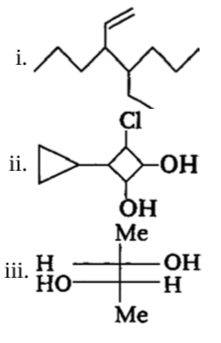
1. Give IUPAC names of the following structures.
Image
2. Benzoic acid is an organic compound. Its crude sample can be purified by crystallization from hot water. What characteristic differences in the properties of benzoic acid and the impurity make this process of purification suitable?
Identify the substance oxidised reduced, oxidising agent and reducing agent for each of the following reactions:

  1. 2AgBr(s) + C6H6O2(aq) → 2Ag(s) + 2HBr(aq) + C6H4O2(aq)

  2. HCHO(l) + 2[Ag(NH3)2]+(aq) + 3OH-(aq) → 2Ag(s) + HCOO-(aq) + 4NH3(aq) + 2H2O(l)

  3. HCHO(l) + 2Cu2+(aq) + 5OH-(aq) → Cu2O(s) + HCOO-(aq) + 3H2O(l)

  4. N2H4(l) + 2H2O2(l) → N2(g) + 4H2O(l)

  5. Pb(s) + PbO2(s) + 2H2SO4(aq) → 2PbSO4(s) + 2H2O(l)

Explain redox reactions on the basis of electron transfer. Give suitable examples.
Equal volumes of 0.002M solutions of sodium iodate and cupric chlorate are mixed together. Will it lead to precipitation of copper iodate? (For cupric iodate Ksp = 7.4 × 10⁻⁸ ).
Calculate the energy required for the process,
$\text{He}^+(\text{g})\rightarrow\text{He}^{2+}\text{(g)}+\text{e}^-$
The ionization energy for the H atom in the ground state is 2.18 × 10⁻¹⁸J atom–1
Explain the half reaction method (ionelectron method) to balance the redox reaction with example.
The amount of energy released when one million of atoms of iodine in vapour state are converted to I- ions is 4.9 × 10-13J according to the reaction:
I(g) + e- → I-(g)
Express the electron gain enthalpy of iodine in terms of kJ mol-1 and eV per atom.
What is Hess's law? Explain with examples.