MCQ
Which is a Lewis base
  • A
    ${B_2}{H_6}$
  • B
    $LiAl{H_4}$
  • C
    $Al{H_3}$
  • $N{H_3}$

Answer

Correct option: D.
$N{H_3}$
d
It’s Obvious.

Need a full question paper?

Generate a complete, print-ready paper with questions like this in minutes — across 16+ boards, with answer keys.

Start Generating Free

Similar questions

Consider the following complexes.

$\left[\mathrm{CoCl}\left(\mathrm{NH}_3\right)_5\right]^{2+}, \quad\left[\mathrm{Co}(\mathrm{CN})_6\right]^{3-} \text {, }$

$(A)$                                        $(B)$

$\left[\mathrm{Co}\left(\mathrm{NH}_3\right)_5\left(\mathrm{H}_2 \mathrm{O}\right)\right]^{3+}, \quad\left[\mathrm{Cu}\left(\mathrm{H}_2 \mathrm{O}\right)_4\right]^{2+}$

$(C)$                                       $(D)$

The correct order of $A$, $B$, $C$ and $D$ in terms of wavenumber of light absorbed is :
Arrange the bonds in order of increasing ionic character in the molecules. $\mathrm{LiF}, \mathrm{K}_2 \mathrm{O}, \mathrm{N}_2, \mathrm{SO}_2$ and $\mathrm{CIF}_3$.
Which one belongs to $3d-$ transition series
The rate of first order reaction is $0.04 \mathrm{~mol} \mathrm{~L}^{-1} \mathrm{~s}^{-1}$ at $10$ minutes and $0.03 \mathrm{~mol} \mathrm{~L}^{-1} \mathrm{~s}^{-1}$ at $20$ minutes after initiation. Half life of the reaction is ____________minutes. (Given $\log 2=0.3010, \log 3=0.4771)$
$C{H_3} - C \equiv CH\xrightarrow[{(ii)\,\,{H_2}{O_2}/\mathop O\limits^\Theta  H}]{{(i)\,\,B{H_3} - THF}}\,(P)$

$C{H_3} - C \equiv CH\xrightarrow[{(ii)\,\,NaB{H_4}}]{{(i)\,\,Hg{{(OAC)}_2}/{H_2}O}}\,(Q)$

Choose the correct option

How many molecules are present in one gram of hydrogen........ $\times {10^{23}}$
Consider the following complexes.

$\left[\mathrm{CoCl}\left(\mathrm{NH}_3\right)_5\right]^{2+}, \quad\left[\mathrm{Co}(\mathrm{CN})_6\right]^{3-} \text {, }$

$(A)$                                        $(B)$

$\left[\mathrm{Co}\left(\mathrm{NH}_3\right)_5\left(\mathrm{H}_2 \mathrm{O}\right)\right]^{3+}, \quad\left[\mathrm{Cu}\left(\mathrm{H}_2 \mathrm{O}\right)_4\right]^{2+}$

$(C)$                                       $(D)$

The correct order of $A$, $B$, $C$ and $D$ in terms of wavenumber of light absorbed is :

For a reaction, $I^-+OCl^-  \to IO^-+Cl^-$ in a aqueous medium, the rate of reaction is given by $\frac{{d[{IO^ - }]}}{{dt}} = k[{I^ - }][OC{l^ - }]$ The overall order of reaction is
$n-$propyl bromide on treatment with ethanolic potassium hydroxide produces
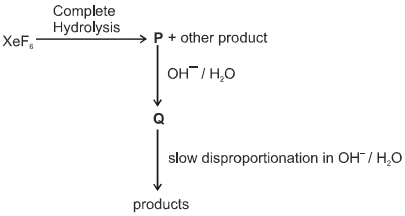
Under ambient conditions, the total number of gases released as products in the final step of the reaction scheme shown below is: