Question
Which is a stronger acid-phenol or cresol? Explain.

Answer

All the cresols are weaker acids than phenols. Methyl group has +I effect (positive inductive effect) as well as hyperconjugation effect but the hyperconjugation effect predominates over the +I effect. Since both these effects increase the electron density in the O-H bond and hence all the cresols are weaker acids than phenols
As hyperconjugation effect can operate only through ortho and para positions and not through meta positions, therefore, meta-cresol is stronger acid than ortho and para-cresols. However, due to stronger +I effect at ortho position than at para position (+I effect decreases with distance), ortho-cresol is a weaker acid than para-cresol. Thus, the order of acidic strength in increasing order is:
ortho-cresol < para-cresol < meta-cresol < phenol
Need a full question paper?

Generate a complete, print-ready paper with questions like this in minutes — across 16+ boards, with answer keys.

Start Generating Free

Similar questions

What happens when
  1. Ethyl chloride is treated with $\ce{NaI}$ in the presence of acetone,
  2. Chlorobenzene is treated with $\ce{Na}$ metal in the presence of dry ether,
  3. Methyl chloride is treated with $\ce{KNO_2}$?
Write chemical equations in support of your answer.
  1. What type of isomerism is shown by $\ce{[Co(NH_3)_5ONO]Cl_2}$?
  2. On the basis of crystal field theory, write the electronic configuration for $d^{4 }$ ion if $\Delta _o< P.$
  3. Write the hybridization and shape of $\ce{[Fe(CN)_6]^{_{3-}}}.$
$($Atomic number of $\ce{Fe = 26)}$
Describe the following :
Cross adol condensation
What do you understand by the term 'conductance'? What are its units?
A chloride of fourth group cation in qualitative analysis gives a green coloured complex $[A]$ in aqueous solution which when treated with ethane $-1, 2-$ diamine $($en$)$ gives pale $-$ yellow solution $[B]$ which on subsequent addition of ethane $-1, 2-$ diamine turns to blue/purple $[C]$ and finally to violet $[D]$. Write the structures of complexes $[A], [B], [C]$ and $[D].$
An organic compound $'A\ ’$ with molecular formula $\ce{C_5H_8O_2}$ is reduced to n pentane on treatment with $\ce{Zn–Hg/ HCl}. \  'A\ ’$ forms a dioxime with hydroxylamine and gives a positive lodoform test and Tollens’ test. Identify the compound $A$ and deduce its structure.
The rate of a particular reaction triples when temperature changes from $50^\circ C$ to $100^\circ C$. Calculate the activation energy of the reaction.$[\log 3 = 0.4771; R = 8.314 \ JK^{-1} \ mol^{-1}].$
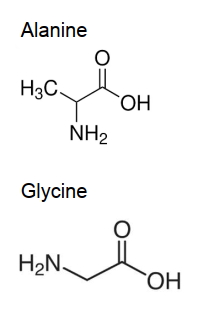
a. Give the structure of all the possible dipeptides formed when the following two amino acids form a peptide bond.
Image
b. Keratin, insulin, and myosin are a few examples of proteins present in the human body. Identify which type of protein is keratin and insulin and differentiate between them based on their physical properties.
(a) Write the IUPAC name of $\left[ K _4 Fe ( CN )_6\right]$
(b) Differentiate between the homoleptic and heteroleptic complexes.
(c) Draw the geometrical diagram of complex ion $\left( Co \left( NH _3\right)_6\right)^{3+}$
Determine the amount of CaCl2 (i = 2.47) dissolved in 2.5 litre of water such that its osmotic pressure is 0.75 atm at 27°C.