Questions

3 Marks Question

Take a timed test

14 questions · self-marked practice — reveal the answer and mark yourself.

Question 13 Marks
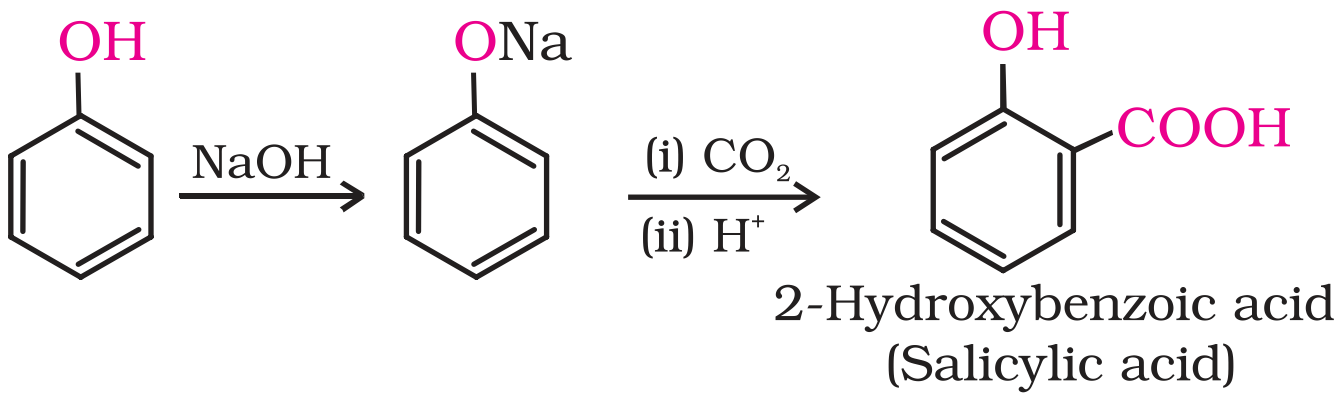
Answer the following question:$An$ organic compound A having molecular formula $\ce{C_6H_6O}$ gives a characteristic colour with aqueous $\ce{FeCl_3}$ solution. A on treatment with $\ce{CO_2}$ and $\ce{NaOH}$ at $400K$ under pressure gives $B$ which on acidification gives a compound $C.$ The compound $C$ reacts with acetyl chloride to give D which is a popular pain killer. Deduce the structure of $A, B, C$ and $D.$
View full question & answer
Question 23 Marks
Match the items of column $I$ with items of column $II.$
 
Column $I$
 
Column $II$
$(i)$
Methanol
$(a)$
Conversion of phenol to $o-$hydroxysalicylic acid
$(ii)$
Kolbe’s reaction
$(b)$
Ethyl alcohol
$(iii)$
Williamson’s synthesis
$(c)$ Conversion of phenol to salicylaldehyde
$(iv)$ Conversion of $2^\circ$ alcohol to ketone $(d)$ Wood spirit
$(v)$ Reimer$-$Tiemann reaction $(e)$ Heated copper at $573K$
$(vi)$ Fermentation $(f)$ Reaction of alkyl halide with sodium alkoxide
Answer
 
Column $I$
 
Column $II$
$(i)$
Methanol
$(d)$
Wood spirit
$(ii)$
Kolbe's reaction
$(a)$
Conversion of phenol to $o-$hydroxysalicylic acid
$(iii)$
Williamson's synthesis
$(f)$ Reaction of alkyl halide with sodium alkoxide
$(iv)$ Conversion of $2^\circ$ alcohol to ketone $(e)$ Heated copper at $573K$
$(v)$ Reimer$-$Tiemann reaction $(c)$ Conversion of phenol to salicylaldehyde
$(vi)$ Fermentation $(b)$ Ethyl alcohol.
Methanol is also known as 'wood spirit' as it was produced by the destructive distillation of wood.
  1. In Kolbe’s reaction, $2-$hydroxy benzoic acid $($salicylic acid$)$ is prepared by the reaction of phenol with $CO_2$ gas.
  1. Williamson,s synthesis is am important method for the preparation of ethers. In this method, an alkyl halide is allowed to react with sodium alkoxide.
  2. $\ce{R-X + R-ONa \rightarrow ROR + NaX}$
  1. When a $2$ alcohol is allowed to pass over heated copper at $573\ K$, dehydrogenation takes place and an ketone is formed.
$\text{R}-\text{CH}-\text{R}'\xrightarrow[573\text{ K}]{\text{Cu}}\text{R}-\text{C}-\text{R} \\ \ \ \ \ \ \ \ \ \ {|} \ \ \ \ \ \ \ \ \ \ \ \ \ \ \ \ \ \ \ \ \ \ \ \ \ \ \ \ \ \ \ \ \ {||} \\ \ \ \ \ \ \ \ \ \text{OH} \ \ \ \ \ \ \ \ \ \ \ \ \ \ \ \ \ \ \ \ \ \ \ \ \ \ \ \text{ O}$
  1. On trating phenol with chloroform in the presence of $\text{NaOH}$, an aldehydic group is introduced at ortho position of benzene ring
  1. Ethanol is prepered by the fermentation of sugars.
$\text{C}_{12}\text{H}_22\text{O}_{11}+\text{H}_2\text{O}\xrightarrow{\text{Invertase}}\text{C}_6\text{H}_{12}\text{O}_6+\text{C}_6\text{H}_{12}\text{O}_6$
$\text{C}_6\text{H}_{12}\text{O}_6\xrightarrow{\text{Zymase}}2\text{C}_2\text{H}_5\text{OH}+2\text{CO}_2$
View full question & answer
Question 33 Marks
Arrange water, ethanol and phenol in increasing order of acidity and give reason for your answer.
Answer

Phenol > Water > Ethanol

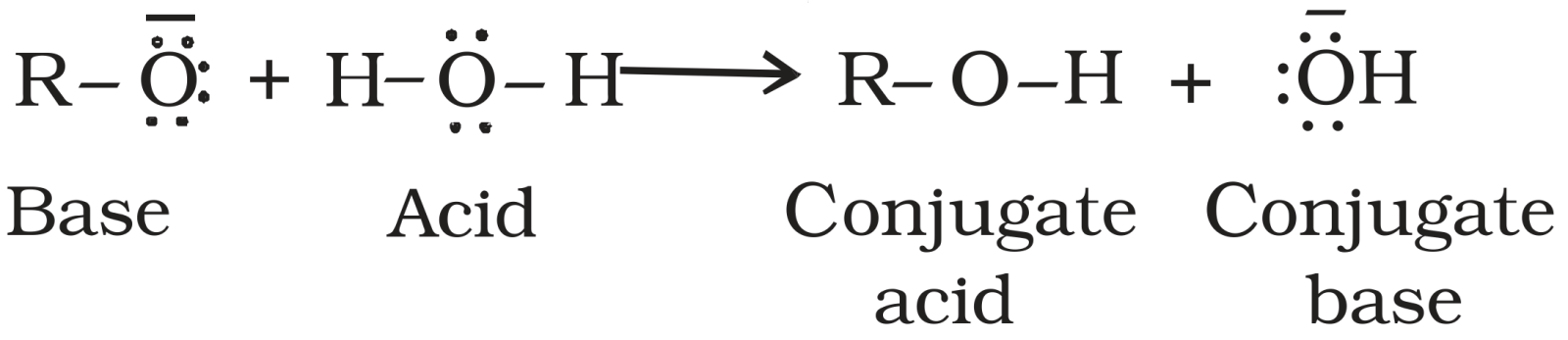
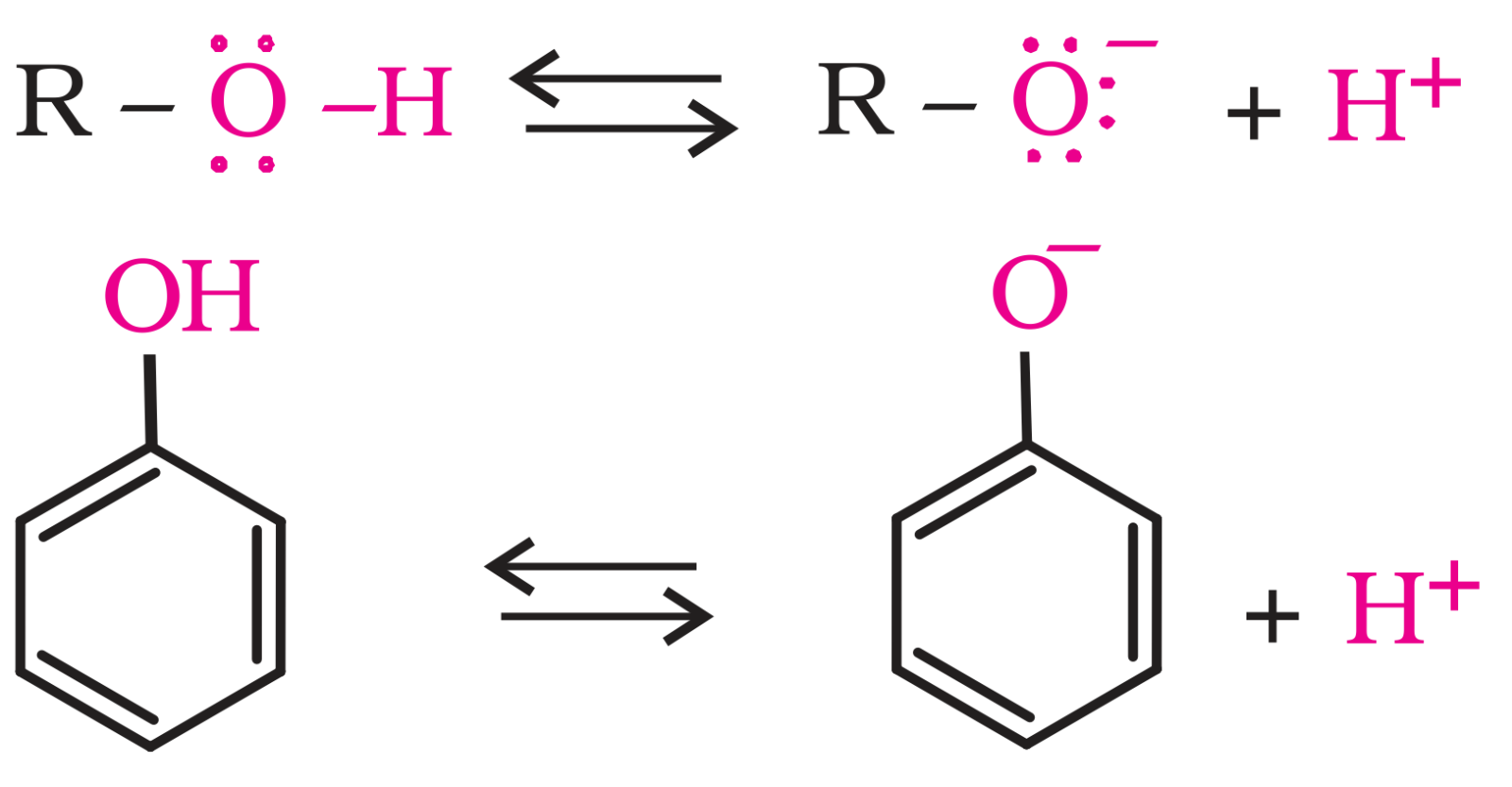
An alkoxide ion is a better proton acceptor than hydroxide ion, which suggests that alkoxides are stronger bases (sodium ethoxide is a stronger base than sodium hydroxide). The reaction of phenol with aqueous sodium hydroxide indicates that phenols are stronger acids than alcohol and water.
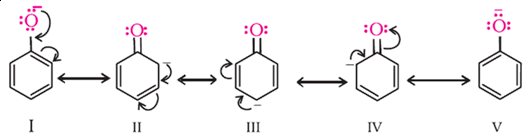
The ionisation of an alcohol and a phenol takes place as follows:

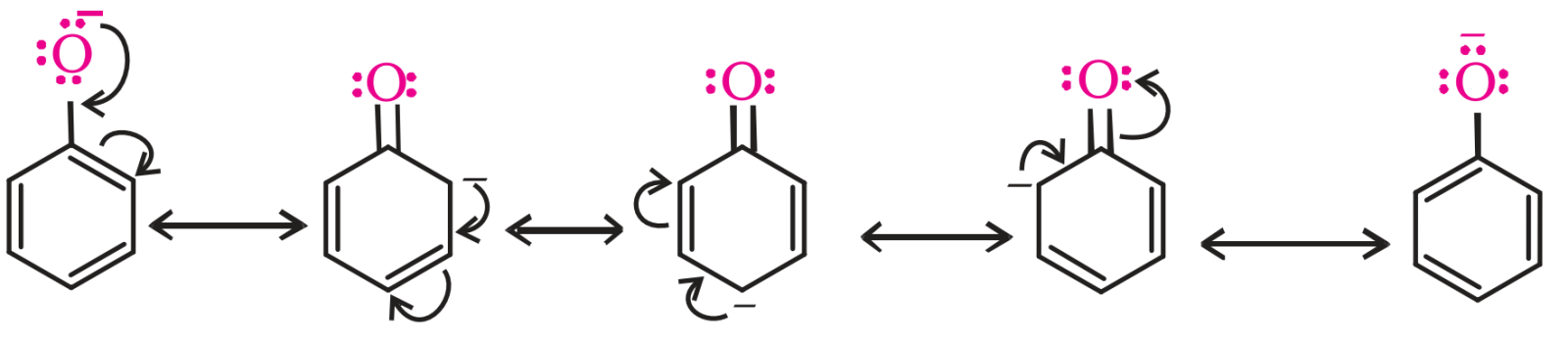
In alkoxide ion, the negative charge is localised on oxygen while in phenoxide ion, the charge is delocalised. The delocalisation of negative charge (structures I-V) makes.
View full question & answer
Question 43 Marks
Match the items of column $I$ with items of column $II$.
 
Column $I$
 
Column $II$
$(i)$
Antifreeze used in car engine
$(a)$
Neutral ferric chloride
$(ii)$
Solvent used in perfumes
$(b)$
Glycerol
$(iii)$
Starting material for picric acid
$(c)$
Methanol
$(iv)$
Wood spirit
$(d)$
Phenol
$(v)$
Reagent used for detection of phenolic group
$(e)$
Ethleneglycol
$(vi)$
By product of soap industry used in cosmetics
$(f)$
Ethanol.
Answer
 
Column $I$
 
Column $II$
$(i)$
Antifreeze used in car engine
$(e)$
Ethleneglycol
$(ii)$
Solvent used in perfumes
$(f)$
Ethanol
$(iii)$
Starting material for picric acid
$(d)$
Phenol
$(iv)$
Wood spirit
$(c)$
Methanol
$(v)$
Reagent used for detection of phenolic group
$(a)$ Neutral ferric chloride
$(vi)$
By product of soap industry used in cosmetics
$(b)$
Glycerol.
 Explanation:
  1. Ethleneglycol $\ce{IUPAC}$ name of ethylene glycol is ethane$-1,2-$diol a small percentage of it is used in antifreeze formulation.
  2. Ethanol $($it is less irritating to skin so it is used in perfumes$).$
  3. Phenol $($by the reaction of phenol with conc. $\ce{HNO3}$ phenol can be converted into picric acid$)$.
  4. Methanol $($methanol is known as wood spirit as it was obtained by destructive distillation of wood$)$.
  5. Neutral ferric chloride $($Neutral ferric chloride gives violet colour when treated with phenol).
  6. Glycerol $($it is the by product in soap industry and is used in cosmetics$)$.
View full question & answer
Question 53 Marks
Illustrate with examples the limitations of Williamson synthesis for the preparation of certain types of ethers.
Answer
Williamson's synthesis is a versatile method for the synthesis of both symmetrical and unsymmetrical ethers. However, for the synthesis of unsymmetrical ethers, a proper choice of reactants is necessary. Since Williamson's synthesis occurs by $SN_2$ mechanism and primary alkyl halides are most reactive in $Sn_2$ reaction, therefore, best yields of unsymmetrical ethers are obtained when the alkyl halides are primary and the alkoxide may be primary, secondary or tertiary. For example, tert$-$butylethyl ether is prepared by treating ethyl bromide with sodium tert$-$butoxide.$\ \ \ \ \ \ \ \ \ \ \ \ \ \text{CH}_3\ \ \ \ \ \ \ \ \ \ \ \ \ \ \ \ \ \ \ \ \ \ \ \ \ \ \ \ \ \ \ \ \ \ \ \ \ \ \ \ \ \ \ \ \ \ \ \ \ \ \ \ \ \ \ \ \ \ \ \ \ \ \ \ \text{CH}_3\\\ \ \ \ \ \ \ \ \ \ \ \ \ \ |\ \ \ \ \ \ \ \ \ \ \ \ \ \ \ \ \ \ \ \ \ \ \ \ \ \ \ \ \ \ \ \ \delta+ \ \ \ \ \ \delta- \ \ \ \ \ \ \ \ \ \ \ \ \ \ \ \ \ \ \ \ |\\ \text{CH}_3-\text{C}-\text{O}^-\text{Na}^++\text{CH}_3\text{CH}_2-\text{Br}\xrightarrow[]{\ \ \Delta\ }\text{CH}_3-\text{C}-\text{OCH}_2\text{CH}_3+\text{Na}^+\text{Br}^-\\\ \ \ \ \ \ \ \ \ \ \ \ \ \ |\ \ \ \ \ \ \ \ \ \ \ \ \ \ \ \ \ \ \ \ \ \ \ \ \ \ \ \ \ \ \ \ \ \ \ \ \ \ \ \ \ \ \ \ \ \ \ \ \ \ \ \ \ \ \ \ \ \ \ \ \ \ \ \ \ \ \ \ \ \ \ |\\ \ \ \ \ \ \ \ \ \ \ \ \ \ \text{CH}_3\ \ \ \ \ \ \ \ \ \ \ \ \ \ \ \ \ \ \ \ \ \ \ \ \ \ \ \ \ \ \ \ \ \ \ \ \ \ \ \ \ \ \ \ \ \ \ \ \ \ \ \ \ \ \ \ \ \ \ \ \ \ \ \ \ \text{CH}_3\\\ \ \ \ \ \ \ (3^\circ\text{ Alkoxide})$
The above ether cannot be prepared by treating sodium ethoxide with tert-butyl chloride or bromide since under these condition an alkene, i.e., isobutylene is the main product.
$\ \ \ \ \ \ \ \ \ \ \ \ \ \ \ \ \ \ \ \ \ \ \ \ \ \ \ \ \ \ \ \ \ \ \ \ \ \ \ \ \ \ \ \ \ \ \ \ \ \ \ \ \ \ \ \ \ \ \ \ \ \ \ \ \ \ \ \ \ \ \ \ \ \ \ \ \ \ \ \ \ \text{CH}_3\\\ \ \ \ \ \ \ \ \ \ \ \ \ \ \ \ |\text{CH}_3)_3-\text{C}-\text{Br}+\text{C}_2\text{H}_5\text{O}^-\text{Na}^+\xrightarrow{\ \ \ \ \ \ \ \ \ \ }\text{CH}_3-\text{C}=\text{CH}_2+\text{NaBr}+\text{C}_2\text{H}_5\text{OH}$
$\ \ \ \ \ \ \ \ \ \ \ \ \ \ \ \ \ \ \ \ \ \ \ \ \ \ \ \ \ \ \ \ \ \ \ \ \ \ \ \ \ \ \ \ \ \ \ \ \ \ \ \ \ \ \ \ \ \ \ \ \ \ \ \ \ \ \ \ \ \ \text{2-Methylpropene}$
Aryl and vinyl halides cannot be used as substrates because they are less reactive in nucleophilic substitution.
View full question & answer
Question 63 Marks
Give two reactions that show the acidic nature of phenol. Compare acidity of phenol with that of ethanol.
Answer
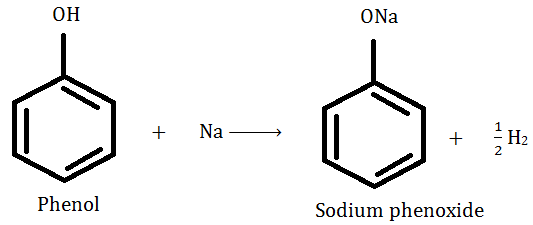
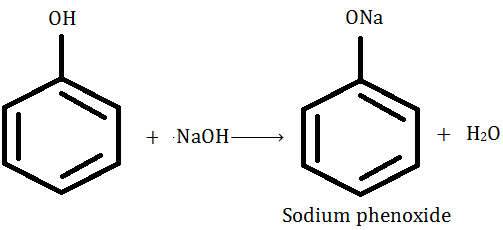
The acidic nature of phenol can be represented by the following two reactions:
  1. Phenol reacts with sodium to give sodium phenoxide, liberating $H_2.$
  1. Phenol reacts with sodium hydroxide to give sodium phenoxide and water as byproducts.

The acidity of phenol is more than that of ethanol. This is because after losing a proton, the phenoxide ion undergoes resonance and gets stabilized whereas ethoxide ion does not.
View full question & answer
Question 73 Marks
Identify the product of the following reaction:$ \ \ \ \ \ \ \ \ \ \text{CH}_3\\ \ \ \ \ \ \ \ \ \ \ \ \ \ \text{|}\\\text{CH}_3-\text{C}-\text{CH}_2-\text{Br}\xrightarrow{\stackrel{{}}{\hbox{Na}}\stackrel{{}}{\hbox{OH}}}\\ \ \ \ \ \ \ \ \ \ \ \ \ \ \text{|} \ \ \ \ \ \ \ \ \ \ \ \ \ \ \ \ \ \ \ \ \ \ \ \ \ \ \ \ \ \Delta\\ \ \ \ \ \ \ \ \ \ \text{CH}_3$
Answer

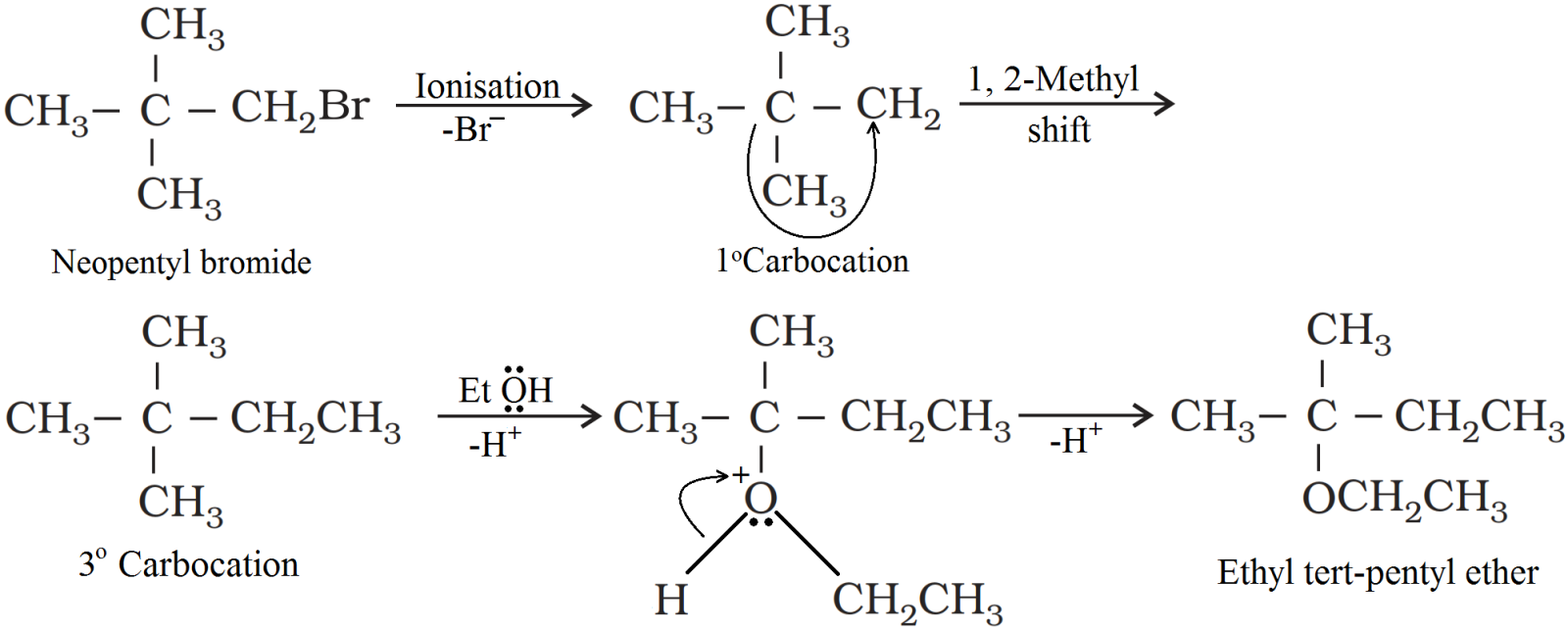
Neopentyl bromide ionises to form first a 1° carbocation which rearranges to form the more stable 3° carbocation. This is attacked by weak nucleophile ethanol followed by loss of proton to yield ethyl tert-pentyl ether.
View full question & answer
Question 83 Marks
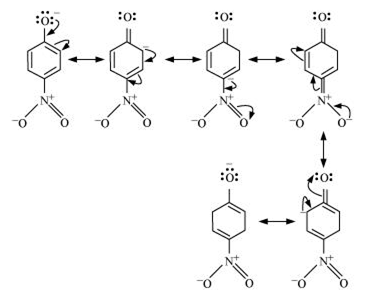
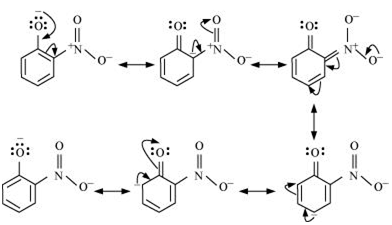
Ortho and para nitrophenols are more acidic than phenol. Draw the resonance structures of the corresponding phenoxide ions.
Answer

The electron withdrawing groups are more effective in increasing the acidic strength at the para-position relative to the ortho position because of greater dispersal of charge on oxygen atom.
Resonance structure of phenoxide ion:

Resonance structure of paranitrophenol:

Resonance structures of ortho nitro phenol:

Thus, presence of nitro group at ortho and para position incerease the acidic character.
View full question & answer
Question 93 Marks
  1. Draw the structures of all isomeric alcohols of molecular formula $\ce{C_5H_{12}O}$ and give their $\ce{IUPAC}$ names.
  2. Classify the isomers of alcohols in question $11.3 (i)$ as primary, secondary and tertiary alcohols.
Answer
  1. Eight isomeric alcohols are possible:
  1. $\text{CH}_3-\text{CH}_2-\text{CH}_2-\text{CH}_2-\text{CH}_2-\text{OH}\\ \ \ \ \text{Pentan-1-ol}(1^\circ)$
  2. $\text{CH}_3-\text{CH}_2-\text{CH}-\text{CH}_2-\text{OH}\\\ \ \ \ \ \ \ \ \ \ \ \ \ \ \ \ \ \ \ \ \ \ \ \ \ \ |\\\ \ \ \ \ \ \ \ \ \ \ \ \ \ \ \ \ \ \ \ \ \ \ \ \ \text{CH}_3\\ \text{2-Methylbutan-1-ol}(1^\circ)$
  3. $\text{CH}_3-\text{CH}-\text{CH}_2-\text{CH}_2-\text{OH}\\\ \ \ \ \ \ \ \ \ \ \ \ \ |\\ \ \ \ \ \ \ \ \ \ \ \ \ \text{CH}_3\\ \text{3-Methylbutan-1-ol}(1^\circ)$
  4. $\ \ \ \ \ \ \ \ \ \ \ \ \text{CH}_3\\\ \ \ \ \ \ \ \ \ \ \ \ \ |\\\text{CH}_3-\text{C}-\text{CH}_2-\text{OH}\\\ \ \ \ \ \ \ \ \ \ \ \ \ |\\\ \ \ \ \ \ \ \ \ \ \ \ \text{CH}_3\\ \text{2,2-Dimethylpropan-1-ol}(1^\circ)$
  5. $\ \ \ \ \ \ \ \ \ \ \ \ \ \ \ \ \ \ \ \ \ \ \ \ \ \ \ \ \ \ \ \ \ \ \ \ \ \ \text{OH}\\\ \ \ \ \ \ \ \ \ \ \ \ \ \ \ \ \ \ \ \ \ \ \ \ \ \ \ \ \ \ \ \ \ \ \ \ \ \ \ |\\\text{CH}_3-\text{CH}_2-\text{CH}_2-\text{CH}-\text{CH}_3\\ \text{Pentan-2-ol}(2^\circ)$
  6. $\ \ \ \ \ \ \ \ \ \ \ \ \text{CH}_3\ \ \ \ \text{OH}\\\ \ \ \ \ \ \ \ \ \ \ \ \ |\ \ \ \ \ \ \ \ \ \ |\\\text{CH}_3-\text{CH}-\text{CH}-\text{CH}_3\\ \text{3-Methylbutan-2-ol}(2^\circ)$
  7. $\ \ \ \ \ \ \ \ \ \ \ \ \ \ \ \ \ \ \ \ \ \ \ \ \ \text{OH}\\\ \ \ \ \ \ \ \ \ \ \ \ \ \ \ \ \ \ \ \ \ \ \ \ \ \ |\\\text{CH}_3-\text{CH}_2-\text{CH}-\text{CH}_2-\text{CH}_3\\ \text{Pentan-3-ol}(2^\circ)$
  8. $\ \ \ \ \ \ \ \ \ \ \ \ \ \ \ \ \ \ \ \ \ \ \ \ \ \text{OH}\\\ \ \ \ \ \ \ \ \ \ \ \ \ \ \ \ \ \ \ \ \ \ \ \ \ \ |\\\text{CH}_3-\text{CH}_2-\text{C}-\text{CH}_3\\\ \ \ \ \ \ \ \ \ \ \ \ \ \ \ \ \ \ \ \ \ \ \ \ \ \ |\\\ \ \ \ \ \ \ \ \ \ \ \ \ \ \ \ \ \ \ \ \ \ \ \ \ \text{CH}_3\\ \text{2-Methylbutan-2-ol}(3^\circ)$
  1. Primary alcohol: Pentan$-1-ol;$ methyl butan$-1-ol; 3-$methyl$-1-ol; 2,2$Dimethyl propan$-t-ol.$
Secondary alcohol: Pentan$-2-ol; 3-$methylbutan$-2-ol;$ pentan$-3-ol.$
Tertiary alcohol: $2-$methylbutan$-2-ol.$
View full question & answer
Question 103 Marks
Which is a stronger acid-phenol or cresol? Explain.
Answer
All the cresols are weaker acids than phenols. Methyl group has +I effect (positive inductive effect) as well as hyperconjugation effect but the hyperconjugation effect predominates over the +I effect. Since both these effects increase the electron density in the O-H bond and hence all the cresols are weaker acids than phenols
As hyperconjugation effect can operate only through ortho and para positions and not through meta positions, therefore, meta-cresol is stronger acid than ortho and para-cresols. However, due to stronger +I effect at ortho position than at para position (+I effect decreases with distance), ortho-cresol is a weaker acid than para-cresol. Thus, the order of acidic strength in increasing order is:
ortho-cresol < para-cresol < meta-cresol < phenol
View full question & answer
Question 113 Marks
How are the following conversions carried out?
Propanol to propan-2-ol
Answer
$ \ \ \ \ \ \ \ \ \ \ \ \ \ \ \ \ \ \ \ \ \ \ \ \ \ \ \ \ \ \ \ \ \ \ \ \ \ \ \ \ \ \ \ \ \ \ \ \ \ \ \ \ \ \ \ \ \ \ \ \ \ \ \ \ \ \ \ \ \ \ \ \ \ \ \ \ \ \ \ \ \ \ \ \ \ \ \ \ \ \ \ \ \ \ \ \ \ \ \ \ \ \ \ \ \ \ \ \ \ \ \text{OH}\\ \ \ \ \ \ \ \ \ \ \ \ \ \ \ \ \ \ \ \ \ \ \ \ \ \ \ \ \ \ \ \ \ \ \ \ \ \ \ \ \ \ \ \ \ \ \ \ \ \ \ \ \ \ \ \ \ \ \ \ \ \ \ \ \ \ \ \ \ \ \ \ \ \ \ \ \ \ \ \ \ \ \ \ \ \ \ \ \ \ \ \ \ \ \ \ \ \ \ \ \ \ \ \ \ \ \ \ \ \ \ \ \ \text{|}\\\text{CH}_3-\text{CH}_2-\text{CH}_2-\text{OH}\xrightarrow{ \ \ \ \ \ \text{H}_2\text{SO}_4 \ \ \ \ }\text{CH}_3-\text{CH}=\text{CH}_2\xrightarrow{\text{H}_2\text{O}/\text{H}^{+}}\text{CH}_3-\text{CH}-\text{CH}_3\\ \ \ \ \ \ \ \ \ \ \text{Propanol} \ \ \ \ \ \ \ \ \ \ \ \ \ \ \ \ \ \ \ \ \ \ 170^{\circ}\text{C} \ \ \ \ \ \ \ \ \ \ \ \ \ \ \ \ \ \ \ \ \ \ \ \ \ \ \ \ \ \ \ \ \ \ \ \ \ \ \ \ \ \ \ \ \ \ \ \ \ \ \ \ \ \ \ \text{Propan-2-ol}$
View full question & answer
Question 123 Marks
An organic compound $'A\ ’$ having molecular formula $\ce{C_3H_6}$ on treatment with aqueous $\ce{H_2SO4}$ gives $'B\ ’$ which on treatment with $\ce{HCl/ ZnCl_2}$ gives $'C\ ’.$ The compound $C$ on treatment with ethanolic $\ce{KOH}$ gives back the compound $'A\ ’.$ Identify the compounds $A, B, C.$
Answer
$\text{A}=\text{CH}_3-\text{CH}=\text{CH}_2\\ \ \ \ \ \ \ \ \ \ \ \ \ \ \ \ \ \ \ \text{Propene}$
$\text{B}=\text{CH}_3-\text{CH}-\text{CH}_3\\ \ \ \ \ \ \ \ \ \ \ \ \ \ \ \ \ \ \ \ \ \ \ \ \text{|}\\ \ \ \ \ \ \ \ \ \ \ \ \ \ \ \ \ \ \ \ \text{OH}\\ \ \ \ \ \ \ \ \ \ \ \ \ \text{Propan-2-ol}$
$ \ \ \ \ \ \ \ \ \ \ \ \ \ \ \ \ \ \ \ \ \ \ \text{Cl}\\ \ \ \ \ \ \ \ \ \ \ \ \ \ \ \ \ \ \ \ \ \ \ \ \ \text{|}\\\text{C}=\text{CH}_3-\text{CH}-\text{CH}_3\\ \ \ \ \ \ \ \ \ \ \ 2-\text{chloropropane}$
$\text{CH}_3-\text{CH}=\text{CH}_2\xrightarrow{ \ \ \ \ \ \ \text{aq}.\text{H}_2\text{SO}_4 \ \ \ \ \ }\text{CH}_3-\text{CH}-\text{CH}_3\xrightarrow{\text{HCl}/\text{ZnCl}_2}\\ \ \ \ \ \ \ \ \ \ \text{Propene} \ \ \ \ \ \ \ \ \ (\text{Hydration}) \ \ \ \ \ \ \ \ \ \ \ \ \ \ \ \ \ \text{|}\\ \ \ \ \ \ \ \ \ \ \ \ \ \ \ \text{A} \ \ \ \ \ \ \ \ \ \ \ \ \ \ \ \ \ \ \ \ \ \ \ \ \ \ \ \ \ \ \ \ \ \ \ \ \ \ \ \ \ \ \ \ \ \ \ \ \ \ \text{OH}\\ \ \ \ \ \ \ \ \ \ \ \ \ \ \ \ \ \ \ \ \ \ \ \ \ \ \ \ \ \ \ \ \ \ \ \ \ \ \ \ \ \ \ \ \ \ \ \ \ \ \ \ \ \ \ \ \ \ \ \ \ \text{Propan-2-ol}\\ \ \ \ \ \ \ \ \ \ \ \ \ \ \ \ \ \ \ \ \ \ \ \ \ \ \ \ \ \ \ \ \ \ \ \ \ \ \ \ \ \ \ \ \ \ \ \ \ \ \ \ \ \ \ \ \ \ \ \ \ \ \ \ \ \ \ \ \ \text{B}$
$\text{CH}_3-\text{CH}-\text{CH}_3\xrightarrow{\text{Ethanolic KOH}}\text{CH}_3-\text{CH}=\text{CH}_2\\ \ \ \ \ \ \ \ \ \ \ \ \ \ \ \ \text{|} \ \ \ \ \ \ \ \ \ \ \ \ \ \ \ \ \ \ \ \ \ \ \ \ \ \ \ \ \ \ \ \ \ \ \ \ \ \ \ \ \ \ \ \ \ \ \ \text{Propene}\\ \ \ \ \ \ \ \ \ \ \ \ \ \ \text{Cl}\\2-\text{Chlorophane}\\ \ \ \ \ \ \ \ \ \ \ \ \ \ \ \ \text{C}$
View full question & answer
Question 133 Marks
Give reasons-
(a) The bond length of C-O bond in phenol is less than that of methanol.
(b) C-O-C bond angle present in ether is more than tetrahedral angle.
(c) Boiling point decreases on increasing branching in isomeric alcohols.
Answer
(a) Bond length of C-O bond in phenol vs. methanol
The C-O bond length in phenol is shorter than in methanol for two main reasons:
1. Partial Double Bond Character: In phenol, the lone pair of electrons on the oxygen atom is in conjugation with the $\pi$ electrons of the benzene ring. This resonance gives the C-O bond a partial double bond character, which shortens the bond.
2. Hybridization: In phenol, the oxygen is attached to an $s p^2$ hybridized carbon of the benzene ring, while in methanol, it is attached to an $s p^3$ hybridized carbon. Since$s p^2$ carbon is more electronegative and has more s-character, it holds the electron pair of the C-O bond more tightly, reducing the bond length.
(b) C-O-C bond angle in ether
The C-O-C bond angle in ethers is slightly greater than the tetrahedral angle $\left(109^{\circ} 28^{\prime}\right)$.
(c) Boiling point and branching in isomeric alcohols
In isomeric alcohols, the boiling point decreases as branching increases.
Reason: Boiling point depends on the strength of Van der Waals forces, which are proportional to the surface area.
As branching increases, the molecule becomes more spherical and compact.
This reduction in surface area leads to weaker intermolecular Van der Waals forces.
Consequently, less energy is required to break these forces, resulting in a lower boiling point. (e.g., n-butyl alcohol has a higher boiling point than t-butyl alcohol).
View full question & answer
Question 143 Marks
Give reasons -
(a) Ethanol has the a higher melting point than methoxy methane.
(b) Ethanol is easily soluble in water.
(c) Phenol is more stronger acid in comparison to alcohol.
Answer
(a) Boiling Point (Ethanol vs. Methoxy methane): Ethanol $\left( CH _3 CH _2 OH \right)$ molecules are associated through intermolecular hydrogen bonding due to the presence of the polar - OH group. Methoxy methane $\left( CH _3 OCH _3\right)$ lacks this bonding and only has weak dipoledipole interactions. Consequently, more energy is required to break the hydrogen bonds in ethanol, giving it a higher boiling point.
(b) (b) Solubility of Ethanol in Water: Ethanol is easily soluble in water because it can form hydrogen bonds with water molecules. The hydroxyl $(- OH )$ group of ethanol interacts with the polar $H _2 O$ molecules, allowing them to mix uniformly.
(c) Acidity (Phenol vs. Alcohol): Phenol is a stronger acid than alcohol because the phenoxide ion formed after losing a proton is stabilized by resonance within the benzene ring. In contrast, the alkoxide ion ( $R-O^{-}$) formed by alcohols is destabilized by the $+I$ effect of the alkyl group, which concentrates the negative charge on the oxygen atom.
View full question & answer