Question
Which is dimensionless

Answer

Hint: If two quantity have same dimension then their ratio will be dimensionless.

Explanation: $A$ dimensionless quantity means the quantity which has no physical dimension or has a dimension one, they are also referred to as scalar quantities. They are often obtained as the ratio of two or more quantities. Since the dimension of work and energy is the same, i.e., $ML ^2 T ^{-2}$, when we take their ratio both the dimensions will cancel out and the result will be a dimensionless quantity.

Need a full question paper?

Generate a complete, print-ready paper with questions like this in minutes — across 16+ boards, with answer keys.
Start Generating Free

Similar questions

The diameter of a cylinder is measured using a vernier callipers with no zero error. It is found that the zero of the vernier scale lies between $5.10 \ cm$ and $5.15 \ cm$ of the main scale. The vernier scale has $50$ division equivalent to $2.45 \ cm$. The $24^{\text {th }}$ division of the vernier scale exactly coincides with one of the main scale divisions. The diameter of the cylinder is :
A piece of wire is bent in the shape of a parabola $y=k x^2$ ( $y$-axis vertical) with a bead of mass $m$ on it. The bead can slide on the wire without friction. It stays at the lowest point of the parabola when the wire is at rest. The wire is now accelerated parallel to the $x$-axis with a constant acceleration $\alpha$. The distance of the new equilibrium position of the bead, where the bead can stay at rest with respect to the wire, from the $y$-axis is
A convex lens is put $10\, cm$ from a light source and it makes a sharp image on a screen, kept $10\, cm$ from the lens. Now a glass block (refractive index $1.5$) of $1.5\, cm$ thickness is placed in contact with the light source. To get the sharp image again, the screen is shifted by a distance $d$. Then $d$ is
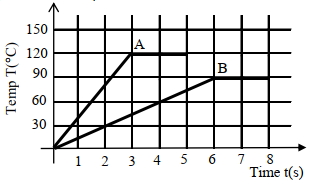
Two different metal bodies $A$ and $B$ of equal mass are heated at a uniform rate under similar conditions. The variation of temperature of the bodies is graphically represented as shown in the figure. The ratio of specific heat capacities is :
A particle of mass $m$ and charge $q$ moves with a constant velocity $v$ along the positive $x$ direction. It enters a region containing a uniform magnetic field $B$ directed along the negative $z$ direction, extending from $x = a$ to $x = b$. The minimum value of $v$ required so that the particle can just enter the region $x > b$ is
Photons with energy $5\, eV$ are incident on a cathode $C$ , on a photoelectric cell. The maximum energy of the emitted photoelectrons is $2\, eV$. When photons of energy $6\, eV$ are incident on $C$, no photoelectrons will reach the anode $A$ if the stopping potential of $A$ relative to $C$ is .............. $V$
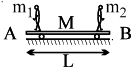
 Two persons of mass $m_1$ and $m_2$ are standing at the two ends $A$ and $B $ respectively, of $a$ trolley of mass $M$ as shown. When the person standing at $A$ jumps from the trolley towards left with urel with respect to the trolley, then
A ball takes $(t)$ second to fall from a height $\left(H_1\right)$ and $2 t$ second to fall from a height $\left( H _2\right)$. Then $\sqrt{\frac{ H _1}{ H _2}}$ is (consider ideal motion) :
A block of mass $m$ is suspended separately by two different springs have time period $t_1$ and $t_2$ . If same mass is connected to parallel combination of both springs, then its time period will be
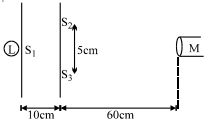
$A$ student is asked to measure the wavelength of monochromatic light. He sets up the apparatus sketched below. $S_1, S_2, S_3$ are narrow parallel slits, $L$ is a sodium lamp and $M$ is a microscope eyepiece. The student fails to observe interference fringes. Your first advice to him will be