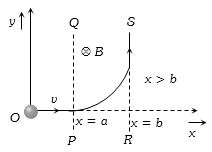
A particle of mass $m$ and charge $q$ moves with a constant velocity $v$ along the positive $x$ direction. It enters a region containing a uniform magnetic field $B$ directed along the negative $z$ direction, extending from $x = a$ to $x = b$. The minimum value of $v$ required so that the particle can just enter the region $x > b$ is
IIT 2002, Diffcult
Download our app for free and get started
(b) In the figure, the $z$-axis points out of the paper, and the magnetic field is directed into the paper, existing in the region between $PQ$ and $RS$. The particle moves in a circular path of radius $r$ in the magnetic field. It can just enter the region $x > b$ for $r \ge (b - a)$
Now, $r = \frac{{mv}}{{qB}} \ge (b - a)$
or $v \ge \frac{{q(b - a)B}}{m}$ $==>$ ${\nu _{\min }} = \frac{{q(b - a)B}}{m}$
Now, $r = \frac{{mv}}{{qB}} \ge (b - a)$
or $v \ge \frac{{q(b - a)B}}{m}$ $==>$ ${\nu _{\min }} = \frac{{q(b - a)B}}{m}$

Download our appand get started for free
Experience the future of education. Simply download our apps or reach out to us for more information. Let's shape the future of learning together!No signup needed.*
Similar Questions
- 1View SolutionIf a positive ion is moving, away from an observer with same acceleration, then the lines of force of magnetic induction will be
- 2A beam of protons with speed $4 \times 10^{5}\, ms ^{-1}$ enters a uniform magnetic field of $0.3\, T$ at an angle of $60^{\circ}$ to the magnetic field. The pitch of the resulting helical path of protons is close to....$cm$View Solution
(Mass of the proton $=1.67 \times 10^{-27}\, kg$, charge of the proton $=1.69 \times 10^{-19}\,C$)
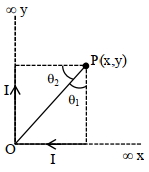
- 3There are two infinitely long straight current carrying conductors and they are held at right angles to each other so that their common ends meet at the origin as shown in the figure given below. The ratio of current in both conductor is $1: 1$. The magnetic field at point $P$ is ...... .View Solution
- 4An electron and a proton enter region of uniform magnetic field in a direction at right angles to the field with the same kinetic energy. They describe circular paths of radius ${r_e}$ and ${r_p}$ respectively. ThenView Solution
- 5An electron (charge $q$ $coulomb$) enters a magnetic field of $H$ $weber/{m^2}$ with a velocity of $v\,m/s$ in the same direction as that of the field the force on the electron isView Solution
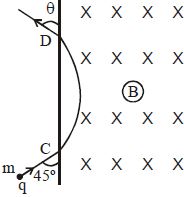
- 6A particle of mass $m = 1.67 \times 10^{-27}\, kg$ and charge $q = 1.6 \times 10^{-19} \, C$ enters a region of uniform magnetic field of strength $1$ $tesla$ along the direction shown in the figure. the radius of the circular portion of the path is :-View Solution
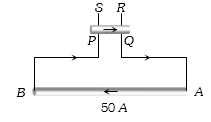
- 7A long wire $AB$ is placed on a table. Another wire $PQ$ of mass $1.0\, g$ and length $50\, cm$ is set to slide on two rails $PS$ and $QR$. A current of $50\,A$ is passed through the wires. At what distance above $AB$, will the wire $PQ$ be in equilibrium.....$mm$View Solution
- 8A point charge $Q\left(=3 \times 10^{-12} C \right)$ rotates uniformly in a vertical circle of radius $R(=1 \,mm )$. The axis of the circle is aligned along the magnetic axis of the earth. At what value of the angular speed $\omega$, the eff ective magnetic field at the centre of the circle .............. $rad / s$ will be reduced to zero? (Horizontal component of earth's magnetic field is $30 \,\mu T )$View Solution
- 9A long copper tube of inner radius $R$ carries a current $i$. The magnetic field $B$ inside the tube isView Solution
- 10When a $12\,\Omega $ resistor is connected with a moving coil galvanometer then its deflection reduces from $50$ divisions to $10$ divisions. The resistance of the galvanometer is ............. $\Omega $View Solution