Question
Which is easier to remove: orbital electron from an atom or a nucleon from a nucleus?

Answer

It is easier to remove an orbital electron from an atom. The reason is the binding energy of orbital electron is a few electron-volts while that of nucleon in a nucleus is quite large (nearly 8MeV). This means that the removal of an orbital electron requires few electron volt energy while the removal of a nucleon from a nucleus requires nearly 8MeV energy.

Need a full question paper?

Generate a complete, print-ready paper with questions like this in minutes — across 16+ boards, with answer keys.
Start Generating Free

Similar questions

It is said that any charge given to a conductor comes to its surface. Should all the protons come to the surface? Should all the electrons come to the surface? Should all the free electrons come to the surface?
The relative luminosity of wavelength 600nm is 0.6. Find the radiant flux of 600nm needed to produce the same brightness sensation as produced by 120W of radiant flux at 555nm.
Characteristic X-rays may be used to identify the element from which they are being emitted. Can continuous X-rays be used for this purpose?
A 60\ kg man skating with a speed of $10m/s$ collides with a $40\ kg$ skater at rest and they cling to each other. Find the loss of kinetic energy during the collision.
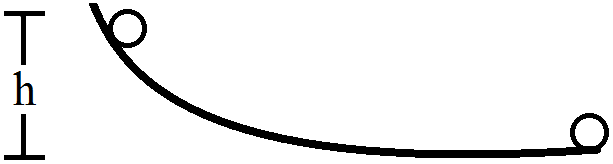
A small spherical ball is released from a point at a height h on a rough track shown in figure. Assuming that it does not slip anywhere, find its linear speed when it rolls on the horizontal part of the track.
A 10 m long wire of uniform cross-section and 20 $\Omega$ resistance is used in a potentiometer. The wire is connected in series with a battery of 5V along with an external resistance of 480 $\Omega$. If an unknown emf E is balanced at 6.0 m length of the wire, calculate:
  1. The potential gradient of the potentiometer wire.
  2. The value of unknown emf  E.
A large conducting plane has a surface charge density $1.0\times10^{-4}\text{Cm}^{-2}.$ Find the electrostatic energy stored in a cubical volume of edge 1.0cm in front of the plane.
A proton describes a circle of radius 1cm in a magnetic field of strength 0.10T. What would be the radius of the circle described by an α-particle moving with the same speed in the same magnetic field?
A small telescope has an objective lens of focal length $140 \ cm$ and an eyepiece of focal length $5.0 \ cm$. What is the magnifying power of the telescope for viewing distant objects when,
  1. the telescope is in normal adjustment $($i.e., when the final image is at infinity$)$?
  2. the final image is formed at the least distance of distinct vision $(25 \ cm)$?
If a piece of paper is placed at the position of a virtual image of a strong light source, will the paper burn after sufficient time? What happens if the image is real? What happens if the image is real but the source is virtual?