Question
Characteristic X-rays may be used to identify the element from which they are being emitted. Can continuous X-rays be used for this purpose?

Answer

Characteristic X-rays are emitted due to the transitions of electrons among different shells. The wavelength of the X-rays emitted in these transitions have definite value for a particular element. But continuous X-rays are emitted due to the conversion of kinetic energy of an electron into photon, which varies from collision to collision and is independent of material. Hence, continuous X-rays provide no information about the element from which they are being emitted.

Need a full question paper?

Generate a complete, print-ready paper with questions like this in minutes — across 16+ boards, with answer keys.
Start Generating Free

Similar questions

The speed of light in glass is $2.0 \times 10^1m/s.$ Does it violate the second postulate of special relativity?
Water falling from a $50m$ high fall is to be used for generating electric energy. If $1.8 \times 10^5\ kg$ of water falls per hour and half the gravitational potential energy can be converted into electric energy, how many $100W$ lamps can be lit?
Does a nucleus lose mass when it suffers gamma decay?
Prove that, if an insulated, uncharged conductor is placed near a charged conductor and no other conductors are present, the uncharged body must be intermediate in potential between that of the charged body and that of infinity.
  1. Draw the circuit diagram of an n-p-n transistor amplifier in common emitter configuration.
  2. Derive an expression for voltage gain of the amplifier and hence show that the output voltage is in opposite phase with the input voltage.
A wire $AB$ is carrying a steady current of $12 A$ and is lying on the table. Another wire $CD$ carrying $5A$ is held directly above $AB$ at a height of $1 mm.$ Find the mass per unit length of the wire $CD$ so that it remains suspended at its position when left free. Give the direction of the current flowing in $CD$ with respect to that in $AB.$ $[$Take the value of $g = 10 ms^{–2}]$
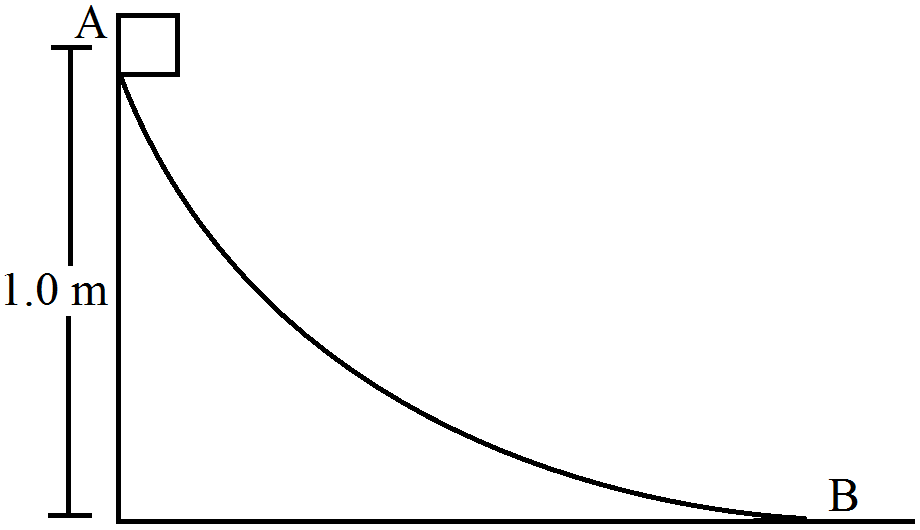
A block weighing 10N travels down a smooth curved track AB joined to a rough horizontal surface (figure). The rough surface has a friction coefficient of 0.20 with the block. If the block starts slipping on the track from a point 1.0m above the horizontal surface, how far will it move on the rough surface?
Consider the situation of the previous problem. Suppose the production of the radioactive isotope starts at $t = 0$. Find the number of active nuclei at time $t$.
Write the expression for the force on a charge moving in a magnetic field.Use this expression to define the SI unit of magnetic field.
Consider the situation of the previous problem. A particle having charge q and mass m is projected from the point Q in a direction going into the plane of the diagram. It is found to describe a circle of radius r between the two plates. Find the speed of the charged particle.