Question
Which is easier to remove: orbital electron from an atom or a nucleon from a nucleus?

Answer

It is easier to remove an orbital electron from an atom. The reason is the binding energy of orbital electron is a few electron-volts while that of nucleon in a nucleus is quite large (nearly 8MeV). This means that the removal of an orbital electron requires few electron volt energy while the removal of a nucleon from a nucleus requires nearly 8MeV energy.

Need a full question paper?

Generate a complete, print-ready paper with questions like this in minutes — across 16+ boards, with answer keys.
Start Generating Free

Similar questions

The electric field associated with a monochromatic beam becomes zero $1.2 \times 10^{15}$ times per second. Find the maximum kinetic energy of the photoelectrons when this light falls on a metal surface whose work function is 2.0eV.
Get the total electric flux associated with a closed cylinder placed in a uniform electric field.

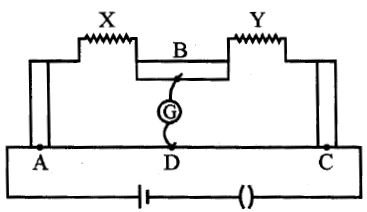
The figure shows experimental set up of a meter bridge. When the two unknown resistances X and Y are inserted, the null point D is obtained 40 cm from the end A. When a resistance of 10 Ω is connected in series with X, the null point shifts by 10 cm. Find the position of the null point when the 10 Ω resistance is instead connected in series with resistance ‘Y’. Determine the values of the resistances X and Y.
A hydrogen atom emits ultraviolet radiation of wavelength 102.5nm. What are the quantum numbers of the states involved in the transition?
The thickness of a glass plate is measured to be 2.17mm, 2.17mm and 2.18mm at three different places. Find the average thickness of the plate from this data.
The radionuclide $^{11}C$ decays according to
$^{11}_{6}\text{C}\rightarrow^{11}_{5}\text{B}+\text{e}^{+}+\text{v}:\ \text{T}_{1/2}=20.3 \text{ min}$
The maximum energy of the emitted positron is 0.960 MeV.
Given the mass values:
$\text{m}(^{11}_{6})=10=11.011434\text{ u and m}(^{11}_{6}\text{B})=11.009305\text {u}.$
calculate Q and compare it with the maximum energy of the positron emitted.
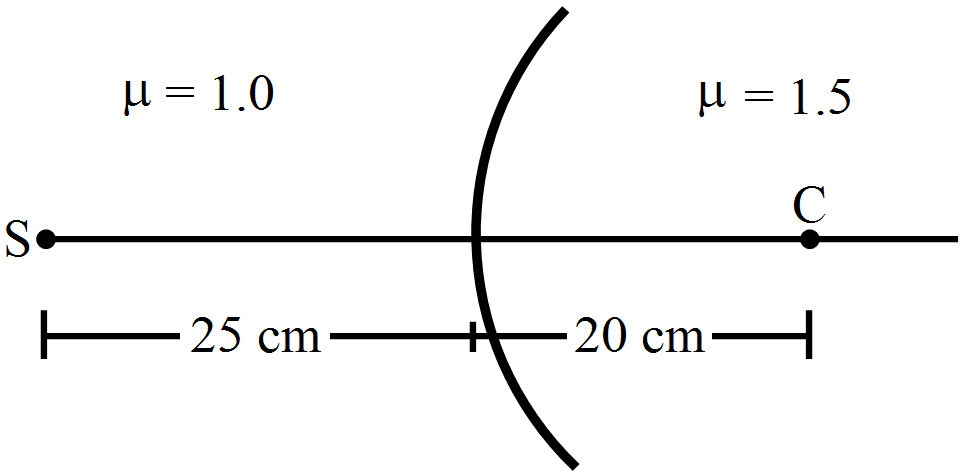
Locate the image formed by refraction in the situation shown in figure.
In a Young's double experiment, the slits are $1.5 mm$ apart. When the slits are illuminated by a monochromatic light source and the screen is kept $1 m$ apart from the slits, width of $10$ fringes is measured as $3.93 \ mm.$
Calculate the wavelength of light used. What will be the width of $10$ fringes when the distance between the slits and the screen is increased by $0.5 m$. The source of light used remains the same.
Two blocks of masses 10kg and 30kg are placed along a vertical line. The first block is raised through a height of 7cm. By what distance should the second mass be moved to raise the centre of mass by 1cm?
In a p-n junction, the depletion region is 400nm wide and an electric field of $5 \times 10^5V/m$ exists in it.
  1. Find the height of the potential barrier.
  2. What should be the minimum kinetic energy of a conduction electron which can diffuse from the n-side to the p-side?