Question
Which is the process used to harness nuclear energy these days? Explain it briefly.

Answer

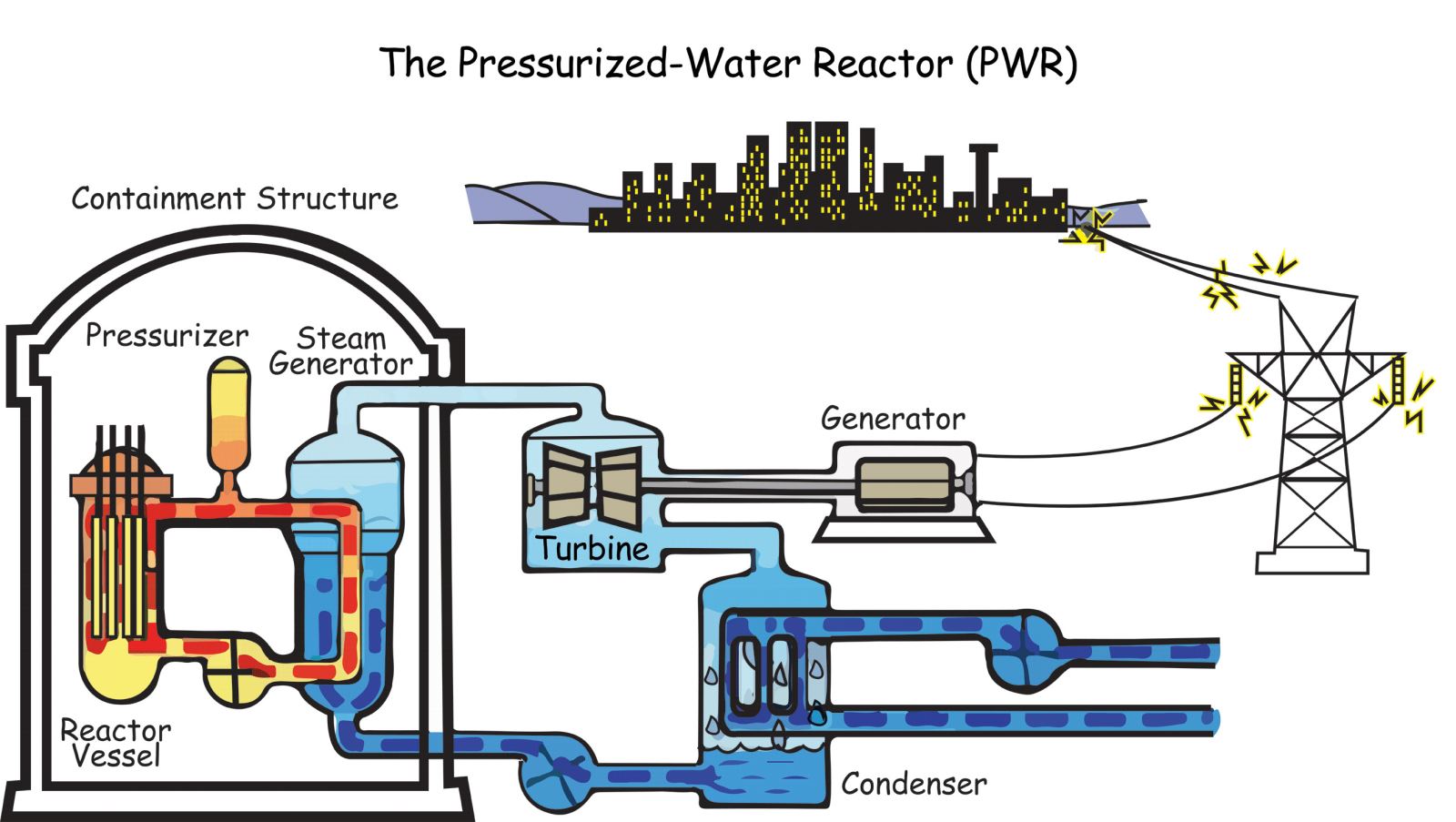
Nuclear energy is harnessed in nuclear power plants. It contains a nuclear reactor, a boiler and a turbine.
  • The nuclear reactor is the place where nuclear fission is carried out. Nuclear fission produces a huge amount of energy.
  • Energy produced during nuclear fission is utilized to boil water, so that steam can be generated.
  • Steam is utilized to turn the turbines to produce electricity.
The following figure shows the working of a nuclear power plant.

Need a full question paper?

Generate a complete, print-ready paper with questions like this in minutes — across 16+ boards, with answer keys.
Start Generating Free

Similar questions

An animal (guinea pig) having black colour is crossed with guinea pig having the same colour.
They produced 100 offsprings, of which 75 were black and 25 were white.
Find out
  1. What is the possible genotype?
  2. Which trait is dominant and which is recessive?
Mendeleev predicted the existence of certain elements not known at that time and named two of them as Eka-silicon and Eka-aluminium.
  1. Name the elements which have taken the place of these elements.
  2. Mention the group and the period of these elements in the Modern Periodic Table.
  3. Classify these elements as metals, non-metals or metalloids.
  4. How many valence electrons are present in each one of them?
Reproduction is essentially a phenomenon that is not for survival of an individual but for the stability of a species. Justify.
With the help of suitable diagram, explain the various steps of budding in Hydra.
Describe some experiment to show that the magnetic field is associated with an electric current.
Why are the Arabari forests of Bengal known to be a good example of conserved forest?
What is meant by ‘reflection of light’? Define the following terms used in the study of reflection of light by drawing a labelled ray-diagram :
  1. Incident ray.
  2. Point of incidence.
  3. Normal.
  4. Reflected ray.
  5. Angle of incidence.
  6. Angle of reflection.
An electric bulb of resistance $20 Ω$ and a resistance wire of $4 Ω $are connected in series with a 6V battery. Draw the circuit diagram and calculate:
  1. Total resistance of the circuit.
  2. Current through the circuit.
  3. Potential difference across the electric bulb.
  4. Potential difference across the resistance wire.
$a.$ Draw a ray diagram for showing the convergence of a parallel beam of light by a concave mirror and mark the
positions of pole and the centre of curvature in it
$b. $ An object $4 \ cm$ in size is placed at $25 \ cm$ in front of a concave mirror of focal length $15 \ cm.$ At what distance
from the mirror should a screen be placed in order to obtain a sharp image? Find the nature and size of the image.
$c.$ List any two uses of a concave mirror
What is meant by ‘reflection of light’? Define the following terms used in the study of reflection of light by drawing a labelled ray-diagram :
  1. Incident ray.
  2. Point of incidence.
  3. Normal.
  4. Reflected ray.
  5. Angle of incidence.
  6. Angle of reflection.