Question
Mendeleev predicted the existence of certain elements not known at that time and named two of them as Eka-silicon and Eka-aluminium.
  1. Name the elements which have taken the place of these elements.
  2. Mention the group and the period of these elements in the Modern Periodic Table.
  3. Classify these elements as metals, non-metals or metalloids.
  4. How many valence electrons are present in each one of them?
Answer

  1. Eka-silicon was later identified as Germanium (Ge) and Eka- aluminium was taken as Gallium (Ga).
  2.  
  • Germanium (Ge)- Group 14, period 4.
  • Gallium (Ga)- Group 13, period 4.
  1. Gallium(Ga) is a metal while Germanium (Ge) is a metalloid.
  2. Gallium is placed in $13^{\text {th }}$ group so there must be $13-10=3$ valence electrons. Similarly germanium is placed in group 14 so there must be $14-10=4$ valence electrons.

Need a full question paper?

Generate a complete, print-ready paper with questions like this in minutes — across 16+ boards, with answer keys.

Start Generating Free

Similar questions

Distinguish between photosynthesis and respiration.
a. Why is the use of iodised salt advisable? Name the disease caused due to deficiency of iodine in our diet and state its one symptom.
b. How do nerve impulses travel in the body? Explain.
A four carbons atoms containing neutral organic compound X reacts with sodium metal to evolve a gas which burns with 'pop' sound. Another four carbon atoms containing carbon compound reacts with sodium hydrogen carbonate to evolve a gas which turns lime water milky. When compounds X and Y are heated together in the presence of a little of concentrated sulphuric acid, then a new compound Z is formed.
  1. What is compound X? Also write its formula.
  2. What is compound Y? Also write its formula.
  3. What is compound Z? Also write its formula.
  4. What type of smell is given by compound Z?
  5. What is the general name of compounds like Z?
  6. What is the general name of the reaction which which takes place between X and Y to form Z?
  1. A gas is released during photosynthesis. Name the gas and also state the way by which the gas is evolved.
  2. What are stomata? What governs the opening and closing of stomata?
What are fossils? How are they formed? List two methods of determining the age of fossils. Explain in brief the importance of fossils in deciding the evolutionary relatrionships.
The gland A is attached to the wind pipe in the human body. The gland A makes and secretes a hormone B which controls the metabolism of carbohydrates, fats and proteins in the body. The non-metal element C is necessary for the formation of hormone B. The deficiency of C in the diet can cause a deficiency of hormone B in the body leading to a disease D in which the neck of a person appears to be swollen. People are advised to use salt E in cooking food so as to avoid disease D.
  1. Name (i) gland A, and (ii) hormone B.
  2. What is the element C?
  3. Name one type of food which can provide sufficient C in the diet of a person.
  4. Name (i) disease D, and (ii) salt E.
Analyse the following observation table showing variation of image distance (v) with object distance (u) in case of a convex lens and answer the questions that follow, without doing any calculations:
S. No.
Object distance u (cm)
Image distance v (cm)
1
-90
+18
2
-60
+20
3
-30
+30
4
-20
+60
5
-18
+90
6
-10
+100
  1. What is the focal length of the convex lens? Give reason in support of your answer.
  2. Write the serial number of that observation which is not correct. How did you arrive at this conclusion?
  3. Take an appropriate scale to draw ray diagram for the observation at S. No. 4 and find the approximate value of magnification.
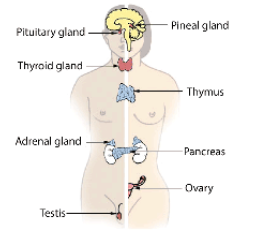
Given below is a diagram of the human endocrine system.
Image
Using the given diagram, answer the following questions:
i. How pituitary gland regulates the growth of the body?
ii. Which hormone is responsible for the carbohydrate, protein, and fat metabolism in the body?
iii. Which pair of glands prepare the body to deal with emergency situations?
iv. Which gland secretes insulin and what does it do in the body?
v. What is the function of endocrine glands?
A part of the early classification of elements has been given below:$\text{H}\ \ \ \ \ \ \ \text{Li} \ \ \ \ \ \ \ \text{Be} \ \ \ \ \ \ \ \ \ \text{B}\ \ \ \ \ \ \ \text{C}\ \ \ \ \ \ \ \text{N}\ \ \ \ \ \ \ \text{O}\\\text{F}\ \ \ \ \ \ \ \text{Na}\ \ \ \ \ \ \text{Mg}\ \ \ \ \ \ \ \text{Al}\ \ \ \ \ \ \text{Si}\ \ \ \ \ \ \ \text{P}\ \ \ \ \ \ \ \ \text{S}$
  1. Which law of classification of element is illustrated by the above arrangement of elements?
  2. Name the scientist who proposed such a classification of elements.
  3. Why is such a classification of elements compared with a characteristics of musical scale?
  4. State one limitation of this classification of elements.
An object $4.0 \ cm$ in size, is placed $25.0 \ cm$ in front of a concave mirror of focal length $15.0 \ cm.$
$i.$ At what distance from the mirror should a screen be placed in order to obtain a sharp image?
$ii.$ Find the size of the image.
$iii.$ Draw a ray diagram to show the formation of image in this case.