MCQ
Which is the quantity which remains conserved in both elastic and inelastic collisions?
  • Linear energy
  • B
    Total mechanical energy
  • C
    Potential energy
  • D
    Kinetic energy

Answer

Correct option: A.
Linear energy
A

Need a full question paper?

Generate a complete, print-ready paper with questions like this in minutes — across 16+ boards, with answer keys.
Start Generating Free

Similar questions

The wave length of light in visible part $({\lambda _V})$ and for sound $({\lambda _S})$ are related as
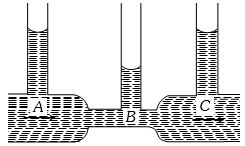
In the following fig. is shown the flow of liquid through a horizontal pipe. Three tubes $A, B$  and $ C$  are connected to the pipe. The radii of the tubes $A, B $ and $C$  at the junction are respectively $ 2 cm, 1 cm$   and $2 cm.$  It can be said that the
The pressure $( P )$ and temperature $( T )$ relationship of an ideal gas obeys the equation $PT ^2=$ constant. The volume expansion coefficient of the gas will be:
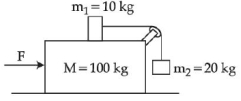
Three masses $M =100\,kg , m _{1}=10\,kg$ and $m_{2}=20\,kg$ are arranged in a system as shown in figure. All the surfaces are frictionless and strings are inextensible and weightless. The pulleys are also weightless and frictionless. $A$ force $F$ is applied on the system so that the mass $m_{2}$ moves upward with an acceleration of $2\,ms ^{-2}$. The value of $F$ is $......N$

$\left(\right.$ Take $\left.g =10\,ms ^{-2}\right)$
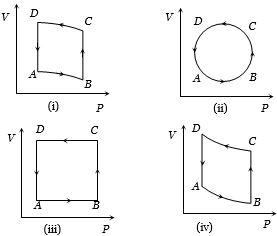
In the diagrams $(i)$ to $(iv)$ of variation of volume with changing pressure is shown. A gas is taken along the path $ABCD. $ The change in internal energy of the gas will be
A block is stationary on a rough inclined plane. How many forces are acting on the block?
A ring of radius $0.5\, m$ and mass $10 \,kg$ is rotating about its diameter with an angular velocity of $20 \,rad/s.$  Its kinetic energy is .......... $J$
The efficiency of a Carnot's engine working between steam point and ice point is:
A body is moving with a velocity $v$, breaks up into two equal parts. One of the part retraces back with velocity $v$. Then the velocity of the other part is
The internal energy of a gram-molecule of an ideal gas depends on: