MCQ
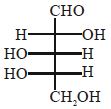
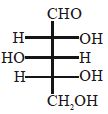
Which $L$ -sugar on oxidation gives an optically active dibasic acid
- ✓
- B
- C
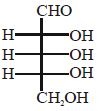
- D
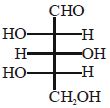
As only $(a)$ and $(d)$ are $L$-sugar, $(b)$ and $(c)$ are $D$-sugar after oxidation.
$(a)$ (Refer to Image $1$)
As the product do not superimpose in its mirror image.
$(d)$ (Refer to Image $2$)
As it has plane of symmetry.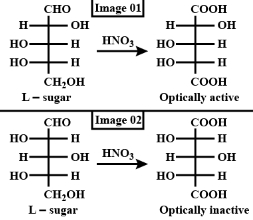
Generate a complete, print-ready paper with questions like this in minutes — across 16+ boards, with answer keys.
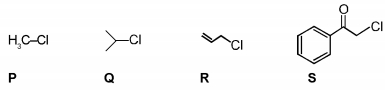
$(A)$ Compounds $P$ and $Q$ are carboxylic acids.
$(B)$ Compound $S$ decolorizes bromine water.
$(C)$ Compounds $P$ and $S$ react with hydroxylamine to give the corresponding oximes.
$(D)$ Compound $R$ reacts with dialkylcadmium to give the corresponding tertiary alcohol.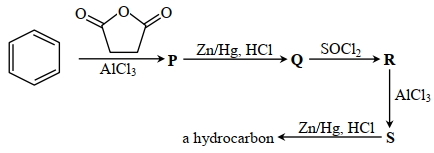
| Test | $C$ | $D$ |
| Ceric ammonium nitrate Test | Positive | positive |
| Lucas Test | Turbidity obtained after five minutes | Turbidity obtained immediately |
| Iodoform Test | Positive | Negative |
$C$ and $D$ respectively are
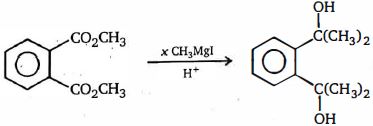
Number of moles $(x)$ of Grignard reagent consumed in the above reaction is