MCQ
Which law is not applicable for a nuclear reaction where large amount of energy is released?
  • Law of conservation of mass
  • B
    Law of definite proportion
  • C
    Law of multiple proportion
  • D
    Avagrado's law

Answer

Correct option: A.
Law of conservation of mass
The law implies that during any chemical reaction, nuclear reaction, or radioactive decay in an isolated system, the total mass of the reactants or starting materials must be equal to the mass of the products. Mass conservation remains correct if energy is not lost but if energy is released in a nuclear reaction, the law of conservation of mass does not hold any good.

Need a full question paper?

Generate a complete, print-ready paper with questions like this in minutes — across 16+ boards, with answer keys.

Start Generating Free

Similar questions

The frequency of radiation absorbed or emitted when transition occurs between two stationary states with energies $E_1$ (lower) and $E_2$ (higher) is given by 
The equilibrium constant $K_p$ for the following reaction at $191\,^oC$ is $1.24$. What is the value of $K_c$ ? $B\left( s \right) + \frac{3}{2}{F_2}_{\left( g \right)} \rightleftharpoons B{F_3}_{\left( g \right)}$
Gaseous $N_2O_4$ dissociates into gaseous $NO_2$ according to the reaction

$[{N_2}{O_4}\,(g)\, \rightleftharpoons \,2N{o_2}(g)]$

At $300\,K$ and $1\,atm$ pressure, the degree of dissociation of $N_2O_4$ is $0.2.$ If one mole of $N_2O_4$ gas is contained in a vessel, then the density of the equilibrium mixture is.......$g/L$
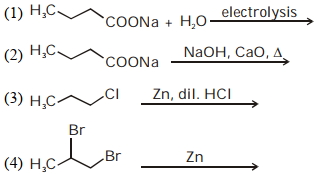
Which of the following reactions produce($s$) propane as a major product?
Among $\ce{III-A}$ group elements, the elements with highest and lowest $I.P$. values are:
The successive ionisation energy values for an element $X$ are given below element $X$ belongs to group :-
$A. 1^{st}$ ionisation energy $= 410\, kJ\, mol^{-1}$
$B. 2^{nd}$ ionisation energy $= 820\, kJ\, mol^{-1}$
$C. 3^{rd}$ ionisation energy $= 1100\, kJ\, mol^{-1}$
$D. 4^{th}$ ionisation energy $= 1500\, kJ\, mol^{-1}$
$E. 5^{th}$ ionisation energy $= 3200\, kJ\, mol^{-1}$
The reaction $2S{O_2} + {O_2}$ $\rightleftharpoons$ $2S{O_3}$; $\Delta H$ $= -ve$ is favoured by
If $1\ mL$ of $1\,M\ HCl$ solution is added to $99\ mL$ of aqueous solution of $NaCl$ so that $pH$ of $NaCl$ solution change by $X$ units. The value of $X$ is 
The correct order of ionisation energy for comparing carbon, nitrogen and oxygen atoms is
In the mixture of conc. ${H_2}S{O_4}$ and $HN{O_3}$the nitrating species is