Question
Which methodology is used while sequencing the total DNA from a cell? Explain it in detail.

Answer

Methodology used:
  • Sequence Annotation-total DNA from a cell is isolated, converted into random fragments of relatively smaller sizes, and cloned in suitable host using specialized vectors.
  • The cloning resulted into amplification of each piece of DNA fragment.
  • The fragments were sequenced using automated DNA sequencers, these sequences are then arranged based on some overlapping regions (present in them).
  • This requires generation of overlapping fragments (for sequencing).
  • Specialised computer based programmes were developed, and these sequences were subsequently annotated and assigned to each chromosome.

Need a full question paper?

Generate a complete, print-ready paper with questions like this in minutes — across 16+ boards, with answer keys.

Start Generating Free

Similar questions

Raj was a known sportsman in his school. While returning home he found some unknown miscreants beating a young fellow. He tried to drive them off, but by that time the fellow died of injury. The police arrested Raj and he was put on trial. The judge being convinced by Raj's plea, ordered for DNA fingerprinting reports.
  1. What is the basis of DNA fingerprinting?
  2. Explain the steps in DNA fingerprinting.
  3. Write the applications of DNA fingerprinting.
  4. Raj's fingerprints on the dead body were sufficient to convict him but the judge asked for authentic proof. What values can be observed by the judge?
Read the following and answer any four questions from (i) to (v) given below:

Plants having foreign genes in their genome through genetic engineering are called transgenic plants. Genes can be incorporated either through a vector or through direct introduction of DNA. Bt cotton is a genetically modified organism which is pest resistant. It contain gene cry I Ac and cry II Ab of Bacillus thuringiensis. It is used to control lepidopterans, coleopterans and dipterans. Bt cotton can resist cotton bollworm and produce higher yields. Cry gene produces cry protein or Bt toxin. It is an endotoxin which remains as protoxin in plants and converted to active toxin after getting ingested by the insects. Alkaline pH of the insect gut solubilises the protein crystals, the activated toxin creates pores to the mid guts wall of the insects which cause them to death.

  1. Bt cotton crops are:
  1. Fungal resistant.
  2. Insect resistant.
  3. Drought resistant.
  4. All of these.
  1. Cotton bollwonns are killed by the protein encoded by the gene:
  1. cry I Ac
  2. cry I Ab
  3. cry I Ab
  4. Both (a) and (c).
  1. Which of the following is not an advantage of GM crops?
  1. GM plants enhance nutritional value of food.
  2. GM plants are more tolerant to abiotic stresses.
  3. GM plants have helped to reduce post harvest losses.
  4. GM plants can cause gene transfer to non-target plant species.
  1. Bacillus thuringiensis is a:
  1. Air borne bacteria.
  2. Soil borne bacteria.
  3. Soil borne fungus.
  4. Food borne bacteria.
  1. Assertion: Cotton bollworms are killed by ingesting the leaves of the transgenic plant.

Reason: Bt toxin binds with the midgut wall of the insect and make pores in them.

  1. Both assertion and reason are true and reason is the correct explanation of assertion.
  2. Both assertion and reason are true but reason is not the correct explanation of assertion.
  3. Assertion is true but reason is false.
  4. Both assertion and reason are false.
Discuss the role of healthy ecosystem services as a prerequisite for a wide range of economic, environmental and aesthetic goods and services.

OR

Describe the advantages for keeping the ecosystem healthy.

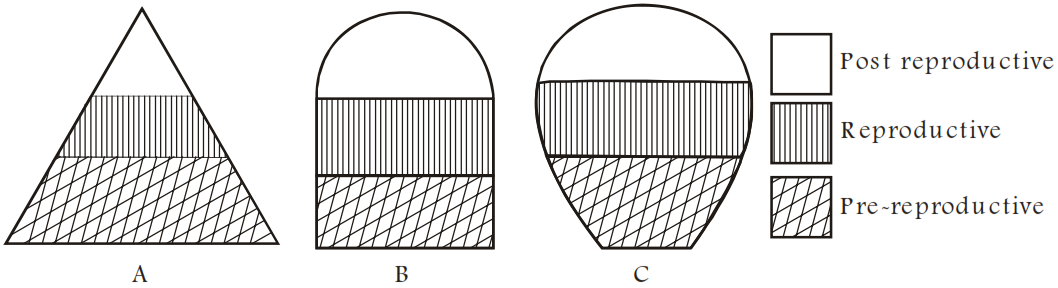
The following diagrams are the age pyramids of different populations. Comment on the status of these populations.

(a) Draw a sectional view of human ovary and label primary follicle, tertiary follicle, Graafian follicle and corpus luteum in it.
(b) Name the gonadotropins and explain their role in oogenesis and release of ova.
a. How did Meselson and Stahl reach the conclusion that DNA replication is semi-conservative while working with E. coli in their experiment?
b. Explain the contribution of Taylor and his colleagues in DNA replication in flowering plants.
Read the following and answer any four questions from (i) to (v) given below:

Stem cells hold the potential for manifold applications in biotechnology based next generation therapeutics. Scientists are trying to formulate better and more personalised treatment modalities against some seemingly irremediable diseases, by harnessing body's own stem cells and stem cell niche. Stem cells of different origin and level of potency are being investigated for tissue regeneration, treatment of bone defect, drug testing, gene therapy and cell based therapy for muscle damage, spinal cord injury, cancer therapy, etc. 'Tile properties of embryonic and adult stem cells to either self-renew or differentiate into multiple cell lineages make them an attractive source for cell therapies, tissue engineering and as model system for drug screening.

  1. Stem cells are widely used in medical research. Which property of stem cells makes them particularly useful in this research?
  1. They can be fused together to form a zygote.
  2. They can divide and eventually give rise to a whole organism.
  3. They can divide and be made to differentiate into various types of cell.
  4. They will continue to divide indefinitely.
  1. Stem cells can be divided into four main types. Which of the four types of stem cell can differentiate into a limited range of tissues?
  1. Adult stem cells.
  2. Embryonic stem cells.
  3. Fetal stem cells.
  4. Zygotic stem cells.
  1. Which feature of stem cells obtained from blood in the umbilical cord enables their use in the treatment of a variety of blood cancers?
  1. They can differentiate into bone marrow cells.
  2. They can differentiate into any cellular component of blood.
  3. They can replace blood stem cells affected by cancer.
  4. They are totipotent.
  1. The search for pluripotent stem cells is intense. The spennatogonium is the diploid precursor of haploid sperm in the development pathway of mouse gametes as shown below.
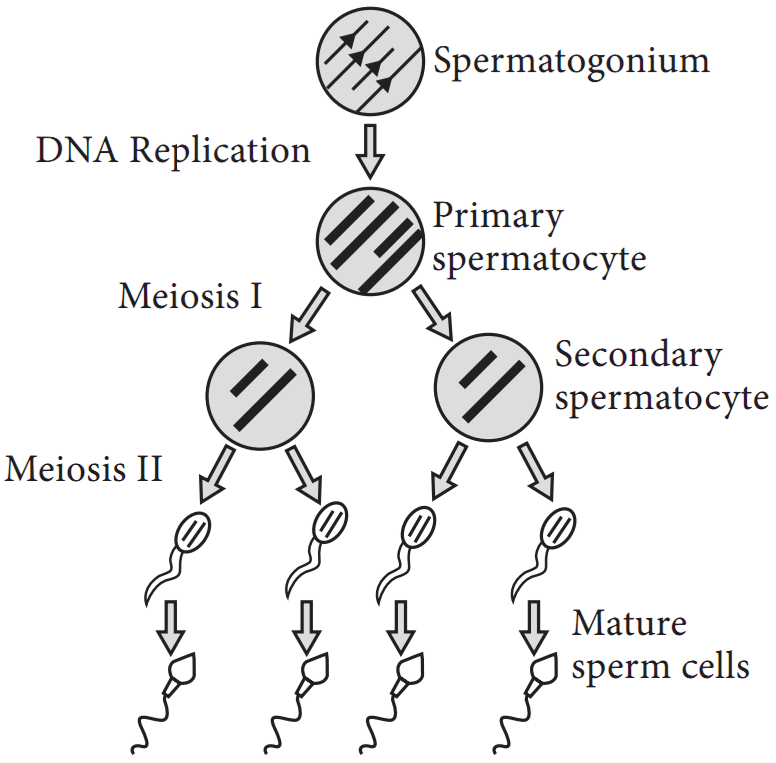
Scientists were interested to find out which stages of sperm development have stem cell capacity. Two experiments were carried out using sterile host males with testes that lacked germ cells. The results are shown in the table.

  Type of cells used Result
Experiment 1 Secondary spermatocytes were injected Fertility was not restored
Experiment 2 Spermatogonia were injected Fertility was restored for the rest of the mouse's life

What property of a stem cell is missing in the secondary spermatocytes?

  1. Specialisation.
  2. Self-renewal.
  3. Commitment.
  4. A proper stem-cell niche.
  1. Which feature of embryonic stem cells (ESCs) is illustrated below?
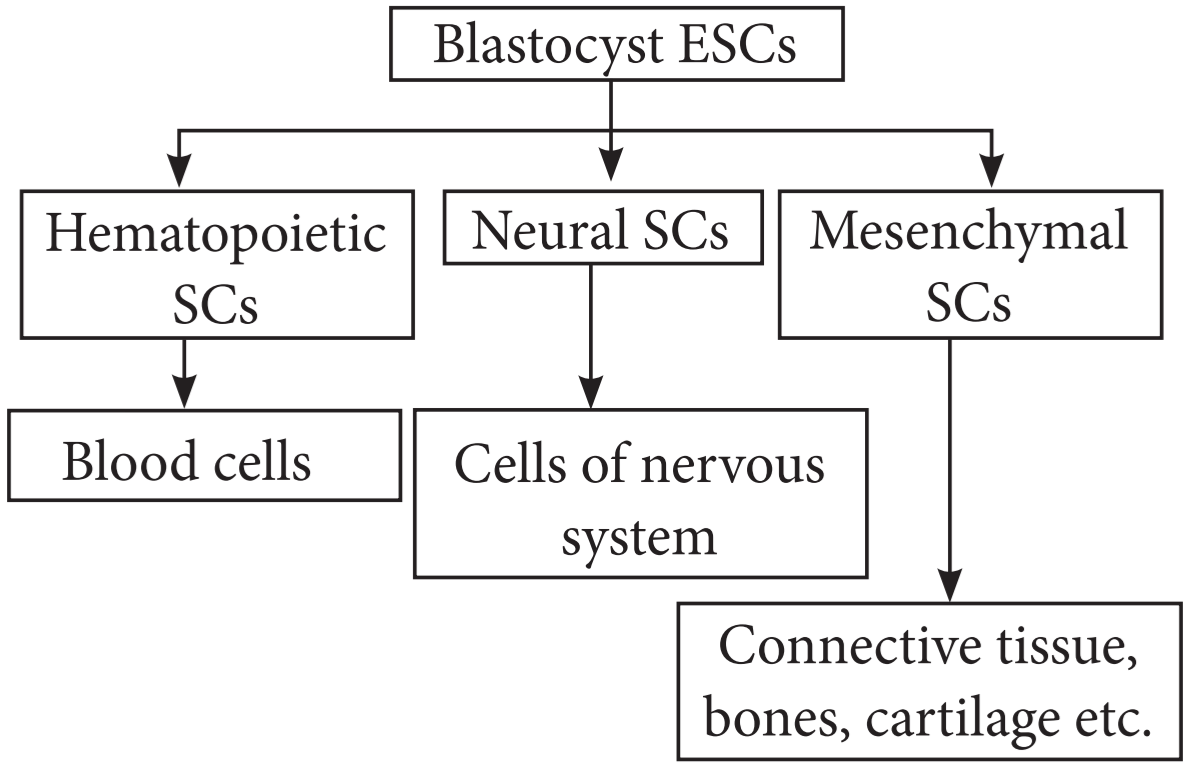
  1. ESCs are capable of dividing.
  2. ESCs are multipotent.
  3. ESCs are pluripotent.
  4. ES Cs show plasticity.
Answer the following questions:
How is ‘oogenesis’ markedly different from ‘spermatogenesis’ with respect to the growth till puberty in the humans?
Give the term/ reason:
Mechanism responsible for parturition.
Draw a labelled diagram of the L.S. of embryo of grasses. How does it differ from that of bean?