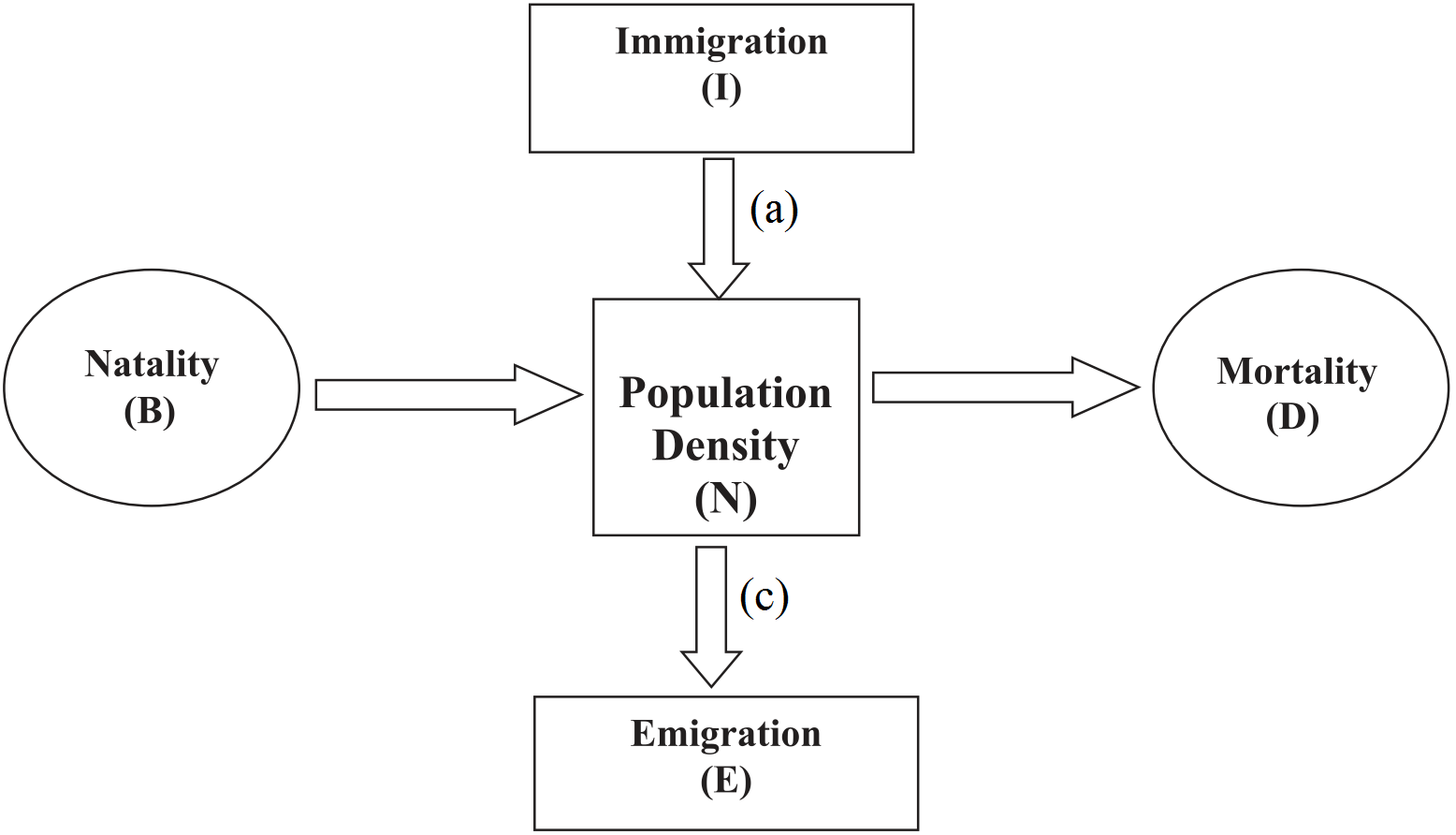
Question

  1. Which of the above represents the increase or decrease of population?
  2. If N is the population density at time t, then what would be its density at time (t + 1)? Give the formula.
  3. In a barn there were 30 rats. 5 more rats enter the barn and 6 out of the total rats were eaten by the cats. If 8 rats were born during the time period under consideration and 7 rats left the barn, find out the resultant population at time (t + 1).
  4. If a new habitat is just being colonized, out of the four factors affecting the population growth, which factor contributes the most?

Answer

  1. a and d represents increase of population and b and c represent decrease of population.
  2. Nt+1 = Nt + [(B + I) - (D + E)]
  3. Here, Nt = 30;

I = 5; E = 7;

D = 6;

B = 8

Putting the value in Nt + 1

= Nt + [(B + I) - (D + E)] Nt + 1

= 30 + [(8 + 5) - (6 + 7)]

= 30 + [13 - 13]

= 30 + 0

= 30 rats.

  1. Immigration contributes the most.

Need a full question paper?

Generate a complete, print-ready paper with questions like this in minutes — across 16+ boards, with answer keys.

Start Generating Free

Similar questions

Starting with the zygote, draw the diagrams of the different stages of embryo development in a dicot.
With the help of a diagram explain the structure of DNA.
Read the following and answer any four questions from (i) to (v) given below:
Apomixis is a mode of reproduction which does not involve formation of zygote through gametic fusion. In plants, apomixis commonly mimics sexual reproduction but produces seeds without fertilization. There are several methods of atomistic development in seeds. Thee two common ones are recurrent agamospermy and advective embryony.
  1. Apomixis is a type of reproduction in plants, in which?
  1. Fertilization does not take place.
  2. Male nucleus takes part in fertilization.
  3. Pollen fusion takes place.
  4. Generative nucleus takes part in fertilization.
  1. Which of the following statements is incorrect regarding recurrent agamospermy?
  1. It is the formation of seed that has an embryo formed without meiosis and syngamy.
  2. All the cells of embryo sac are diploid.
  3. An embryo develops directly from a diploid cell other than egg like that of nucleus and integument.
  4. None of these.
  1. Adventive embryony is found in:
  1. Citrus.
  2. Opuntia.
  3. Apple.
  4. Both (a) and (b).
  1. Formation of embryo directly from diploid egg without fertilization is called:
  1. Apospory.
  2. Diplospory.
  3. Polyembryony.
  4. Diploid parthenogenesis.
  1. If any somatic cell of sporophyte produces gametophyte without reduction division, it is called:
  1. Parthenogenesis.
  2. Apogamy.
  3. Apospory.
  4. Amphimixis.
Explain double fertilisation and trace the post-fertilisation events in sequential order leading to seed formation in a typical dicotyledonous plant.
(i) Define the cross-pollination.
(ii) Give one example each of aluminious, exalbuminous, perispermic seeds.
(iii) Draw a well labelled diagram showing the growth of pollen tube in longitudinal section of pistil.
  1. A primary succession start on a bare rock and reach a climax community
Give the technical terms for the following:
  1. Molecular Scissors.
  2. Molecular Sieve.
  3. Molecular Glue.
  4. Autonomous replicating circular DNA.
  5. First isolated restriction endonuclease.
  6. Extraction of DNA fragments from gel.
Study the schematic representation of the genes involved in the lac operon given below and answer the questions that follow.

  1. Identify and name the regulatory gene in this operon. Explain its role in 'switching off the operon.
  2. Why is lac operon's regulation referred to as negative regulation?
  3. Name the inducer molecule and the products of the genes 'z' and 'y of the operon. Write the function of these gene products.
A pregnant woman who have had amniocentesistest was advised to undergo MTP. It was diagnosed by her doctor that the embryo she is carrying has an extra barr body.
  1. Name the syndrome which is likely to be associated with the embryo.
  2. Why was she advised to undergo MTP?
  3. Do you justify the statutory ban on amniocentesis in our country Give reasons.
Answer the following questions:
Write the specific location and the functions of the following cells in human males:
  1. Leydig cells.
  2. Sertoli cells.
  3. Primary spermatocyte.