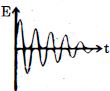
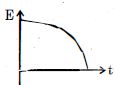
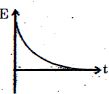
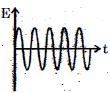
Which of the diagrams shown in figure represents variation of total mechanical energy of a pendulum oscillating in water as function of time?
- A
- B
- C
- D
Easy


Download our appand get started for free
Experience the future of education. Simply download our apps or reach out to us for more information. Let's shape the future of learning together!No signup needed.*
Similar Questions
- 1A string fixed at both ends is in resonance in its $2^{nd}$ harmonic with a tuning fork of frequency $f_1$. Now its one end becomes free. If the frequency of the tuning fork is increased slowly from $f_1$ then again a resonance is obtained when the frequency is $f_2$. If in this case the string vibrates in $n^{th}$ harmonic thenView Solution
- 2A source of sound of frequency $90$ vibrations/ sec is approaching a stationary observer with a speed equal to $1/10$ the speed of sound. What will be the frequency heard by the observer .... $vibrations/sec$View Solution
- 3A train is moving on a straight track with speed $20\ ms^{-1}$. It is blowing its whistle at the frequency of $1000\ Hz$. The percentage change in the frequency heard by a person standing near the track as the train passes him is ( speed of sound $=320$ $ms^{-1}$ ) close to .... $\%$View Solution
- 4Ultrasonic, Infrasonic and audible waves travel through a medium with speeds ${V_u},\,{V_i}$ and ${V_a}$ respectively, thenView Solution
- 5At which temperature the speed of sound in hydrogen will be same as that of speed of sound in oxygen at $100\,^oC$ ..... $^oC$View Solution
- 6A pipe $17\, cm$ long is closed at one end. Which harmonic mode of the pipe resonates a $1.5\, kHz$ source ?View Solution
(Speed of sound in air $= 340\, m\, s^{-1}$) - 7A uniform wire of length $L$ and mass $M$ is stretched between two fixed points, keeping tension $F$. A sound of frequency $m$ is impressed on it. Then the maximum vibrational energy is existing in the wire when $\mu $ =View Solution
- 8A string fixed at both ends is in resonance in its $2^{nd}$ harmonic with a tuning fork of frequency $f_1$. Now its one end becomes free. If the frequency of the tuning fork is increased slowly from $f_1$ then again a resonance is obtained when the frequency is $f_2$. If in this case the string vibrates in $n^{th}$ harmonic thenView Solution
- 9A stationary source is emitting sound at a fixed frequency $\mathrm{f}_0$, which is reflected by two cars approaching the source. The difference between the frequencies of sound reflected from the cars is $1.2 \%$ of $f_0$. What is the difference in the speeds of the cars (in $\mathrm{km}$ per hour) to the nearest integer? The cars are moving at constant speeds much smaller than the speed of sound which is $330 \mathrm{~ms}^{-1}$.View Solution
- 10View SolutionMechanical waves on the surface of a liquid are