Question
Which of the elements Na, Mg, Si and P would have the greatest difference between the first and second ionisation enthalpies? Briefly explain your answer.

Answer

Na has greatest difference between first and second ionisation enthalpies because Na has stable electronic configuration, i.e., 1s2 2s2 2p6, therefore, it has very high second ionisation energy.

Need a full question paper?

Generate a complete, print-ready paper with questions like this in minutes — across 16+ boards, with answer keys.
Start Generating Free

Similar questions

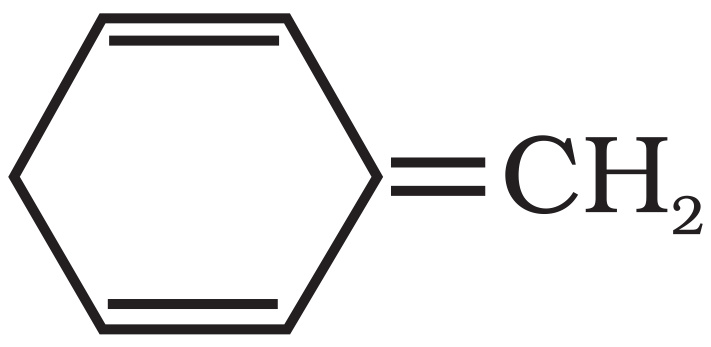
Explain why the following systems are not aromatic?

A sample of drinking water was found to be severely contaminated with chloroform, $CHCl _3$, supposed to be carcinogenic in nature. The level of contamination was 15 ppm (by mass).
(i) Express this in percent by mass.
(ii) Determine the molality of chloroform in the water sample.
Calculate $\Delta_\text{r}\text{G}^\circ$ for conversion of oxygen to ozone, $\frac{3}{2}\text{O}_2(\text{g})\overrightarrow{\ \ \ \ \ }\ \text{O}_3(\text{g})$ at 298K, if KP for this conversion is 2.47 × 10⁻²⁹.
Calculate the number of atoms in the following:
52u of He.
Write IUPAC name of following compounds :
Image
Use Lewis symbols to show electron transfer between the following atoms to form cations and anions :
(a) K and S (b) Ca and O (c) Al and N .
The first $(\Delta_{1}\text{H}_{1})$ and the second $(\Delta_{1}\text{H}_{1})$ ionization enthalpies (in kJ mol–1) and the $(\Delta_{1}\text{H}_{1})$ electron gain enthalpy (in kJ mol–1) of a few elements are given below:
Elements $\Delta\text{H}_{1}$ $\Delta{\text{H}}_{2}$ $\Delta_{\text{eg}}\text{H}$
I 520 7300 -60
II 419 3051 -48
III 1681 3374 -328
IV 1008 1846 -295
V 2372 5251 +48
VI 738 1451 -40
Which of the above elements is likely to be:
The least reactive non-metal.
Why do elements in the same group have similar physical and chemical properties?
Explain why $BeH _2$ molecule has a zero dipole moment although the $Be - H$ bonds are polar.
If the photon of the wavelength 150 pm strikes an atom and one of this inner bound electrons is ejected out with a velocity of $1.15 \times 10^7 m s ^{-1}$, calculate the energy with which it is bound to the nucleus.